
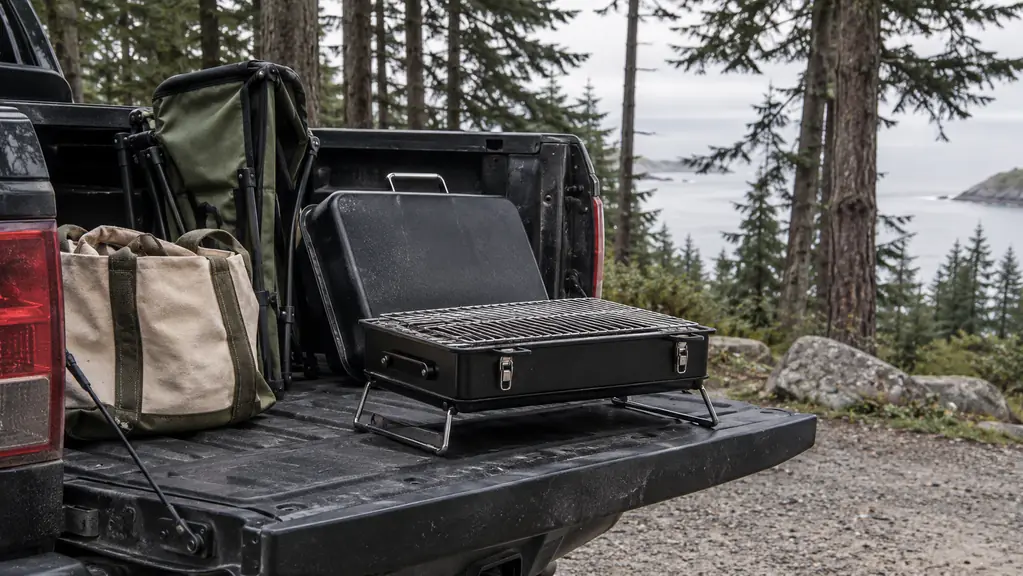
I bought the Weber Go-Anywhere because I got tired of hauling my full-size kettle to the coast for two nights and then scrubbing ash out of the truck bed for a month. That was the whole reason. Not because I read a buying guide, and not because I wanted a project. I wanted a charcoal grill I could set behind the seat, pull out at a gravel pullout, cook a dozen burgers for the band, and put away wet without a ceremony.
Five or six seasons later I have opinions, and they are not all kind. This is the honest version: what the Weber Go-Anywhere actually does well, where it fights you, and the two habits you have to build if you want it to last past a couple of seasons. If you want the long-term ownership notes, that is a separate write-up on this site. This one is the stuff nobody mentions in the first week.
The Quick Verdict
A genuinely good 160 square inch charcoal grill that travels. Buy it for the portability and the two-piece grate. Do not buy it expecting kettle-style temperature control, because you will not get it.
Amazon Check Today's Price →If you want a charcoal grill that lives behind the truck seat and not in the garage, this is the one.
160 square inches, 14 pounds, steel and charcoal. It has grilled a lot of burgers for a lot of people on my patio and at more than one gravel pullout. Current price and stock are on the Amazon listing.
Amazon Check Today's Price on Amazon →How I've Used It
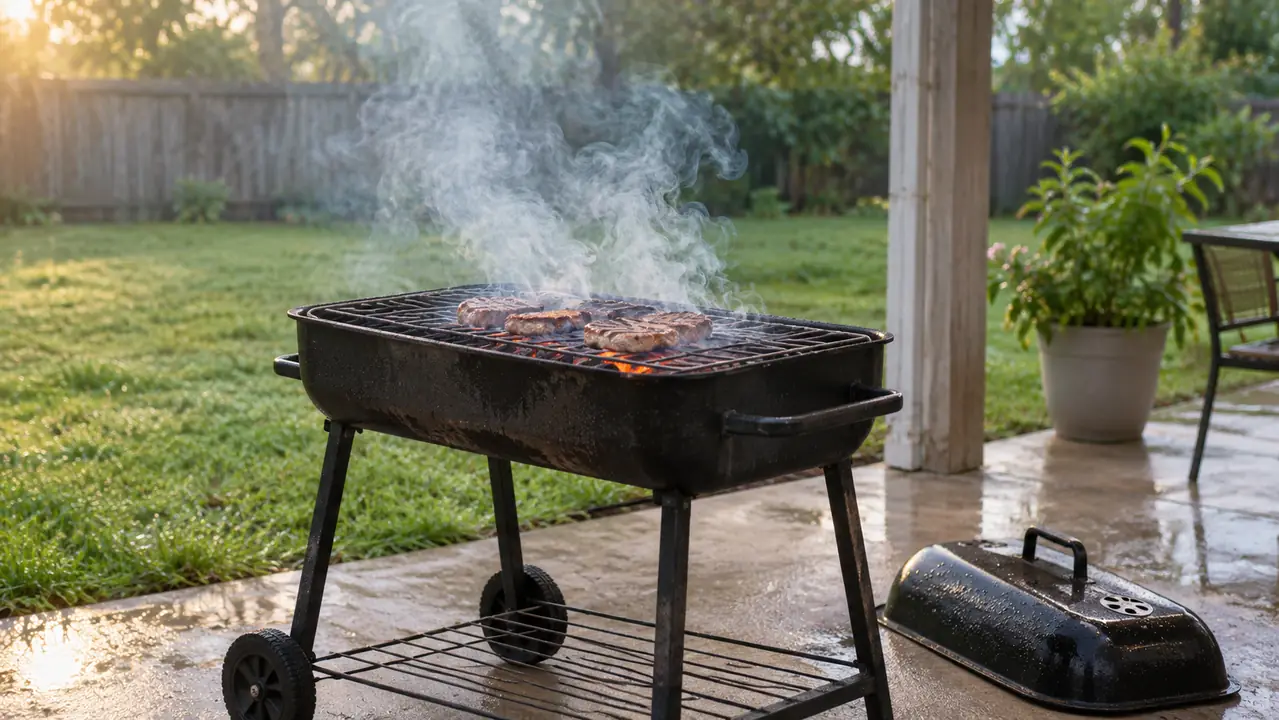
Most of my cooking happens on a covered back patio outside Salem, Oregon, on a concrete pad, and that pad is where the Go-Anywhere spends about half its life. The other half is in the bed of a pickup on trips to the coast and up into the Cascades, plus a handful of summer evenings when the band and their families come over and I end up cooking for somewhere between eight and fifteen people.
That last part matters, because a 160 square inch grill does not cook for fifteen. I do not pretend otherwise. When the band comes over I either run the Go-Anywhere alongside a bigger grill or I accept that I am cooking in waves and the first wave goes to whoever is hungriest. The listing says it cooks for two to four people and that is accurate. What it does not say is that two to four people is the right number of people to be responsible for when you are also trying to play bass later.
Weather is the other factor. The Willamette Valley rains from October to May, so I cook under the patio cover in the off months and the grill gets put away damp more often than I would like. Metal and damp are not friends. That is the source of the first real complaint below, and it is a complaint about my own habits as much as about the grill.
What Nobody Tells You Before You Buy
The first thing is the lid. The Go-Anywhere is a rectangular box with a lid that lifts off completely. It does not hinge. That sounds like a small detail until you are holding a hot lid in one hand and trying to move a burger with the other, and there is nowhere to set the lid down that is not the ground or your own knee. I have gotten used to it. I still do not like it.
The second thing is the airflow. This is a direct-heat grill with a single-level configuration, and the vents are limited. You are not going to hold 225 degrees for six hours in this thing. You are going to build a bed of coals and cook over it, fairly hot and fairly fast. That is the job it was built for. If you buy it wanting to smoke a pork shoulder, you bought the wrong grill and no amount of technique will fix that.
The third thing, and the one that actually costs people money, is the ash situation. The base is the ash pan. There is no separate removable tray you lift out and carry to the bin. You dump the whole thing, and until you learn to let the coals die completely and tip it carefully, you will scatter ash. I did this twice in the truck bed and once on Jo's flower bed. She has not forgotten the flower bed.
Here is the part that is a Weber design decision rather than an accident. The lift-off lid and the base-as-ash-pan are not cost cutting, they are how the thing gets to be 14 pounds and 19.5 inches wide. Every hinge is weight, and every separate ash tray is another part to rattle loose in a truck bed on a washboard road. Weber traded convenience at the grill for convenience in the packing. Whether that is a good trade depends entirely on how often you carry it, and I carry mine a lot, so I have mostly made my peace with it.
The Two-Piece Grate Is the Best Feature and I Did Not Expect That
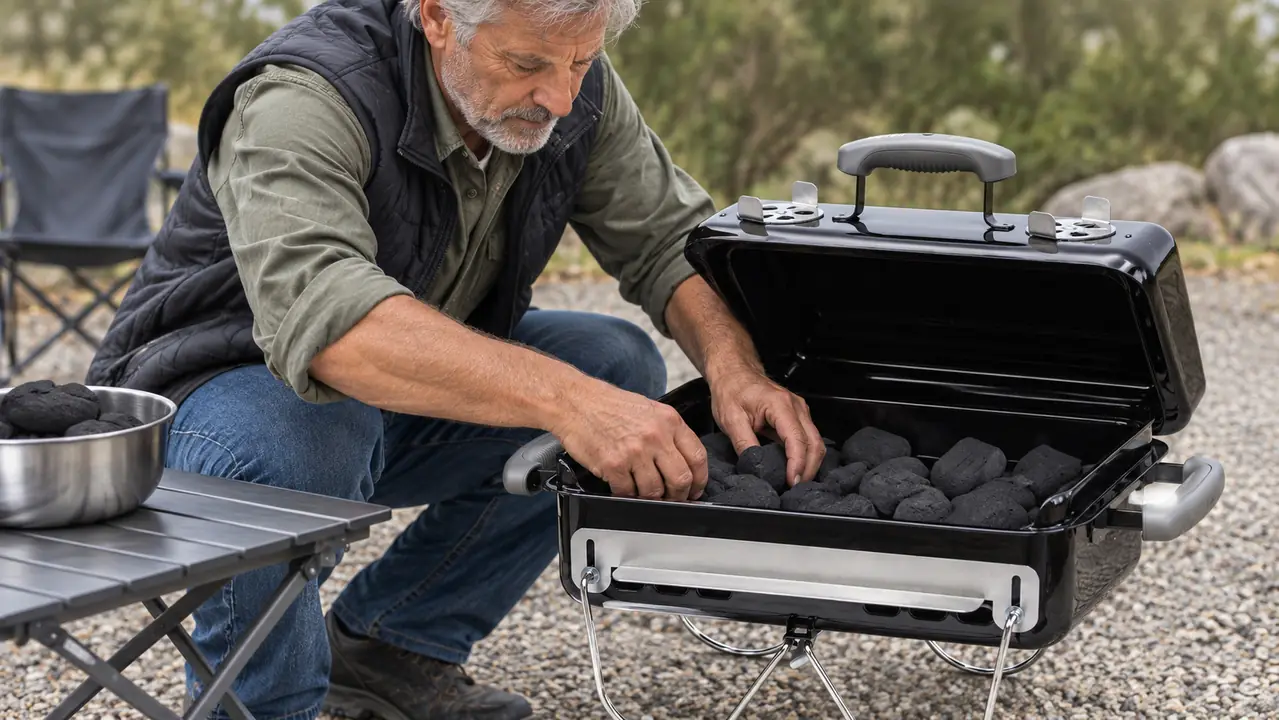
The cooking grate comes in two pieces, and the reason is that you can lift one half out and add charcoal underneath while the other half keeps cooking. That is a real, working advantage. On a cheap portable grill you either lift the entire grate, juggling hot food, or you accept that you cannot add fuel mid-cook.
In practice this means I can start a modest bed of coals, get the first round of burgers going on one half, and top up charcoal through the open half without ever picking up a burger. For a two-hour cook with people arriving at different times, that is the difference between a pleasant evening and a juggling act.
The char-rail insert does something related. It is a metal piece that lets you arrange coals to one side for indirect cooking. I want to be honest about how much I use it: not much. It works for finishing thicker pieces or keeping something warm while the coals are still going strong elsewhere, but the grill is small enough that indirect cooking is a cramped operation. It is a real feature, it is not a marketing fiction, but it is not the reason to buy this.
I can top up charcoal through the open half of the grate without ever picking up a burger. For a two-hour cook with people arriving at different times, that is the whole ballgame.
Where It Actually Falls Short
Heat control is the honest weakness. With one cooking level and limited venting, you cannot dial the heat down the way you can on a kettle. Windy days are worse. On the coast last September I had a steady crosswind and spent the whole cook rotating burgers from the hot side to the cooler side, which is a technique, but it is also extra work you did not plan on.
The second shortfall is capacity in a specific way. It is not just that 160 square inches feeds four people. It is that the rectangular shape means you are cooking in a strip. Four burgers fit comfortably. Four burgers and a row of corn do not. You make choices. I have learned to cook the corn in foil on the cooler end first and add burgers after, and it works, but it is a sequence, not a simultaneous operation.
Third, the painted finish on the metal body will show wear. Mine has a couple of chips at the corners from riding in a truck bed, and damp storage made a small rust spot near the bottom seam that I sanded and touched up. Metal plus paint plus moisture equals eventual rust. This is not a defect. It is what the material does. It does mean you should not buy this expecting it to look new forever.
What I Liked
- 14 pounds and a rectangular footprint that packs flat behind a seat or in a truck bed
- 160 square inches of cooking surface, which is honest for two to four people
- Two-piece cooking grate lets you add charcoal mid-cook without lifting hot food
- Char-rail insert gives you a workable indirect zone in a small space
- Charcoal fuel, direct heat, no electronics to fail, nothing to charge
Where It Falls Short
- Lid lifts off entirely with no hinge, so you need somewhere to put it
- Limited venting and a single cooking level mean poor low-and-slow control
- Base doubles as the ash pan with no removable tray, so dumping is messy
- Painted metal will chip and can rust at seams if stored damp
- Rectangular cook surface means you cook in a strip, not a full field
Who This Is For
This is for someone who wants charcoal flavor without a trailer, and who understands that a small grill means small-batch cooking. If you are feeding two to four people most of the time, cooking in a park or a pullout or a tailgate, and you want something that weighs about as much as a loaded tool bag and takes up as much room, the Go-Anywhere does exactly that job.
It is also for the person who does not want a battery, a fan, a probe, or an app involved in dinner. There is nothing on this grill that can fail electronically because there is nothing electronic on it. Charcoal, a grate, a metal box. That appeals to me more every year.
And it is for the patio cook who wants a second grill for weeknights, when firing up the big one for two burgers feels like a waste of charcoal. I use it that way more than I expected. A small chimney of coals, twelve minutes, dinner.
Who Should Skip It
If you want to smoke, skip it. This is not that grill and no accessory makes it one. If you regularly cook for more than four people, skip it or plan on a second grill. If you want set-and-forget temperature control, skip it and buy something with a thermostat, because you will spend this grill's whole life fighting it.
Also skip it if you are not going to maintain it. This is the part I want to be blunt about. The people who leave one-star reviews about rust after one season are, in my experience, people who put it away wet and left it in a shed. If you are not willing to dry it and store it under cover, the metal will tell on you within a year. That is not Weber's fault, but it is a real cost of ownership and you should count it in before you buy.
The Maintenance Habit That Makes It Last
Two habits, actually, and they take about four minutes total. First, let the coals die all the way down before you dump. Not mostly dead. All the way. Tipping a base full of live coals is how you scatter ash and how you warp things, and it is how I ended up hosing off a patio at eleven at night.
Second, wipe the inside of the lid and the base with a dry rag once it is cool, and store it with the lid off or ajar so air moves through. Trapped moisture is what rusts these. I keep mine under the patio cover with the lid sitting slightly off to the side, and the rust I do have has not spread in two years. It is not a beautiful system. It works.
The grate itself I scrub with a stiff brush while it is still warm, which is the easiest time to do it, and I oil it lightly before the next cook. That is the whole routine. Nothing here is difficult. It is just the difference between a grill that lasts five seasons and one that lasts fifteen.
What I'd Compare Before Buying
The obvious alternative is a small tabletop gas grill, and I understand the appeal. Push a button, get heat, no ash. If your priority is convenience and you do not care about charcoal flavor, gas wins and I will not argue. I want charcoal or I would not own this.
The other comparison worth making is against other small charcoal portables, and there are a few shapes to consider. A round portable kettle gives you better heat control and a lid you can vent, but it is a worse shape to pack and generally heavier for the same cooking area. A folding suitcase-style grill packs flatter than the Go-Anywhere but tends to be flimsier in the body. If you want a direct side-by-side on one of those, there is a comparison on this site that goes through it dimension by dimension.
What I would tell you is that none of these are bad grills. The question is which compromise you can live with. I can live with a lift-off lid and a messy ash dump in exchange for 14 pounds, 160 square inches, and a two-piece grate. Someone else would trade the other way, and they would be right for their own cooking.
The one thing I would hold against the alternatives is Weber's own parts support. I ordered a replacement grate for a different Weber grill a few years back and it arrived in four days with no drama and no phone call. That kind of thing does not show up in a spec sheet, and it is a large part of why I keep buying from them even when the lid annoys me.
The honest pitch: 14 pounds, 160 square inches, and nothing electronic to break.
I have cooked on this thing for years on a wet Oregon patio and in more than one gravel pullout, and the only parts I have had to touch up are cosmetic. If that matches how you cook, it is worth a look at today's price.
Amazon See Current Price and Details on Amazon →A Few Things I Would Tell a Friend
Buy a small chimney starter if you do not have one. Lighting charcoal in the base of a grill this size with lighter fluid is a good way to taste fluid in your dinner, and a chimney gets a usable bed of coals in about fifteen minutes with no fuss. It is the single accessory that changed how often I use this grill, because the barrier to cooking dropped from twenty-five minutes to fifteen.
Get a cheap instant-read thermometer. Not for the grill, for the food. Small grills run hot and direct, and the difference between a burger at 155 and one at 175 is about ninety seconds of inattention. I learned that the hard way at a tailgate and have not repeated it.
And bring a small folding table or plan on the tailgate itself. The Go-Anywhere has no side shelves, so everything you need, tongs, a plate, the salt, has to live somewhere that is not the grill. On the ground is how you lose a spatula to a dog you do not own.
None of this is rocket science. It is the kind of thing you figure out in a season and then forget you ever did not know. If you are at the front end of that season, save yourself the tailgate burger incident and buy the thermometer and the chimney at the same time.
If you have read this far, you already know whether it fits how you cook.
Two to four people, charcoal, a truck bed or a patio pad, and a maintenance habit you are willing to keep. It is not the grill for everyone. It has been the right grill for me. Current price and stock are on the listing.
Amazon Check Today's Price on Amazon →