

The first cook with a wireless probe in the meat is the one that decides it for you or does not. Mine was a seven pound pork shoulder on a kettle grill in July, with a band rehearsal happening in the garage and thunderheads stacking up over the Coast Range. I put the MEATER Plus in, set a target in the app, and went inside. Two hours later my phone buzzed from the kitchen counter. Nothing burned. Nobody had to sit in a lawn chair watching a dial through the lid vent. I have cooked with this thing for a full year now, through wet Oregon springs and the dry stretch of August, on the patio and at two campgrounds, and I have a fair amount to say about where it earns its keep and where it just does not.
The short version. MEATER Plus is a single wireless probe, 6.18 inches per the listing, that talks to your phone over Bluetooth. The charger doubles as a repeater, so the signal carries farther than the probe alone would manage, and that repeater is the real difference between this and the cheaper wireless units I tried before it. The working range is listed at 32 to 527 degrees Fahrenheit. The probe is oven safe and wipe clean rather than dishwasher safe. That is the hardware, all of it. Everything else is the app and the habits you build around it.
The Quick Verdict
The probe that finally got me out of the lawn chair. One cut of meat at a time, and you pay for that in patience rather than accuracy.
Amazon Check Today's Price →Stop opening the lid to guess at dinner
The MEATER Plus reads internal and ambient temperature at the same time, off one probe, so you can be somewhere else while the meat finishes. Check the current price and the full listing on Amazon.
Amazon Check Today's Price on Amazon →How I've Used It
I cook outdoors year round under a patio cover, so this probe has seen far more than fair weather. Salem hands us rain from October into May, and a covered concrete pad does nothing about the humidity. The probe has sat in a pork butt through a four hour downpour without missing a reading. I have also had it in a brisket on an overnight cook in February, with the charger on a shelf inside the house roughly thirty feet away, and the link held the whole night. That is the repeater doing its job. Without it I would have been walking out to the patio every twenty minutes in the dark to squint at a display.
Camping is where I expected the whole thing to fall apart. We take a few trips a year, one out to the coast and one up into the Cascades, and cell service is spotty to nonexistent at both. The MEATER Plus does not need a network to work, only the Bluetooth link between probe, charger, and phone, so a dead zone in the mountains makes no difference at all. I have run it over coals at a campsite outside Tillamook with the charger clipped to the truck tailgate and the phone in my jacket pocket. It worked. What I do not do at camp is run a long overnight cook, because I am not leaving a fire unattended while I sleep in a tent forty feet away.
The other nine months it is household cooking as much as barbecue. I use it in the oven for a whole chicken, which is fine per the listing as long as I keep the ambient heat under the rated ceiling. I use it for a pork loin on a weeknight when Jo and I want to eat at a reasonable hour and I do not want to open the oven door six times to poke at something. A probe is a probe. What a wireless one changes is that you stop building your evening around the oven door and start building it around the people in the other room.
What the Two Sensors Actually Tell You
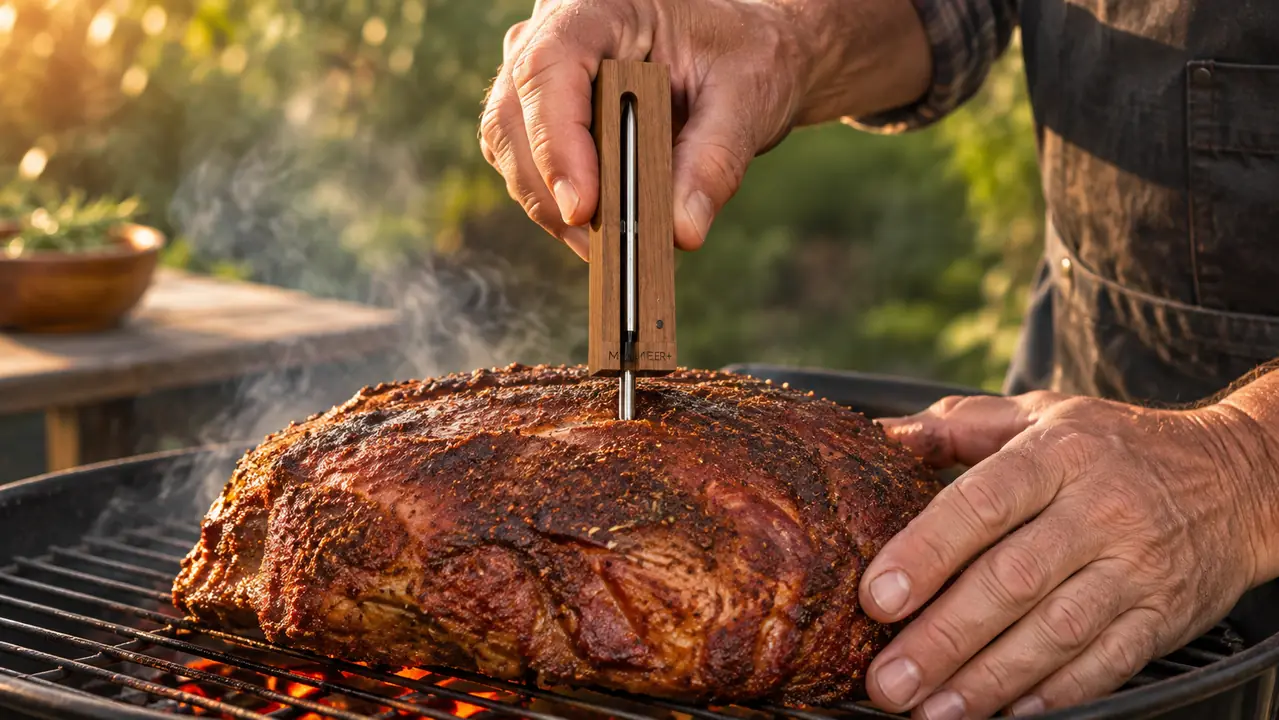
The probe carries two sensors, and this is the part most people skim past. One reads the internal temperature of the meat. The other reads the ambient temperature at the probe itself, meaning the heat your dinner is actually sitting in, and both numbers come back at once. That pairing matters more than I expected. Internal temperature tells you when to pull the meat. Ambient tells you whether your fire is doing what you believe it is doing. I have caught a dying charcoal basket a full hour before I would have noticed it otherwise, purely because the ambient number started sliding while the internal number stalled out.
Accuracy has been good enough that I trust it over my handheld instant read for anything longer than twenty minutes. I still reach for the handheld on burgers and thin cuts, because a probe is awkward in a quarter pound patty and the cook is over before opening an app is worth the trouble. But for a shoulder, a brisket, a whole bird, or a Sunday roast, the probe is the better tool and it is not close. The app plots a predicted finish time based on how the meat is actually climbing, and while that estimate drifts early in a cook, it tightens up considerably in the final hour. I have planned a dinner around that number and had it land inside fifteen minutes.
One honest limit on the ambient reading. It measures heat where the probe is, not heat in the whole cooker. On a kettle with the coals banked to one side, a probe hanging over the cool zone will read lower than the dome thermometer, and both are telling you something true. That is physics, not a fault, but it confused me on my first cook and I wasted twenty minutes thinking the probe was off. Read the ambient number as a report from your meat's immediate neighborhood, not a verdict on the entire fire.
The Charger Does More Than Charge
The charger is the part that surprised me. It holds the probe, it holds one AAA battery, and it repeats the Bluetooth signal, which is exactly how the range gets from the patio into the kitchen. MEATER rates a five minute charge for two hours of cook time, and in practice that has been close to accurate. I have forgotten to charge it, plugged it in while I was trimming a roast, and still had plenty of run time for a four hour cook. The cradle tops the probe up while it sits there, so the routine is simply to set it back in when you pull it out of the meat. No cable to lose, no dock to remember.
The battery arrangement is old fashioned in the best way. One AAA in the charger, replaceable at any hardware store, no proprietary charging brick. I have swapped that battery maybe three times in a year of steady use, and I cook more than most people I know. I keep the cradle on a shelf next to the patio door and I have never once had to hunt for it, which sounds like a small thing until you have owned a thermometer you could not find at the start of a long cook. That was my life before this one.
Cleaning is wipe clean, by hand, and the listing is plain that it is not a dishwasher item. That is the one routine chore in the whole system. Warm water, a soapy cloth, dry it, back in the cradle. I have taken the lazy road with other probes and paid for it with a sensor that read eight degrees cool forever after, so I do this one properly. A year in, the probe still reads true against my handheld, which is the only test that matters to me.

A Year In: What Held Up
Twelve months of steady use has not produced a single failure. No moisture in the sensor, no loss of range, no dead battery inside the probe. The handle has a couple of scuffs from being set down on concrete, which is cosmetic and my fault. What has worn thin is my patience for the app, and that is not really the hardware's problem. The app is where the cook actually lives, and it is a good app that occasionally wants a firmware update at exactly the wrong moment, usually when I am already late getting dinner on and the band is already in the driveway.
The bigger structural limit is one probe, one piece of meat. When I cook a brisket plus a couple of chickens for the band and their families, the MEATER Plus handles one of them. I have to prioritize, and the brisket gets the probe because it is the cook I cannot afford to miss on. The chickens get the handheld and my attention, and everybody eats about when I said they would. For a crowd, that is a real constraint, and it is the single reason I have thought seriously about a multi probe setup for the summer cooks.
The Thanksgiving bird was the cook that sold Jo on it. A whole turkey is a long, boring, high stakes piece of work, and I have dried out more of them than I care to admit. I put the probe in the thigh, watched the internal number climb on the counter while I made gravy and answered questions from people who had wandered into the kitchen, and pulled it when the app said to. Best turkey I have made. That has nothing to do with my skill and everything to do with not opening the oven door every twelve minutes to check.
Range has been dependable but not unlimited. Patio to the kitchen through an exterior wall, no trouble at all. Patio to a bedroom at the far end of the house, it dropped once during a cook when I walked off to take a phone call. The app told me plainly that it had lost the connection, which is the important part. It failed loudly instead of quietly, and it picked the signal back up when I came back within range. A silent gap in the data would be worse than no data. That has happened to me with a cheap unit and I did not find out until I opened the lid.
What I Liked
- Wireless probe, so there is no cable to route through a grill lid or an oven door
- Two sensors on one probe, internal and ambient, reported at the same time
- Charger repeats the Bluetooth signal, so the phone can stay inside while the meat stays outside
- A five minute charge yields roughly two hours of cook time
- Runs on one replaceable AAA battery in the charger, no proprietary cable
- Oven safe up to the rated ceiling, so it works indoors as well as on the patio
- Warns you clearly when the link drops, and reconnects when you come back in range
Where It Falls Short
- One probe means one cut of meat per cook
- Wipe clean by hand only, never the dishwasher
- The ambient reading is local to the probe, not a report on the whole cooker
- App firmware updates show up at inconvenient times
- Range drops through distant interior walls in a larger house
I have caught a dying charcoal basket a full hour before I would have noticed it otherwise, purely because the ambient number started sliding while the internal number stalled out.
Who This Is For
This is for the cook who wants to be somewhere else while dinner finishes. If your idea of a good afternoon is standing next to the grill with a beverage and a handheld thermometer in your fist, you do not need this and you will find the app fussy. If your idea of a good afternoon is sitting on the patio with the band, or inside where it is dry, or doing anything at all besides lifting a lid, this earns its place on the shelf. Backyard cooks, campers with a truck and a cooler, and anyone cooking one important piece of meat at a time.
It suits a small household well. Jo and I cook for two most nights, and one probe covers a roast or a chicken with nothing left over but the planning. It also suits anyone still learning. Watching the internal number climb in real time on a graph taught me more about how a shoulder actually behaves than a decade of reading about it ever did. The stall, the climb, the way a brisket fights you at the same temperature every single time. The probe is a teacher as much as a tool, and that part I genuinely did not expect.
Who Should Skip It
Skip it if you regularly cook three or four different things at once and need a reading on all of them. One probe cannot be in four places, and you will spend more time moving it between cuts than it ever saves you. Skip it if you want a thermometer you can throw in the dishwasher at the end of the night. Skip it if you cook over a live open flame with flare ups that push ambient heat past the rated ceiling, because that is outside what this probe is built for and no app can fix it. And skip it if having a phone in the kitchen bothers you, because the app is the interface. The probe alone will not tell you anything.
One probe, two readings, and your evening back
A year on the patio and two campgrounds later, the MEATER Plus is still the thing I reach for before any long cook. Check today's price and the full listing on Amazon.
Amazon Check Today's Price on Amazon →