
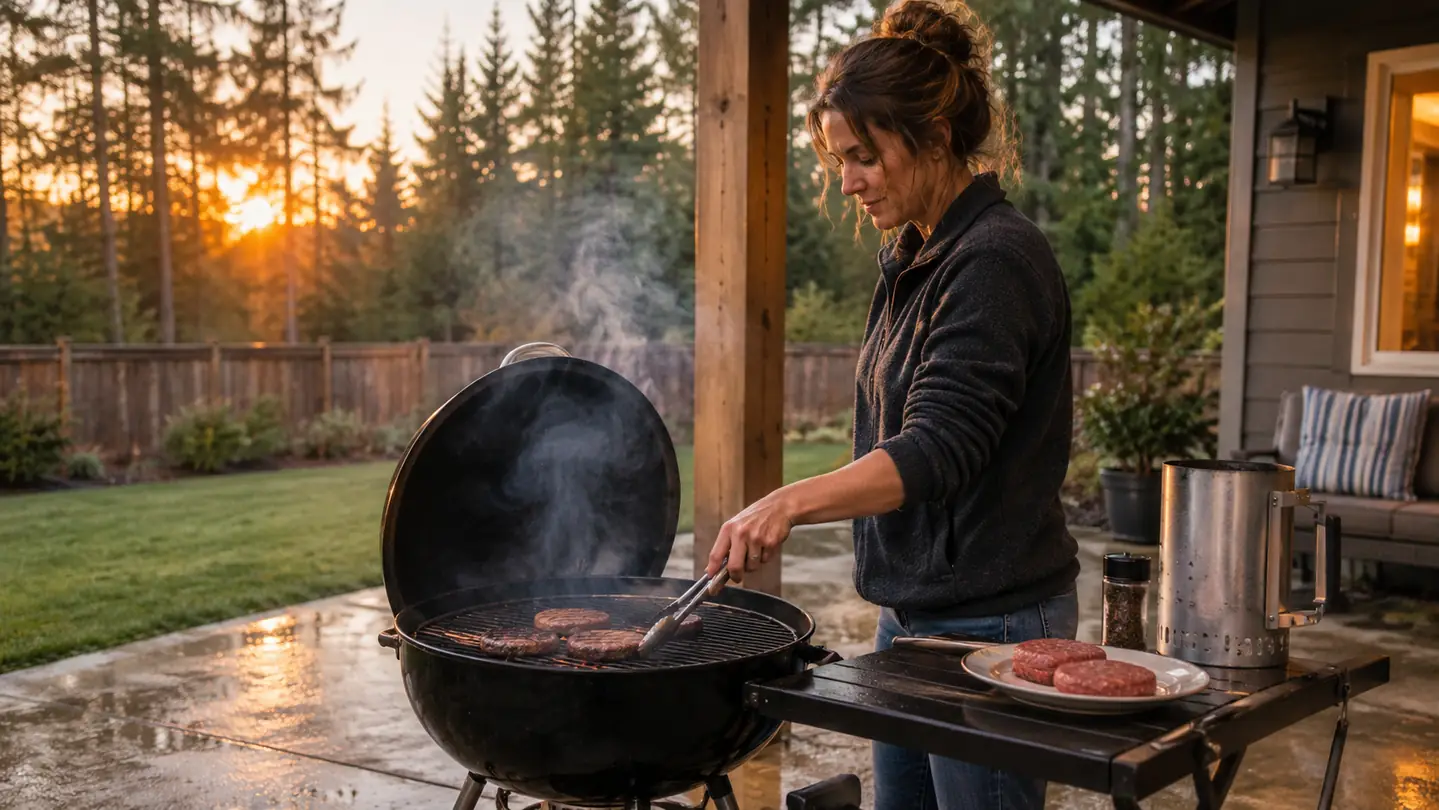
The short answer first. If you cook for three or four people and you want one small grill that handles a patio weeknight and a campsite Saturday, buy the Weber Go-Anywhere. If you cook for two, or the grill has to live on a balcony or in the trunk of a car, the Cuisinart 14 inch portable grill is the more sensible size. I have cooked on the Go-Anywhere for three seasons on the covered patio outside Salem and on trips to the coast, and I spent this spring running the Cuisinart beside it to see whether the smaller grill would make me switch. It did not. It came closer than I expected.
A small grill is a compromise no matter which one you buy, and the only question worth asking is which compromise you can live with. The Weber gives up almost nothing in cooking room and asks you to carry 14 pounds and 19.5 inches of width. The Cuisinart gives up cooking room and asks you to carry less of everything else. Most of what follows comes back to that trade.
| Weber Go-Anywhere | Cuisinart 14 Inch | |
|---|---|---|
| Cooking surface | 160 square inches, rectangular, comfortable for 2 to 4 people | 14 inch grate, sized for two |
| Cooking for two | More grate to heat than a couple of burgers need | Small coal bed, less fuel, ready sooner |
| Packing and storage | 19.5 inches wide and 14 pounds, wants real room in the truck | Slides behind a seat, fits a closet shelf or a balcony |
| Adding charcoal mid cook | Two piece grate lifts in halves, so the food stays put | One grate to lift, so the food comes off first |
| Indirect heat | Char rail banks the coals for a hot side and a cool side | Coals spread across the bed, direct heat |
| Setting it down | Free standing on gravel, grass, or a tailgate | Happier on a flat table |
| Fuel | Charcoal | Charcoal |
| Best for | Camping out of a truck, patio dinners for three or four | Two people, small cars, small spaces |
Where the Weber Go-Anywhere Wins
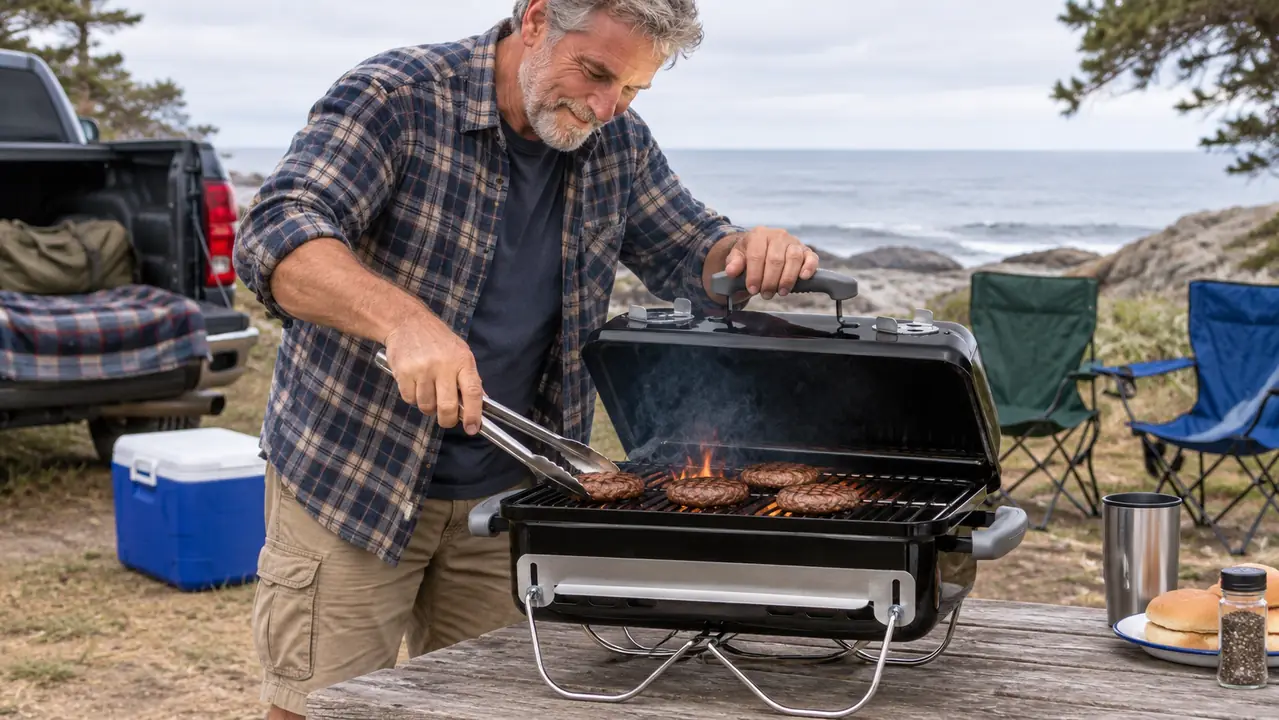
160 square inches does not sound like much until you lay food out on it. The cooking area is a rectangle, 19.5 inches across and 11.5 inches deep, and that shape is the reason it cooks bigger than the number suggests. Four quarter-pound patties fit in a row with a line of corn beside them. Six chicken thighs fit without touching. In June I fed four adults and two kids at a band cookout out of the back of my truck, working in two rounds, and nobody waited long for a second burger. That same crowd on the Cuisinart would have been three rounds and a lot of standing around.
The two-piece cooking grate is the part I would miss most if I switched. Each half lifts out on its own, so when the coals fade halfway through a cook you hook one half up, drop a handful of lit charcoal underneath, and set it back down with the food still sitting on the other half. On a single grate you move everything onto a plate first, and that is exactly when a grill loses its heat. The char-rail insert handles the other half of the job. It sits in along one side of the base and lets you bank the coals against that wall, which gives you a hot side and a quiet side on a grill that fits behind a truck seat. I cook a pork loin that way, seared over the coals for a few minutes and then moved across with the lid down until it reads 145 in the middle. That is a two-zone setup on 160 square inches, and the Cuisinart does not offer it.
It also stands up by itself, which sounds trivial until you are setting a grill down on gravel at a campsite in fading light. The Go-Anywhere is free standing, 14 pounds, with a plastic handle I can grab one handed to shift it out of the rain. I have cooked on it on the concrete pad, on a tailgate, and on a lumpy patch of ground at a state park, and it did not care which. A grill that needs a flat table limits where you can put it, and half the places I cook are not flat.
Where the Cuisinart 14 Inch Portable Grill Wins
The Cuisinart wins the packing argument and it is not close. It is a 14 inch grill, so it takes up less room in the truck, slides behind the seat of a car, and stores on a garage shelf without rearranging anything around it. If your camping is a small car and a tent, or your outdoor space is a balcony with two chairs on it, that difference is the whole decision. The Weber is 19.5 inches wide and 14 pounds, which I do not mind lifting, but I also have a pickup and a shop with floor space. Somebody in an apartment does not.
It is also the better two-person grill, for a reason that has nothing to do with how it is built. A smaller grate needs a smaller coal bed to get hot, and a smaller coal bed lights faster and burns less fuel. For two burgers and a couple of sausages on a Tuesday, the Cuisinart is up to temperature sooner and I am not standing there with half a chimney of leftover coals. The Weber wants a fuller bed to heat 160 square inches properly. That is not a flaw, it is the cost of the extra room, and it is a cost you pay every single time you light it.
There is something to be said for less grill to manage, too. The Cuisinart is a simpler object with less surface to scrape and less ground to cover with a brush at the end of the night. When I am tired and it is drizzling, simple wins. I noticed that more than I expected to.
What Both Grills Get Right
Both of these are charcoal grills, and that is the thing that matters most. Neither one gives you the convenience of a gas knob, and neither one gives you the flat, flavorless result that comes with it. They light with a chimney, they run hot, and they put a crust on a burger that a small gas grill cannot manage. If you are comparing either of these to a tabletop propane unit, you are really deciding whether you want to deal with ash at all.
Both are also small enough to bring inside, which matters more in the Willamette Valley than it does in Arizona. Neither one is going to take up permanent residence on a deck and quietly rot through nine months of rain. That alone puts them ahead of the big kettle sitting out back.
How I Compared Them
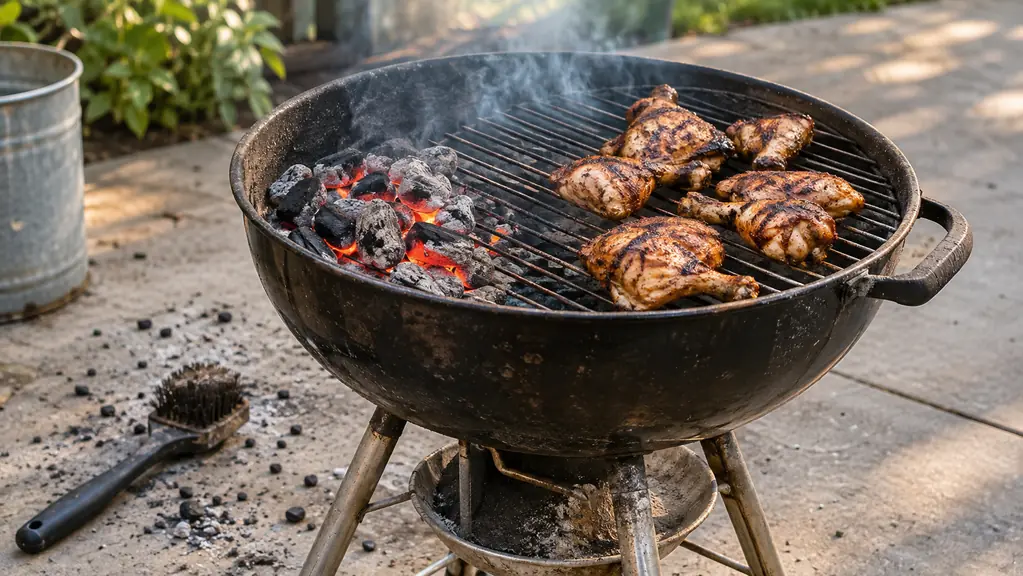
I ran both grills for most of this spring, on the covered patio and on one weekend trip to the coast. Same charcoal, same chimney starter, same pair of tongs. I cooked burgers, chicken thighs, sausages, and one pork loin, and I kept rough notes on how long each grill took to get ready and how much fuel each one went through. I am not a competition cook and I am not going to pretend the testing was scientific. It was three months of weeknight dinners and a couple of band cookouts, which is the only kind of testing that means anything to me.
Most of it happened on the patio, because Salem gives me rain from October to May and I cook under a cover year round. I set both grills on the concrete, lit them at the same time, and cooked the same food on each. That is how I found out the Cuisinart heats faster for a small load while the Weber holds a steadier bed of coals for a longer cook. It is also how I found out that the Weber's extra width is no problem at all on a patio and a real problem in a crowded truck bed with a cooler and two duffel bags in it.
At the coast the wind did what wind does, and I ended up turning the truck to block it and cooking with the lid down. Nothing dramatic. It lit, it held heat, it turned out four burgers and a foil packet of onions, and I packed it away with the ash still warm. That trip is the reason I would still take the Weber camping over the Cuisinart. Not because the Cuisinart could not do the job, but because I never had to think about where to set the Weber down.
Four burgers and a line of corn on 160 square inches, with a two-piece grate that lets me add coals without moving the food. That is the entire argument.
The 14-pound grill that rides in the truck and still feeds four
160 square inches, a two-piece grate you can add charcoal through, and a char rail for banking coals to one side. 19.5 inches wide, 14 pounds, free standing on any kind of ground.
Amazon Check Today's Price on Amazon →Rain, Ash, and Where It Lives
Nine months of the year here is wet, and any charcoal grill left out takes it badly. Both of these are small enough to bring in, and the Weber lives in my shop when it is not in use. The painted metal body and the plastic handle have held up over three seasons with a wipe and an occasional scrape. Cleanup on either grill is a brush, a bag, and five minutes on a Sunday morning while the coffee goes cold.
Storage is the quiet factor in all of this. A grill that lives in a shed and comes out twice a summer is a grill you stop bothering with. The Weber sits on a shelf at 19.5 inches wide and comes out two or three nights a week once the dry weather arrives. If I had to carry it up a flight of stairs every time, I would feel those 14 pounds by July. I do not, so I do not.
Who Should Buy Which
Buy the Weber Go-Anywhere if you cook for three or four people, if you camp out of a truck or a roomy SUV, or if you want the option of cooking a piece of meat with indirect heat. The char rail and the two-piece grate are not gimmicks, they are the reason a 160 square inch grill can turn out a pork loin instead of just burgers. It is also the one to buy if you have a patio and a shelf to store it on, because that is where it does its best work.
Buy the Cuisinart 14 inch if there are two of you, if the grill lives on a balcony or in a car trunk, or if you mostly cook burgers and sausages and want the smallest thing that will do the job. It heats faster, it burns less charcoal, and it takes up half the shelf. For a two-person household with limited space it is the honest choice, and I would not talk anyone out of it.
If you are on the fence, the tiebreaker is what you actually cook. Count the times last summer you fed more than two people. If the answer is a handful, get the Weber and stop thinking about it. If the answer is never, the Cuisinart's smaller size is a real advantage and the Weber's extra room is wasted on you. My longer notes on living with the Go-Anywhere season after season are on the site, and there is a separate piece on why a portable charcoal grill earns its place on a patio as well as at a campsite.
If you ever cook for more than two, get the one with the room
I would rather carry 14 pounds than cook in three rounds while everybody waits. Three seasons in, the Go-Anywhere is still the grill that comes out of my truck first.
Amazon See the Go-Anywhere on Amazon →