
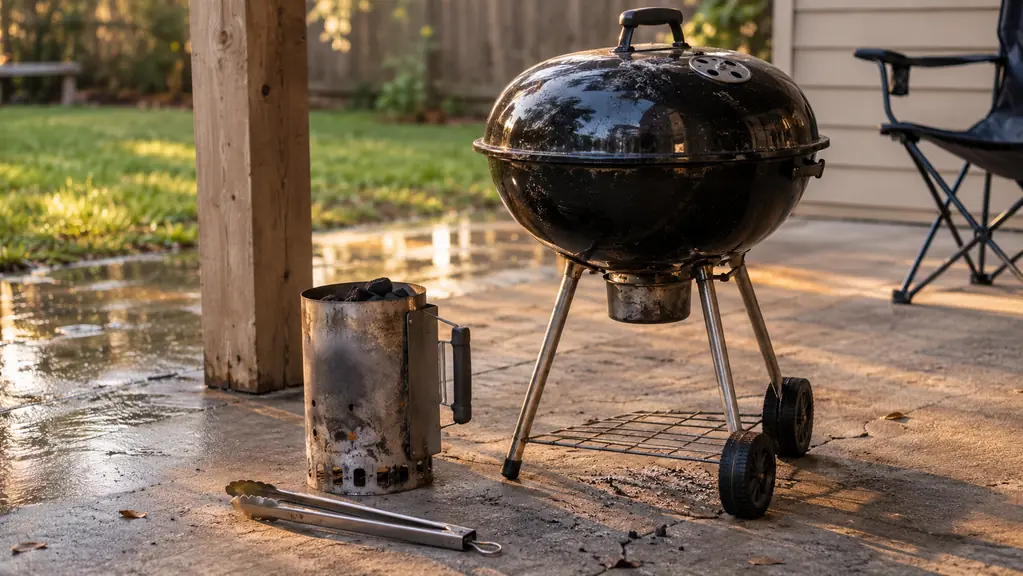
The first grill I hauled to a campsite was a gas two-burner that took up half the truck bed and needed a propane tank I forgot to load twice. I have cooked on a covered patio outside Salem for about thirty years now, and I still put a grill in the truck a few times a year for the coast or the Cascades. The lesson I keep relearning is that small wins. A Weber Go-Anywhere has earned a permanent spot in my garage because it does the patio job and the camp job without asking me to plan around it.
What follows is not a spec sheet read out loud. It is the list of reasons this style of grill actually gets used, in the order they matter to me: how it travels, how it cooks, and whether it is still sitting out in the rain in February. If you cook for two most nights and camp a few weekends a summer, most of these will sound familiar.
The grill that lives on the patio pad and still fits behind the truck seat
160 square inches of grate, 14 pounds, and a two-piece cooking grate you can open mid-cook. Check the current listing and the review count before you decide.
Amazon Check Today's Price on Amazon →It rides behind the seat of a pickup without a second trip
The footprint is 19.5 inches wide, 11.5 inches deep, and 15 inches tall, and the whole grill weighs 14 pounds. In a pickup that means it slides behind the seat or under a cover and leaves the bed for coolers, duffels, and the folding chairs. At home it means you carry it out of the garage in one hand with a bag of charcoal in the other. Getting it to the cooking spot is never a project, and that is the difference between a grill you use and a grill you own.
160 square inches feeds four people without a second round
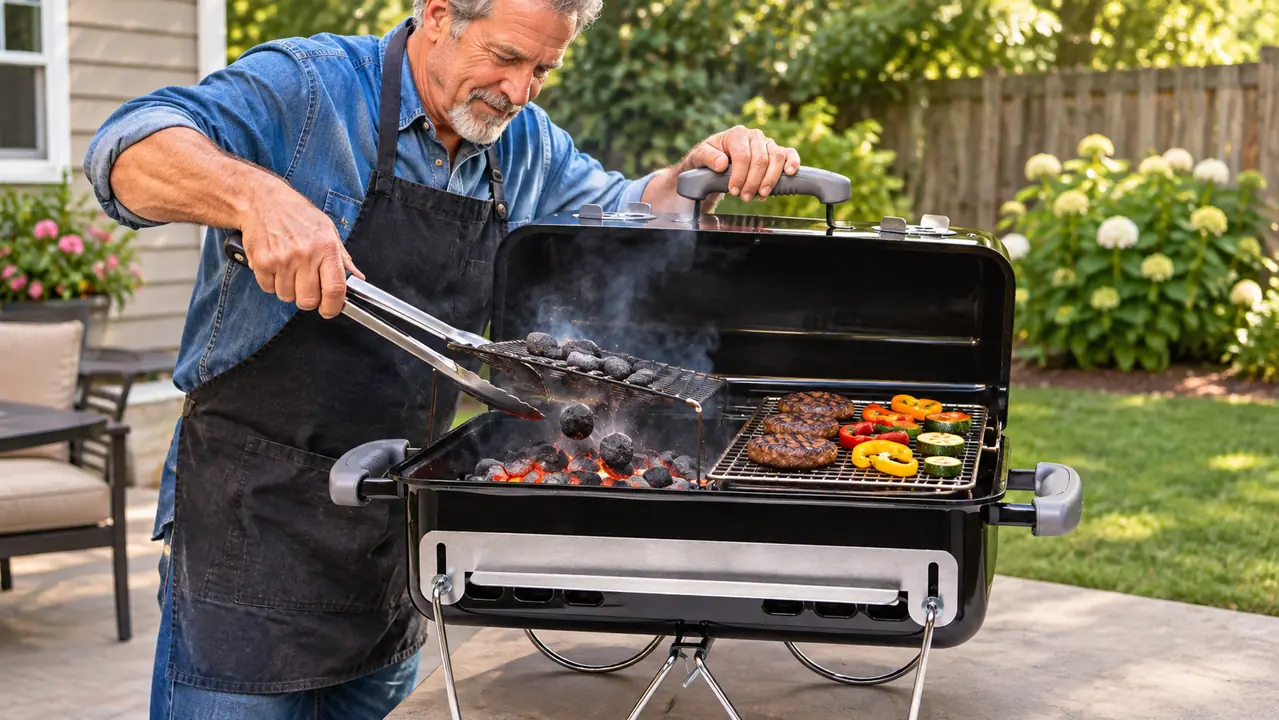
Cooking surface is the number that decides who this grill is for. 160 square inches is not a party grill and it does not pretend to be. It is a two to four person grill, and it handles that without crowding: four burgers and a split sausage per person fit with room left to turn things. Cook for two and you get empty grate to move food onto when one piece starts running ahead of the rest, which is the whole trick to not serving shoe leather.
The two-piece grate lets you add charcoal without unloading dinner
The cooking grate comes in two pieces, and once you have used that you will not go back. When the coals fade halfway through a cook, you lift one half with tongs, drop fresh charcoal onto the hot side, and set it back down. On the Weber the other half never moves, so the food on it never moves either. On a one-piece grate your choices are to cook hotter and faster than you wanted, or to pull everything off the grill and start over while people are already sitting down with plates.
The char-rail insert gives you two heat zones on a small grill
The char-rail insert holds coals where you put them, and that is how you get indirect heat out of a grill this size. Bank the charcoal against the rail on one side, cook over the other, and a thick pork chop finishes through without the outside burning before the middle is anywhere close. It is the same two-zone idea people use on a full-size kettle, just scaled down to a smaller grate. Nothing about it is fancy, it just means you are not guessing where the heat is.
It is free standing, so a concrete pad or a picnic table is enough
19.5 by 11.5 inches of base sits on a small concrete pad, a picnic table, or the tailgate of a truck. There is no cart to wheel around and no side shelf to knock into when someone walks past with a plate. You set it down and it stays where you put it. Mine sits on the pad under the patio cover, and it has been out there through weather that would have sent me back inside with anything fussier. Free standing also means you can move it into the shade when the afternoon sun is on your back.
160 square inches of grate and 14 pounds of grill is the whole case: it feeds four and one person carries it.
Charcoal is the fuel, and that is the reason to bring it
If you did not want charcoal flavor you would not be reading this. The fuel is the point. I light a chimney on the patio, dump it into the Weber, spread it with the rail, and cook. From match to food is about twenty minutes on a weeknight, which is not much slower than gas once you count the drive for a tank swap. At a campsite it is even simpler, because a bag of charcoal does not need a regulator, a hose, or a place to stand upright in the truck.
Nothing to plug in, nothing to fail in the rain
There is no gas line, no regulator, no ignition switch, and no battery. Charcoal and a match. In the Willamette Valley that matters from October through May, because the usual failure point on a gas grill in wet weather is electrical or a burner tube that has taken on water. This grill has neither of those things to break. If it gets rained on, it gets rained on, and the next cook is a chimney of coals away. That reliability is worth more to me than any feature on a bigger unit.
It stores in a corner, so it stays out instead of getting buried
15 inches tall and 14 pounds means it goes on a garage shelf or stands in the corner of the patio, not shoved behind the mower and forgotten until July. A grill you can put away in ten seconds is a grill you use on a Tuesday. The one that gets buried is the one that turns into a weekend event you have to schedule, and eventually into the thing you stop bothering with. Storage sounds like a boring reason until you count how many grills sit unused because getting them out is a chore.
It travels to the coast without a tank in the cab
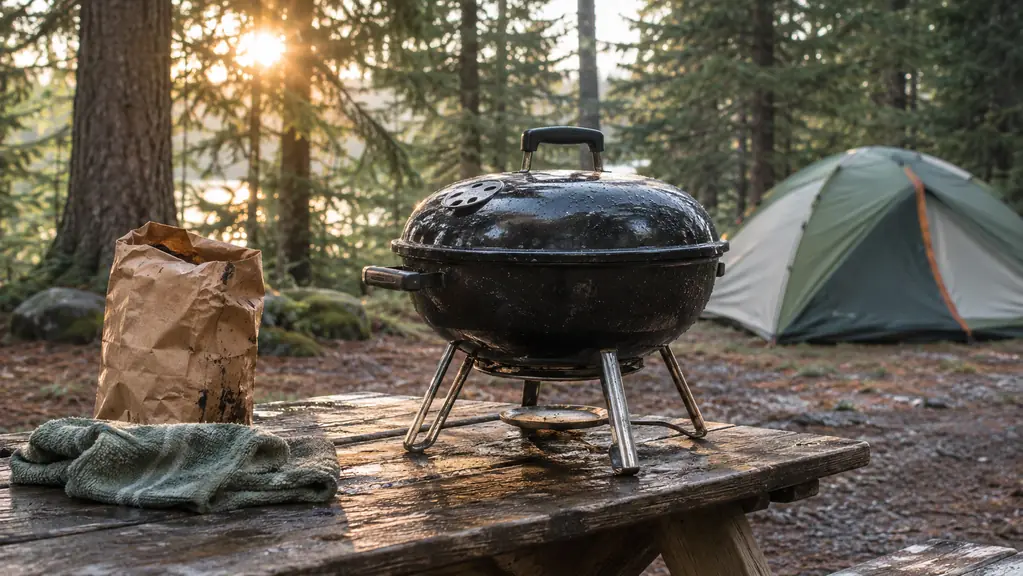
On a coast trip the Weber goes in the truck with the folding chairs, a bag of charcoal goes in a plastic tub, and that is the entire fuel system. No propane tank rolling around the bed, no regulator left on the workbench, no wondering whether a tank in a hot truck is a problem. Setup at the campsite is the grill on a picnic table and a chimney of coals. Teardown is the reverse, and the whole thing fits in the space a cooler would take.
It works as the everyday patio grill, not just the camping one
The real argument is not that this is a camping grill that also works at home. It is a home grill that also camps. Most nights I am cooking for two people, and a big grill is a lot of lit charcoal and a lot of cleanup for two chops and a couple of ears of corn. This one is already out, already clean enough, and the grate is the right size for the food. The Weber gets used more than the bigger grill in my garage, and that is the only measure of a grill that means anything.
What I'd Skip
I would skip most of the accessory aisle. A carrying bag, a cover, and a folding side table all cost money and all add a step between you and dinner, and the plastic handle and painted metal body do not need a bag to survive a truck bed. I would also skip the idea that this replaces a big grill for a crowd. Twelve people need a bigger grate, and you will be cooking in shifts while the food gets cold. If you are between this and something else, the long-term review on this grill covers seasoning and cleanup in detail, and the head-to-head against the Cuisinart 14-inch portable covers the size question directly.
One grill, two jobs, and it still fits in the corner of the garage
14 pounds, 160 square inches, and a two-piece grate that opens mid-cook. Rated 4.7 across more than 5,700 reviews, so you are not the first to try it.
Amazon Check Today's Price on Amazon →