
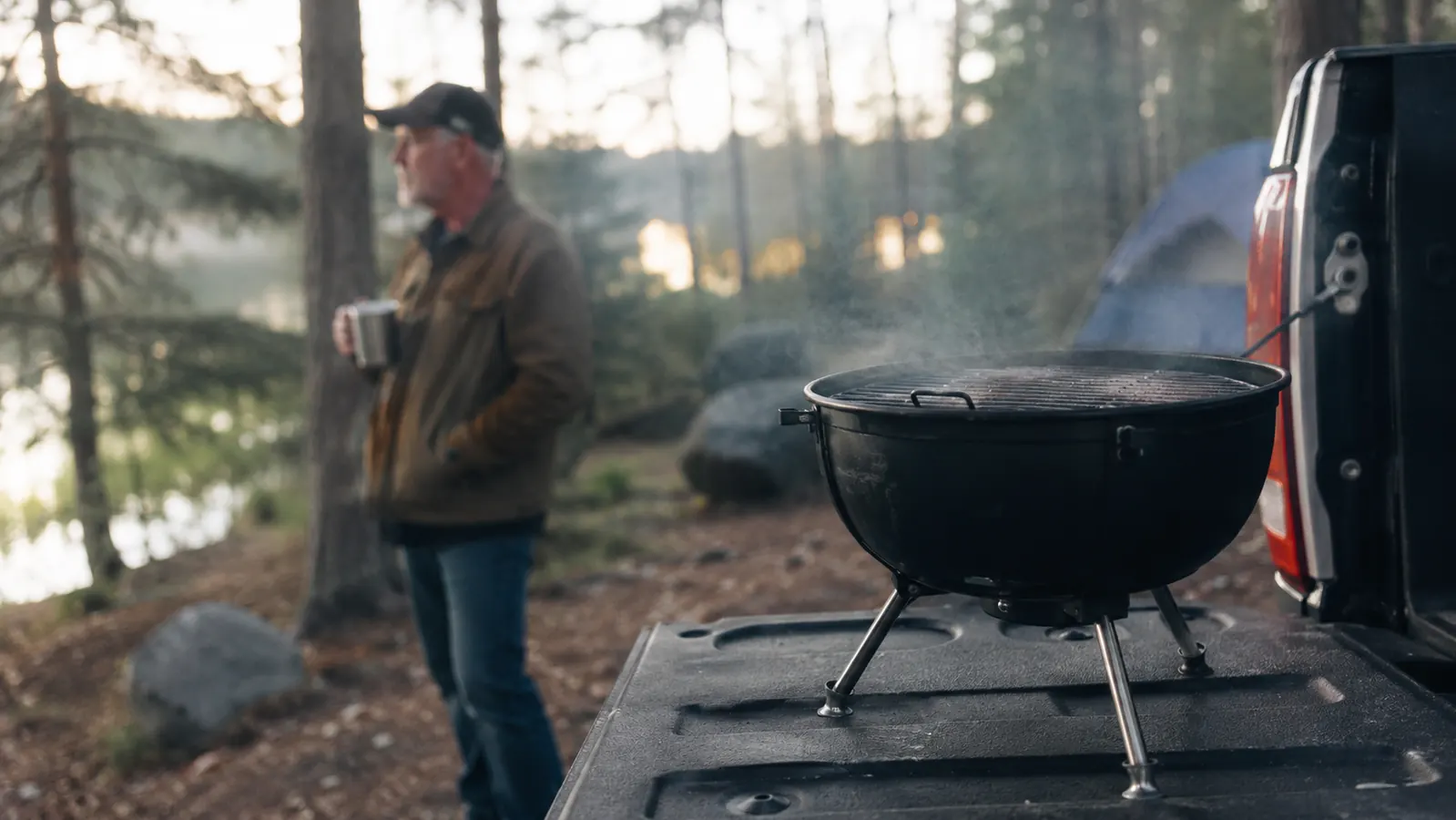
Three summers ago I stood on a windy beach outside Lincoln City watching a friend fight a disposable grill. Foil pan, cold coals, half a bag of the easy-light stuff, and a dozen people standing around holding paper plates. I drove home that night and started looking for something small enough to live in the truck bed without eating the whole thing.
The Weber Go-Anywhere is what I settled on. Two seasons of camping out of a pickup, one long wet Willamette Valley spring cooking under the patio cover, and a handful of band cookouts later, I know what it does well and where it irritates me. It weighs 14 pounds, measures 19.5 inches wide by 15 inches tall by 11.5 inches deep, and gives you 160 square inches of grate. Those numbers read small on a spec sheet. They are also the reason it comes with me and the kettle stays home.
The Quick Verdict
A 14-pound charcoal grill that sets up in a minute and feeds three or four without drama. Buy it for the road. It is not trying to replace your patio grill.
Amazon Check Today's Price →The grill that lives in the truck bed and never complains about it
19.5 inches wide, 14 pounds, 160 square inches of grate. Small enough to slide under a cooler, quick enough that you are eating before the firewood is ready.
Amazon Check Today's Price on Amazon →How I've Used It
I am 57 and I have been cooking outside for about 30 years, and I am not a competition cook. What I want is simple: get it lit, get food on it, and stay outside with the people instead of babysitting a fire. Mine lives in a plastic tote in the truck bed from May through September. It has been to the coast four times and up into the Cascades twice, and it has done duty on the concrete pad under my patio cover more Sundays than I can count. Jo and I cook for two most nights, and the band plus their families is eight or nine when we host, which means I run it twice in a row on those evenings.
Setup is the part that sold me. You set it on a flat surface, dump coals in, light them, and put the grate on. There is no assembly ritual and no parts to lose in the grass. From match to first burger is about 20 minutes on a decent night, roughly the same as a chimney starter through a kettle, except I am not lifting a hot chimney and I am not cleaning out a big kettle bowl afterward.
Teardown is where it earns its keep. Once the coals die, the whole thing goes back in the tote and rides home. Nothing rattles, nothing leaks, and I have never once arrived at a campsite to find the inside of my truck covered in soot.
Before this I had a cheap folding grill that cost less than a tank of gas and lasted one season. The legs splayed on uneven ground at a campsite outside Tillamook, the whole thing tipped, and the coals went into the gravel. Nobody got hurt, but I spent 20 minutes kicking hot charcoal off a campsite pad at dusk. The Weber stands level on a tailgate or a picnic table, and the rectangular base does not rock the way a round folding grill does on dirt. That is a low bar. It is also the bar the cheap grill failed to clear.
One trip sticks with me. We were up past Detroit Lake in early June and the weather turned. Everyone else stood under a tarp waiting for a break. I set the grill on the tailgate, got coals going, and had sausages and peppers done before the rain settled in for good. That is not a heroic story. It is exactly the kind of small win this grill is built for, and it is the reason the Weber has been the one piece of camp gear I never have to think about.
What 160 Square Inches Actually Cooks
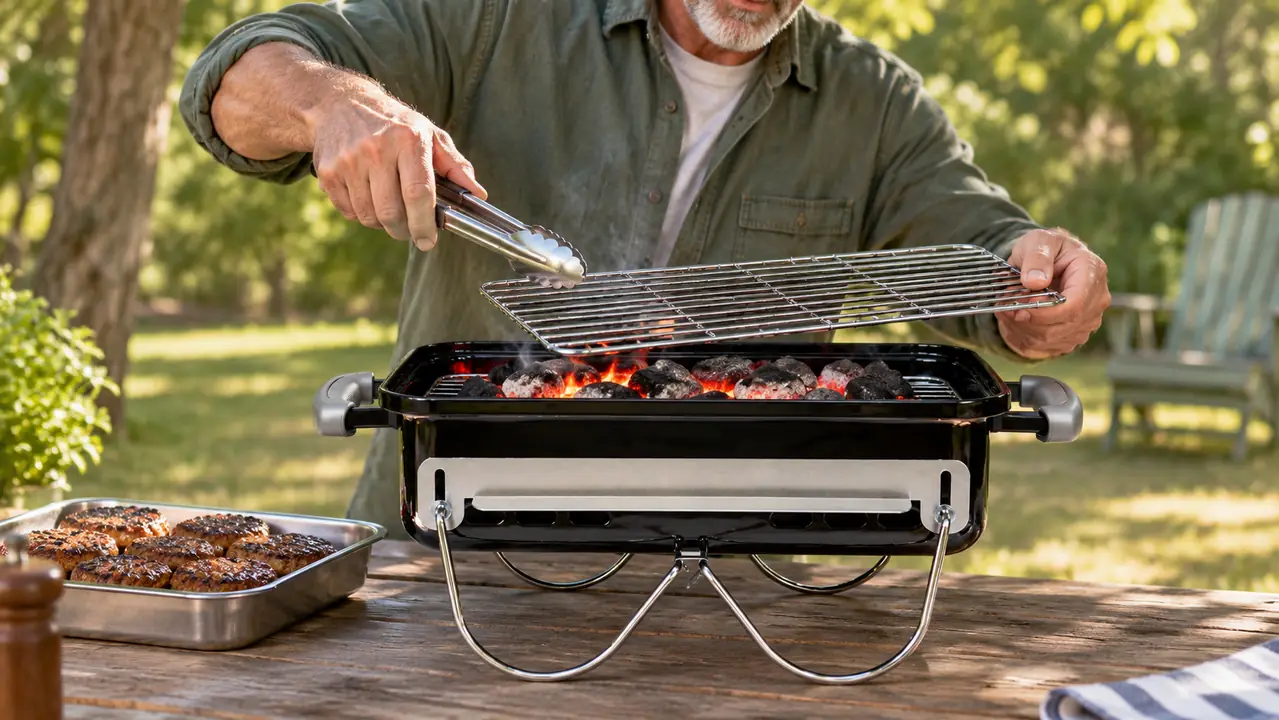
The listing says it cooks for two to four people, and after two seasons I would call that honest. Four quarter-pound burgers and a couple of sausages fit with room to turn them. Six chicken thighs fit if you are willing to move them around. A spatchcocked chicken fits. A full rack of baby backs fits if you curl it or cut it in half.
What does not fit is a brisket, a turkey, or burgers for twelve without a second batch. When the band comes over I do a first wave of burgers, pull them to a pan in the house, add coals, and run a second wave. It works. It is not the same as having a big grill, and I would not pretend otherwise.
The Sunday that sticks is one in July when Jo's sister and her husband drove down from Portland on short notice. Four of us, a pack of brats, and two pounds of ground beef. I ran eight patties in two waves, lifting one half of the grate to add coals between them, and everything was on the table about 35 minutes after I lit the chimney. Twelve patties would have stretched that to an hour and a half with me standing outside alone while everyone else ate. That is the arithmetic of a small grate, and it is worth knowing before you buy.
The first summer I tried to cook a whole chicken on it. Do not do that. Spatchcocked, yes. Whole, no, unless you enjoy raw poultry in the middle and charcoal on the outside.
The grate is metal and the body is painted metal with a plastic handle. The handle matters more than it sounds. It stays comfortable to grab, which I do constantly, and you are not hunting around for a glove while something is burning.
The Two-Piece Grate and the Char-Rail Do the Real Work
Two features separate this from a cheap folding grill, and both are on the spec sheet. The first is the two-piece cooking grate. Each half lifts out on its own, so you can add charcoal mid-cook without pulling the whole grate and losing your food arrangement. That sounds like a small thing until you have tried to add coals to a one-piece grate with eight burgers on it.
The second is the char-rail insert, a folding rail that helps you arrange coals to one side for indirect cooking. On 160 square inches you are not building a two-zone setup with much real estate, but you can push coals to one half and put the food on the other. I have done chicken quarters that way and they came out cooked through instead of scorched, which is the usual outcome when you try to cook chicken over direct heat on a small grill.
The grill is direct heat and single-level, and that is the honest description. The char-rail gives you a workaround. It does not turn this into a smoker.
I have also used the half I am not cooking on to park finished food while the rest catches up. That is not what the feature is for, but it works well enough that I stopped bothering with a separate tray.
Rain, Ash, and the Boring Parts
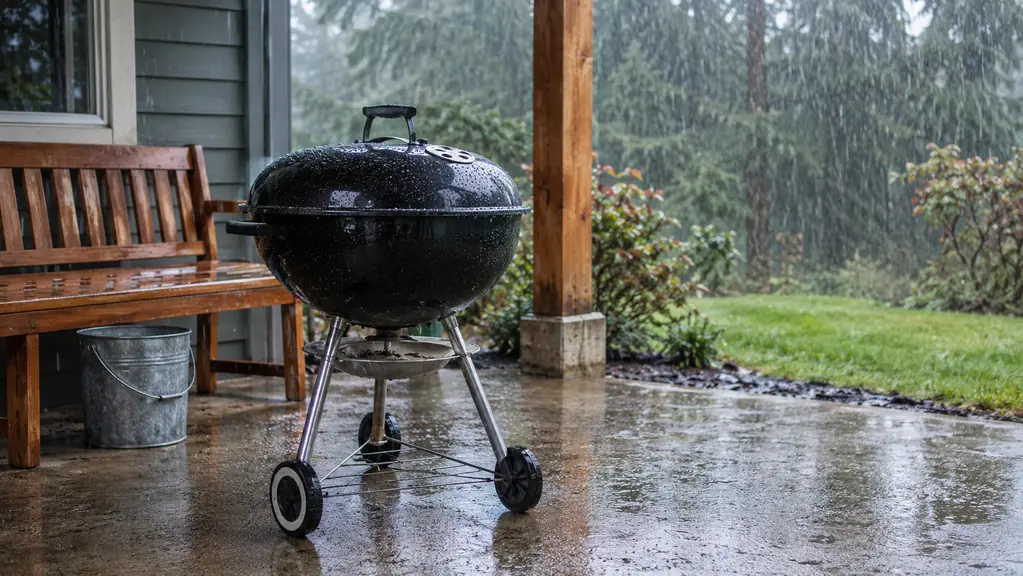
I cook under a patio cover from October to May because the Willamette Valley does not give you a choice. The painted metal and the plastic handle hold up fine to that as long as you do not leave the thing standing in the rain for weeks at a stretch. Mine has some dull spots on the outside after two seasons. Nothing has rusted through and nothing has warped.
February is the real test. I cooked on it through a stretch last winter when it rained 19 days out of 28, and the only change I made was moving it deeper under the cover and giving the coals a few extra minutes. The painted finish went chalky on the outside after that run, which wiped off with a rag and a little oil. What I would not do is leave it standing out uncovered from October to May. Mine has never sat in water and I intend to keep it that way.
Cleanup is the part nobody writes about. After the coals die I let it cool overnight, dump the ash into a metal bucket, and wipe the grate with a stiff brush. Ten minutes, maybe. The inside of the body gets a scrub two or three times a season. I keep a spare brush and a scraper in the same tote and I have replaced the brush twice. The grill itself has needed nothing. The user manual it ships with is thin and I did not read past the lighting instructions.
One thing I will say plainly: it is 15 inches tall. You are cooking closer to the ground than you are with a kettle, so if your back is already complaining, plan to set it on a picnic table or a tailgate rather than on the ground.
Where It Falls Short
Small grate, no way around it. Anything over four people means batches. If you regularly cook for six or more, this is a second grill, not a first one.
It also does not hold heat the way a heavier grill does. On a cold, breezy evening at the coast I went through more charcoal than I expected and I had to stay closer to it than I like. That is the trade for 14 pounds. Light enough to move easily also tends to mean thin and thirsty.
Wind is the other thing I underestimated. On the beach outside Lincoln City the coals burn fast and the ash goes sideways, and I ended up setting the grill on the leeward side of the truck and turning it so the breeze hit the narrow face. Better, not good. If a windy beach is your usual cooking spot, plan on more charcoal than you think you need and a way to block the wind. I use the truck.
Storage is another small annoyance. At 11.5 inches deep and 15 inches tall it does not stack flat against a garage wall the way a folding grill does. Mine lives in the tote or on a shelf, taking up roughly the footprint of a milk crate.
And there is no getting around the fact that charcoal takes time. If you want to eat 10 minutes after you walk out the door, this is the wrong tool and a small gas grill is the right one. I still keep charcoal because I like the result, but I am not going to pretend the wait does not exist.
What I Compared It To
I looked hard at the 14-inch Cuisinart portable before I bought this one, and I have cooked on a friend's. It is a fine little grill and it is easier to carry. What pushed me to the Weber was the two-piece grate and the char-rail. Being able to add coals without unloading the food is the difference between a grill I use and a grill I avoid on anything more involved than hot dogs. If you want the full side by side, I wrote that up separately.
I also considered a small gas portable and passed. The whole reason I cook outside is the charcoal. If I wanted gas I would want it bigger than this.
A friend has a small gas portable that lights in 60 seconds. He uses it four times a summer. I use mine a dozen times a summer. That is the whole argument, and it is not really about the grill. It is about whether the fire is part of the evening or an obstacle in front of it.
What I Liked
- 14 pounds and 19.5 inches wide, so it rides in the truck bed without taking it over
- Two-piece grate lets you add charcoal without pulling the food
- Char-rail insert makes indirect cooking possible on a small surface
- Plastic handle is comfortable to grab without a glove
- Sets up and tears down in minutes, no assembly ritual
- 160 square inches honestly feeds two to four
Where It Falls Short
- Four people is about the ceiling before you are cooking in batches
- Thin body loses heat fast on a cold, breezy evening
- 15 inches tall, so it cooks low unless you set it on a table
- Still charcoal, still about 20 minutes from match to food
The two-piece grate is the whole reason I kept it. Being able to add coals without unloading eight burgers is the difference between a grill I use and a grill I avoid.
Who This Is For
This is for the person who cooks for two to four, wants real charcoal flavor, and needs the grill to fit in a truck bed, a trunk, or a closet. Campers, tailgaters, small patio cooks, and anyone who has hauled a kettle somewhere and regretted it. If you cook under a cover through a wet winter and want something you can leave out without guilt, it handles that too. Weber builds it to do one job, and it does that job.
Who Should Skip It
Skip it if you regularly feed six or more, if you want to eat within 10 minutes of walking outside, or if you are not willing to deal with ash. It is also a poor choice as an only grill for someone who wants to smoke. The char-rail helps you arrange coals, but 160 square inches is not a smoker and never will be. And if your back does not tolerate low cooking surfaces, budget for a table to set it on.
Two seasons in, it still rides in the truck bed
160 square inches, 14 pounds, a two-piece grate and a char-rail for banking coals. If your cooking tops out at four people and you want to eat outside more often, this is the one I would buy again.
Amazon Check Today's Price on Amazon →