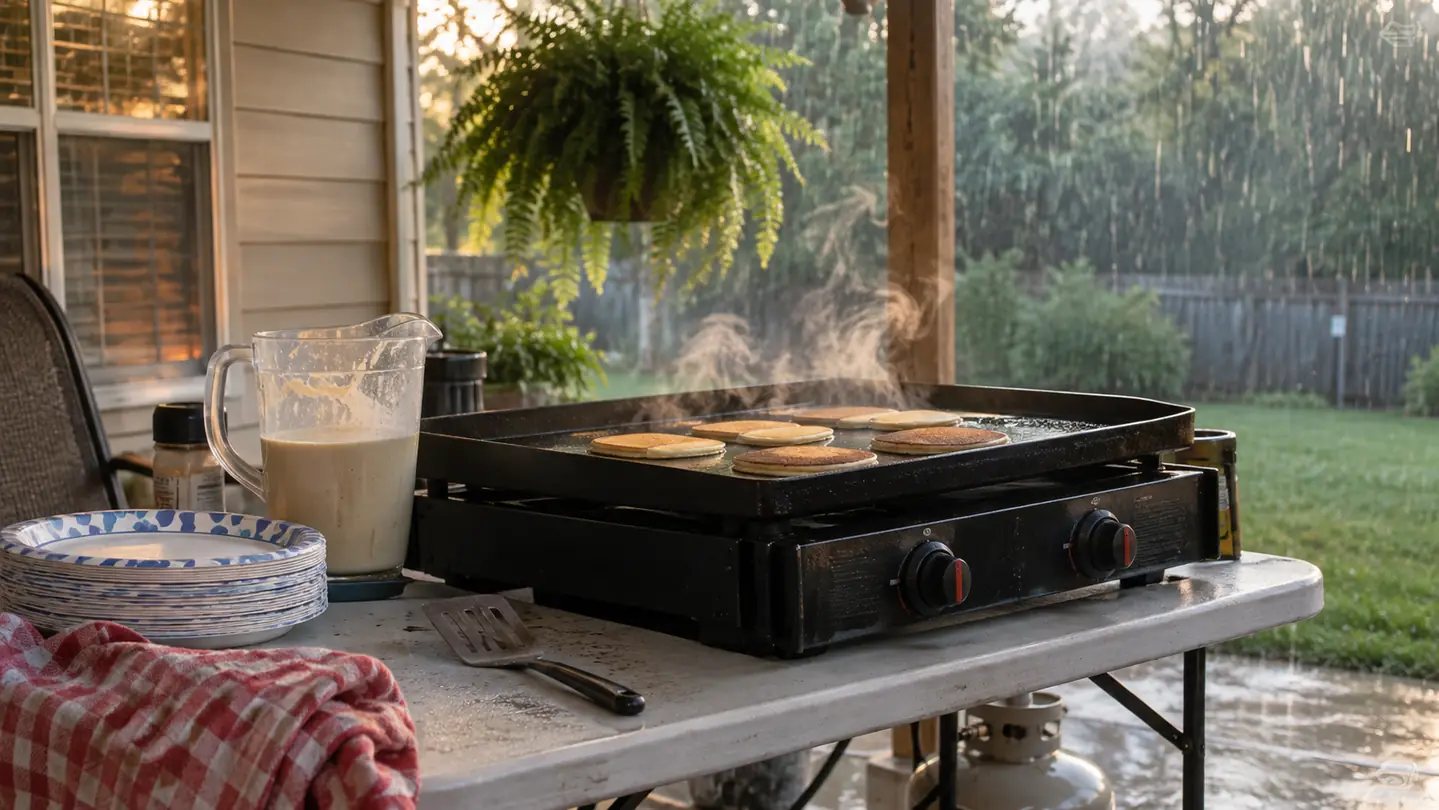
Breakfast for a crowd on a small griddle usually fails for one reason, and it is not the griddle. It is the order. You start the eggs because eggs feel like the thing you are supposed to cook first, they finish in ninety seconds, they sit on a plate under foil, and the potatoes are still raw when the first person walks up. Then you spend the rest of the meal apologizing and shuffling pans around. I have run that exact play on my covered patio outside Salem more times than I want to admit, for the band and their families, and the food was never the problem. The sequence was.
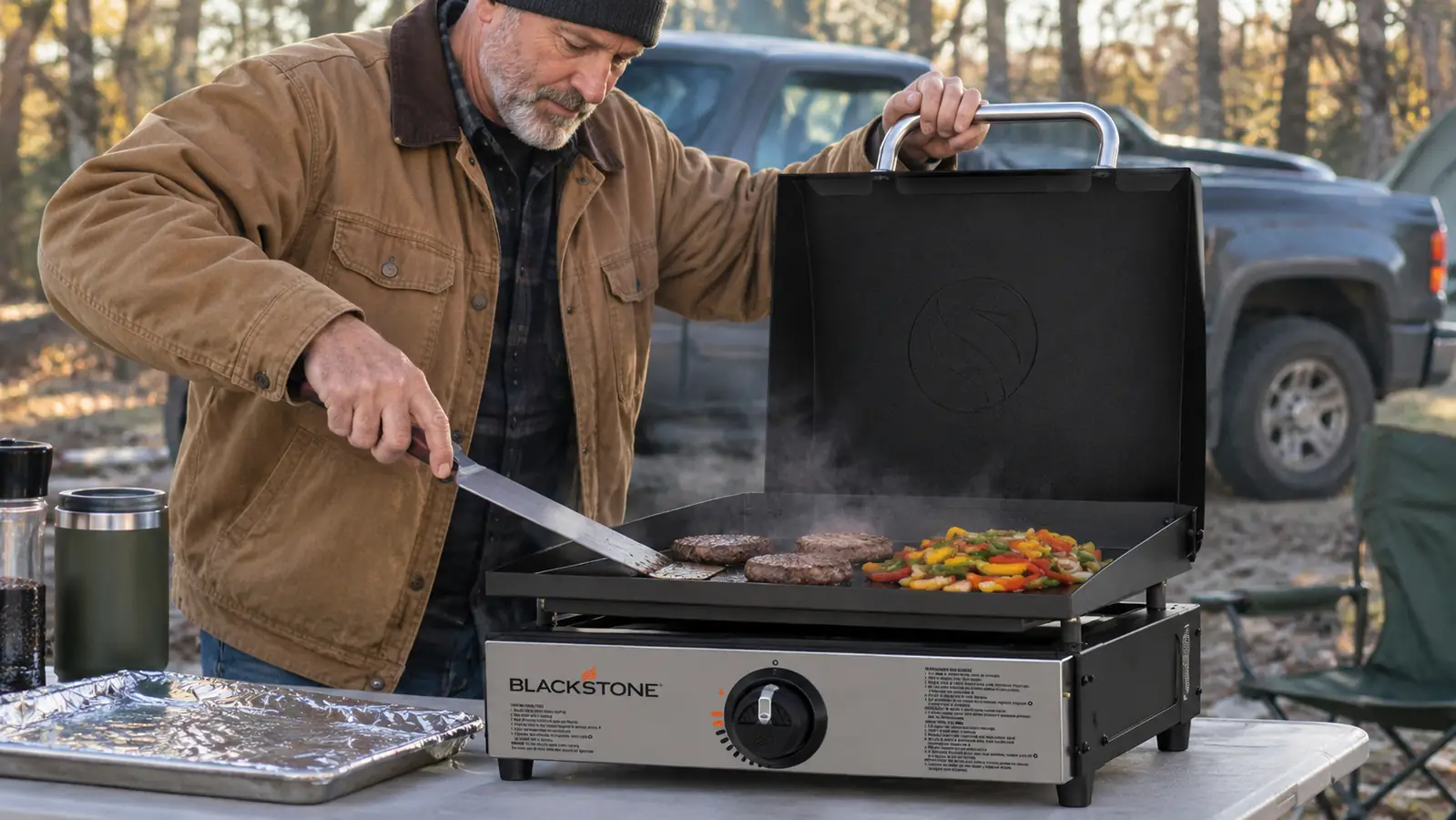
The Blackstone 17 inch propane griddle is the smallest thing I own that still counts as a real cooking surface. Blackstone rates the plate at 268 square inches, which their listing translates to nine burgers. It weighs a hair under twenty pounds, it rides in the truck bed on camping trips out to the coast, and it sets up on any folding table that is not actively wobbling. What it will not do is cook ten different things at ten different times. It cooks what you put on it, in the order you put it there. Once I stopped fighting that, ten people ate hot food off 268 square inches and nobody stood in line more than four minutes.
Nine burgers of surface, twenty pounds in the truck bed
The Blackstone 17 inch is the griddle this whole sequence is built around. Small enough to haul to a campsite, big enough to feed a line if you run it in the right order.
Amazon Check Today's Price on Amazon →What 268 Square Inches Actually Gives You to Work With
Think of the plate as three narrow strips instead of one surface. The back strip runs hottest and holds the long items. The middle strip is your workhorse, where things get turned. The front strip, closest to you, is where finished food waits for the thirty seconds it takes you to find a plate. On a 17 inch griddle those strips are not generous. A spatula runs about five inches wide, so you have roughly three spatula widths of room front to back, and if you fill all three with food at the same time you have nowhere to slide the spatula under anything.
The H style burner under the plate is what makes the arrangement work. It carries heat across the width instead of dumping it in a hot ring in the middle, so the back edge is not scorching while the front sits lukewarm. The built-in igniter saves you from hunting a lighter in the wind. The heat control runs from light to high, and on a plate this size that range is more than you need for eggs and about right for potatoes. I run potatoes on high, pancakes just above low, and eggs on low.
A ten person breakfast breaks down like this: back strip for potatoes and sausage, middle strip for pancakes in rounds, front strip for finished items moving out. That plan does not change from the first pancake to the last egg. What changes is how much of it is running at once. If you try to run all three strips at full load you end up with a plate covered in food and no room to get a spatula under any of it, which is how a good griddle turns into a warming tray.
Step 1: Preheat the Whole Plate Before Anything Touches It
A cold spot on a small griddle is worse than a cold spot on a big one, because there is no room to cook around it. Give the plate a full ten minutes on high with nothing on it. Not five. Ten. On a cool Oregon morning, with the griddle sitting on a table in the open air, that plate is fighting the weather the entire time, and a plate that is only half hot will give you pale pancakes and potatoes that stick.
When you think it is ready, flick a few drops of water across the surface. They should skate and evaporate in a couple of seconds. If they sit there in a puddle, close it up and wait. If they vanish on contact with a hiss and leave a scorch mark, back the heat down and give it two minutes to even out. Under the patio cover in October, with rain coming off the gutter, I have waited fifteen.
Oil after the plate is hot, not before. A thin film, spread with a paper towel held in tongs. Too much oil on a 17 inch griddle and everything you cook from that point forward is sitting in it, because there is no room for the excess to run off to.
Step 2: Start the Longest Items First and Park Them at the Back
Potatoes go on before anything else. Frozen shredded hash browns, spread thin across the back strip, pressed down once with the spatula, then left alone for four or five minutes. Every time you poke at them you break the crust that is the entire reason you are making them. If you are feeding a camping crowd and working out of a cooler, this is the moment the cooler lid stays open too long and everybody stands around watching you. Have the bag already open on the table before the plate gets hot.
If there is bacon in the plan, cook it before the potatoes, at home, on a sheet pan in the oven, and bring it wrapped in foil. Bacon on a 17 inch plate eats the whole surface, throws grease over the front edge, and leaves you wiping instead of cooking. When we are camping and there is no oven, I cook the bacon first, pour the grease into the tray, scrape and wipe, and then start over with potatoes. It costs me eight minutes and saves me a mess I would be fighting for the rest of the meal.
Sausage links or patties go in the back strip next to the potatoes, turned once, then pushed forward as they finish. Finished food does not stay on the griddle. It goes to a foil covered sheet pan on the corner of the table, or into a low oven if you are at home. The griddle is a stove, not a warming drawer, and every square inch holding food that is already done is an inch that is not cooking food that is not.
Step 3: Run Pancakes in Batches You Can Actually Turn
This is where people lose the meal. They pour batter into every open space and then stand there with a spatula and nowhere to put it. Five or six pancakes on a 17 inch plate is the practical limit if you want to flip them cleanly, and the gaps between them matter more than the count.
Get the batter into a squeeze bottle or a pitcher with a spout. Pouring from a mixing bowl with a lip is how you end up with one pancake shaped like a map of Oregon and no room for the rest. Start them on the middle strip, wait for the bubbles on top to pop and stay open, then flip once. Once. A pancake that gets flipped twice is a hockey puck with a nice color.
The first one off the plate is the test. Eat it standing up, adjust the heat, then pour the real batch. Every griddle runs a little different depending on wind and how cold the propane tank is, and one pancake tells you more than anything printed on a box.
Move finished pancakes straight to the holding pan and cover them. Do not stack them on the back strip to stay warm. They steam, they go limp, and they take up surface you need for eggs. A batch runs about three minutes from pour to pan, so with ten people you are looking at three rounds, and the potatoes hold fine the whole time.
Step 4: Cook Eggs Last, and Only as Many as You Can Serve
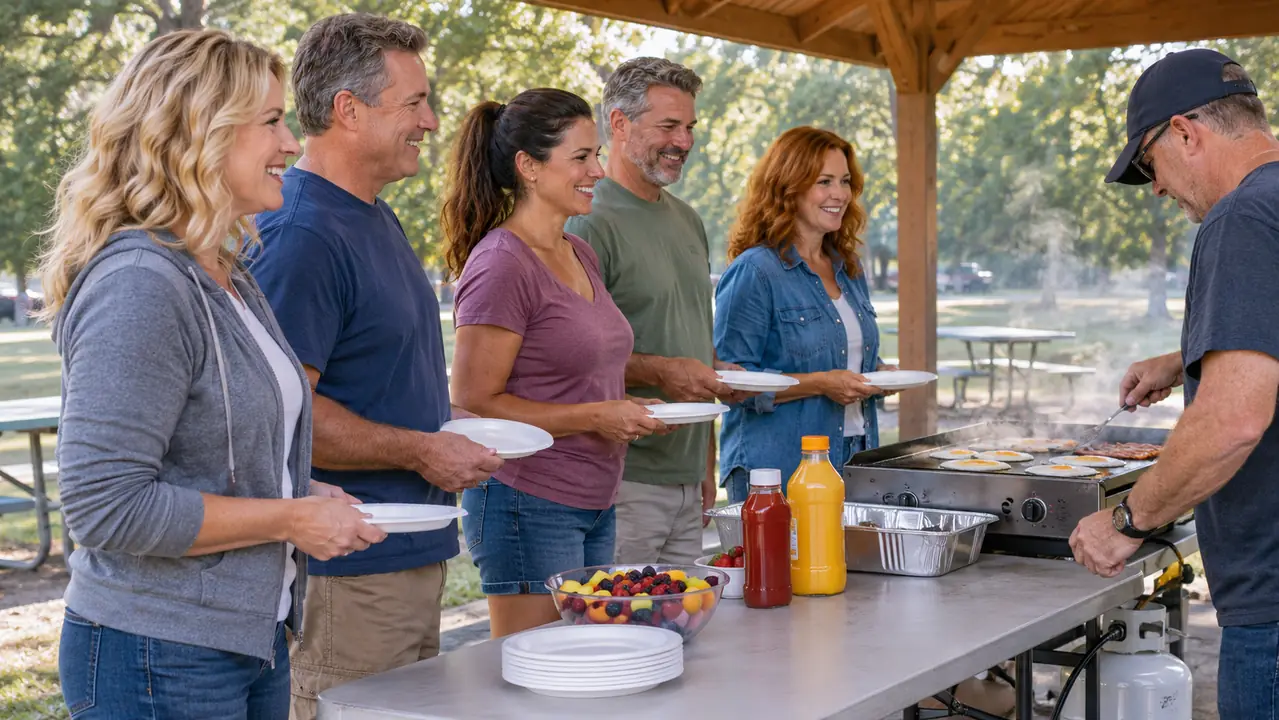
Eggs are the last thing on and the first thing that has to be right. By the time you get here the plate has been cooking for twenty minutes, so scrape it down, push the grease into the tray, wipe it with a paper towel held in tongs, and lay down a fresh thin film of oil. Turn the heat to low. Eggs go on a cool surface and come off before they are fully set.
The count matters more than the technique. On 268 square inches you can hold six eggs without crowding them, but only if the potatoes and pancakes are already off. Six eggs, not twelve. Cook them in two rounds of six and hand the first six out while the second six are going. Over easy in one round, scrambled in a corner in the other, or whatever the line asks for. If somebody wants theirs hard, theirs goes on first and stays on the front strip while everything else slides around it.
Scrambled eggs look like they should be easy on a flat plate, and they are, as long as you keep them moving and keep them out of the grease. A corner of the griddle is enough room for four eggs if you work them with the edge of the spatula instead of stirring them like a pan. Take them off while they still look slightly wet. They finish on the plate on the way to the table.
Step 5: Scrape and Wipe While It Is Still Warm
The meal is not over until the plate is clean, and cleaning it hot takes three minutes where cleaning it cold takes twenty. Scrape the residue into the grease tray while the plate is still warm. The Blackstone tray holds more than you expect, which matters at breakfast, because the grease goes from nothing to a problem fast and you are not going to stop mid-line to deal with it.
Wipe it down with a paper towel in tongs, then a second one, then lay a thin coat of oil over the whole surface. That coat is what keeps the plate from rusting in the truck bed between trips. Let it cool completely before you fold anything down or set the hood back on. Then eat your own breakfast, which by now is the last pancake on the pan and cold, and that is the price of being the one who cooks.
What Else Helps
A folding table that does not wobble is not a small thing. You are going to lean on it, the plate is hot, and a griddle that shifts while you are sliding a spatula under six eggs is a bad way to start the day. Set the table up first, put the griddle on it, and check that the propane hose is not running across the spot where people will walk with hot plates.
Beyond that, the gear that pays for itself: a squeeze bottle for batter, a long thin spatula instead of a short wide one, a roll of foil, a sheet pan for holding, and a small silicone mat to set the hot spatula on. If you are cooking in the evening or under the patio cover in November, a headlamp beats holding a flashlight in your teeth. And hand somebody else the coffee and the toast. There is no reason for one person to do all of it while nine people watch.
Match the crowd to the plate honestly. Ten is a comfortable number on this griddle if you are running pancakes and eggs and nothing else. Twelve gets tight. Fourteen and you are cooking in waves, which is fine, but say so up front so the first wave is not eating while the last wave stands there waiting and feeling awkward about it.
The listing says nine burgers fit on 268 square inches. At breakfast, that is five pancakes and four eggs if you want anybody to eat hot food.
Feed the line, then go sit down with them
The Blackstone 17 inch fits in a truck bed and runs breakfast for ten in five steps, as long as you work it in the right order. Get it on the table before the next crowd shows up.
Amazon Check Today's Price on Amazon →