The first thing I noticed about the Blackstone 17 inch griddle was not the cooking. It was that I stopped walking back and forth to the kitchen. I have cooked outdoors for about thirty years, most of it over charcoal and a propane grill, and both of those keep me standing in one spot, tending. A griddle does the opposite. I carry it out to the patio table, light it, and stand there with a cup of coffee while an entire breakfast comes off at once. That sounds like a small thing. Two years in, it is the only thing.
I bought it for camping. That was the plan: something that fits in the truck for the coast and the Cascades, something better than a skillet on a camp stove. What actually happened is that it never went back in the garage. It has lived on the covered patio from April through October and gone camping maybe six times a year. My wife Jo has stopped asking which cooker I am using. The answer is the Blackstone, unless I am feeding the band.
The Quick Verdict
A two to four person flat top that fits in a truck and holds an even heat, held back by a single heat zone and a surface that runs out of room fast at a crowd.
Amazon Check Today's Price →The patio cooker I reach for on a Tuesday, not just on a camping trip
268 square inches of flat surface, a built in igniter that lights on the first click, and nine kilos of weight so one person can move it. If your weekend breakfast involves three pans and a lot of walking, this replaces all of it.
Amazon Check Today's Price on Amazon →How I've Used It
Most weekends from April through October, this griddle comes out on Saturday and Sunday morning. Pancakes, eggs, hash browns, bacon, and the occasional batch of smash burgers on a weeknight. In winter I still use it under the patio cover when the rain lets up, because the Willamette Valley hands you a dry Saturday now and then even in January. It has been to the coast four times and into the Cascades twice, and it has cooked on a picnic table, a tailgate, and once, badly, on a campsite bench that was not level. That last one was my fault, not the griddle's.
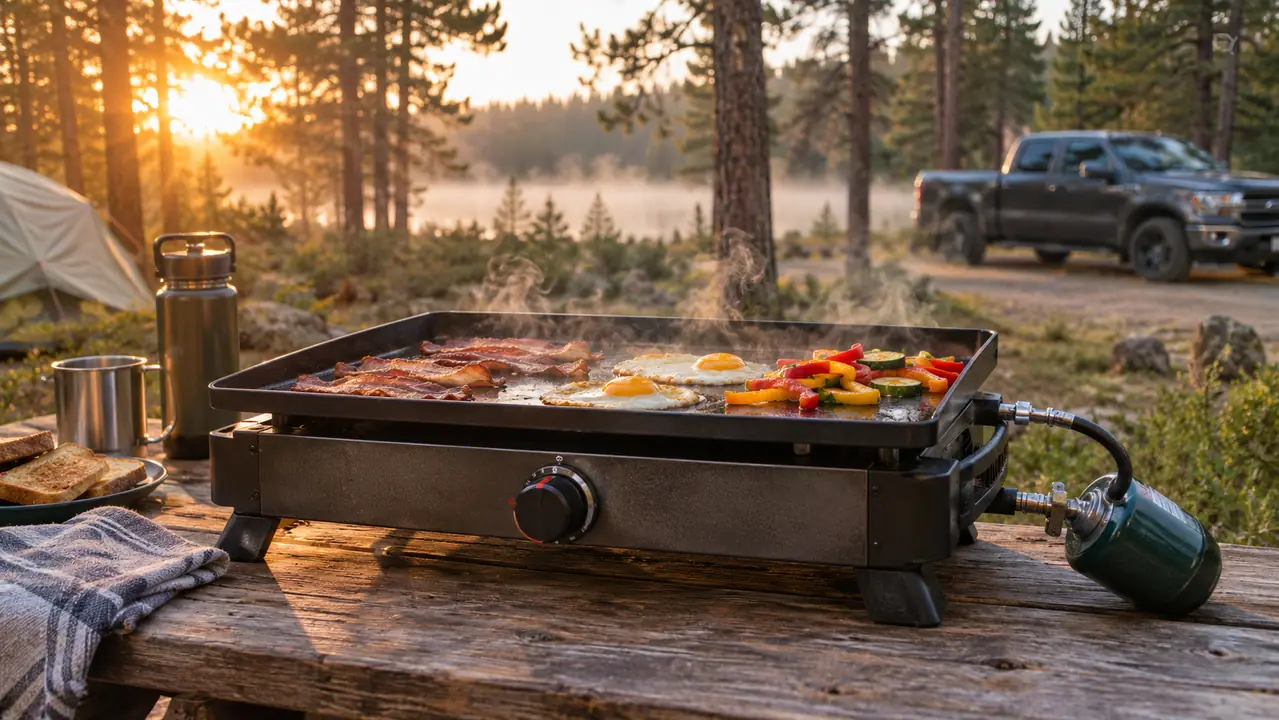
Camping is where it earns its keep. A camp stove and a skillet means one pan at a time and a lot of food going cold while you wait. With this, I do bacon on one end and eggs on the other, and the tortillas warm on the idle strip before anything else is ready. It runs off a propane bottle, the built in igniter has caught on the first click every time, and it has lit at forty degrees on a cold morning near Mount Hood without any coaxing. If you have ever fought a damp campfire at dawn, you understand why that matters more than any spec sheet.
The band cookout is where it shows its limits. I play bass in a cover group, and a few times a summer we feed eight or nine people. At 268 square inches that is two rounds of burgers with a plate of onions in between. It is fine, but it is not fast. I have learned to start the first round before anyone arrives, hold them in a pan, and cook the second round when people are actually hungry. If you want to feed a crowd in one pass, this is the wrong size, and I will say so again further down.
What 268 Square Inches Actually Cooks
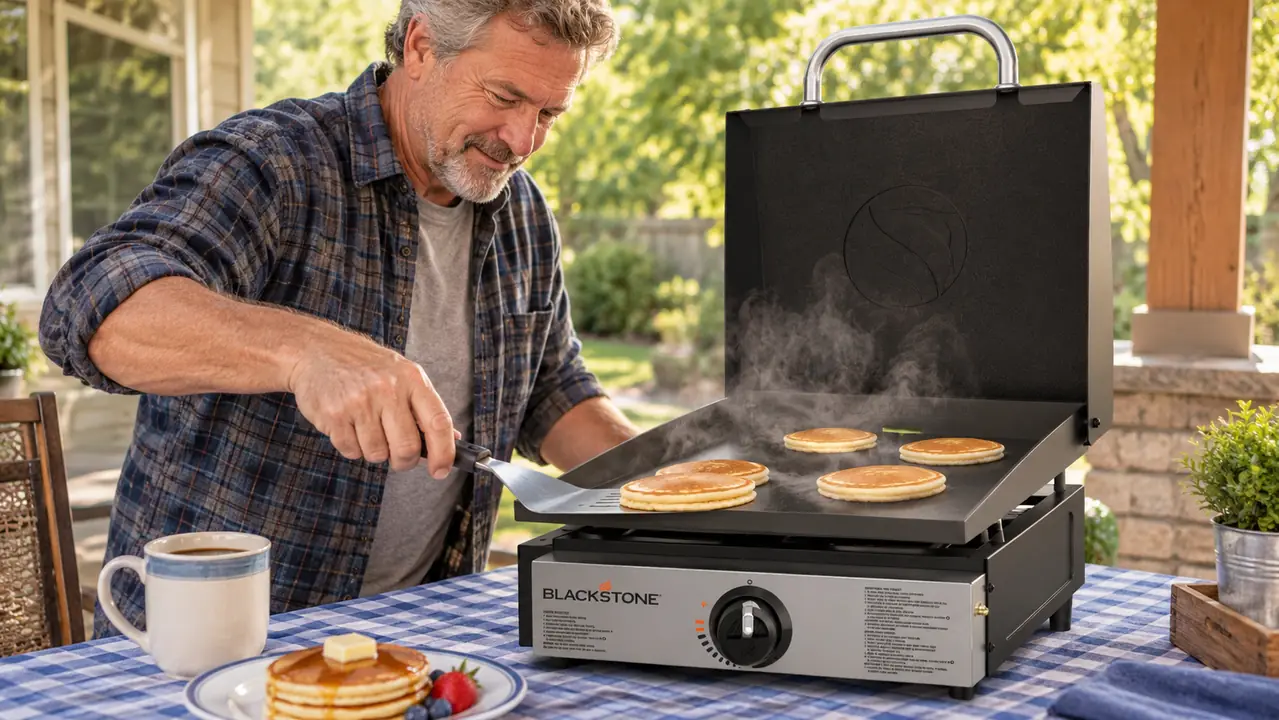
Two hundred sixty eight square inches is the number that decides everything else, and the listing claims nine burgers fit on it. Mine will take nine thin ones if I am careful with the spacing. What I actually cook is more useful to know. Six pancakes at a time with room to get a spatula under them. A dozen eggs scrambled in one pass if I keep the pile moving. Five smash burgers. A pound of hash browns spread thin so they crisp instead of steam. A full package of bacon in two batches. Two people eat well off this. Four people eat in shifts, which is fine if you plan for it. Six people and you are standing there for an hour.
The Blackstone's surface is flat and it stays flat, and that is the whole argument for a griddle over a pan at breakfast. Every pancake gets the same contact, the eggs do not run into a corner, and I can shove finished food to the side I am not using while the rest catches up. Nothing is fighting for space on a burner. It sounds like a small convenience until you have stood at a stove juggling three pans and a plate of toast that went cold four minutes ago.
A normal Sunday for us is six pancakes, a dozen eggs, and a pound of hash browns, and it all comes off in one pass with the tray never filling up. The grease tray is the quiet win here. It is a large one, and on a cook that size it does not need emptying until I am done and the plates are already on the table. I have owned small tabletop griddles where the tray was a mid cook interruption. This is not that.
The first cold morning I cooked on it, the whole thing behaved differently than I expected. I had it on a picnic table at a campground outside Tillamook, forty some degrees, a little mist, and the plate came up to heat in about six or seven minutes with the hood down. Pancakes that morning were as even as any I have made on the patio. I mention it because cold and damp is the normal condition for camping in this state, and a cooker that sulks in it is no good to me.
The Burner, the Igniter, and Heat You Can Actually Steer
Blackstone uses one H shaped burner under the plate and one control for it. That means one heat zone, not two. If you are coming from a two burner grill and expecting a hot side and a cool side, you are not going to get it, and you should know that before you buy. What you do get is a plate that heats evenly across the middle and a control that goes from a low light setting up to high without a dead spot in the middle. I run pancakes at about a third, burgers at three quarters, and bacon low so it renders out instead of scorching.
Wind is the real enemy, and this is where tabletop griddles in general struggle. On the coast, with a breeze coming off the water, the plate loses heat faster than the burner can replace it and my pancakes start taking twice as long. The hood helps as a windbreak if I stand it right, but it is a cover, not a windshield, and I have learned to pick the leeward side of the truck. On the patio, tucked under the cover, I have never had a problem.
Recovery time is the thing nobody mentions. Load a cold pound of bacon onto a hot plate and the surface drops, and you wait. That is true of every griddle at this size. The way around it is to cook in the order that suits the plate: bacon first because it gives up fat and takes a while, eggs last because they take two minutes. Once I stopped loading everything at once, my breakfasts got faster, not slower.
Six pancakes, a dozen eggs and a pound of hash browns come off this in one pass, and the grease tray has never needed emptying in the middle of a cook.
Two Years of Rain, Campgrounds, and One Bad Habit
Two years in, the Blackstone's stainless steel front plate and hood still look like they did the week I unboxed them. The body has scuffs from riding in the truck bed, which is what a body gets when it rides in a truck bed. Nothing has warped, no fastener has loosened, and the plate has stayed flat, which is the one thing I actually worried about. It weighs nine kilos, a bit under twenty pounds, so I carry it with two hands and I have never once thought it was too heavy to take along.
The propane bottle is the other thing to plan around. This runs on a small bottle, and a weekend of breakfasts does not come close to emptying it, but I carry a spare anyway, because running out at eight in the morning with a plate of raw eggs in front of you is a bad way to start a day. Nothing about the connection has failed or leaked in two years. I check it with soapy water at the start of every season, which is a habit left over from my charcoal days more than anything.
The bad habit is mine. Twice I have left it out overnight with grease still on the plate, once in a drizzle, and both times I paid for it with a scraping session and a re oil the next morning. A griddle rewards you for ten minutes of cleaning at the end of a cook and punishes you for skipping it. That is not a knock on this unit. It is how flat top cooking works, and if you are not willing to do the ten minutes, buy a grill instead.
The one thing I would change is the hood. It covers the plate for storage and travel, and it does that job, but it is not something I cook with closed, and it gets in the way when I am scraping the surface down. I would like a lid that stays exactly where I put it while I work. That is a small complaint about a cooker I use forty weekends a year, and it is the only one I have.
Setup, Cleanup, and the Grease Tray
Setup takes about five minutes once you have a routine. Level table, bottle on, control to high, click the igniter, hood down for a few minutes. I set the Blackstone on a sturdy folding table on the patio and on a picnic table at camp, and I check the level with a bottle of water before I cook, because a griddle that tilts sends the grease running to one end of the tray.
Cleanup is scrape, wipe, oil. I push the crumbs and the fat into the tray with a scraper while the plate is still warm, wipe it down with a rag and a little water, then run a thin coat of oil across the surface once it cools. Ten minutes, start to finish, and the tray lifts out for washing in a sink or a dishpan at camp. Do that every time and the plate stays slick instead of sticky.
For travel I let the plate cool completely, scrape it, oil it, and drop the hood. It rides in the truck bed on a moving blanket, with the bottle off and stowed separately. Packed, it takes up about the footprint of a mid sized cooler, which was the comparison that mattered to me when I was deciding whether it deserved the space on a camping trip. It did, and the camp stove has stayed home since.
What I Liked
- 268 square inches of flat cooking surface in something that fits in a car trunk
- Built in igniter lights on the first click, cold mornings included
- The H shaped burner holds an even heat across the middle of the plate
- A large grease tray that handles a full breakfast without a mid cook empty
- Nine kilos, so one person can move it and one person can carry it to a campsite table
Where It Falls Short
- One burner means one heat zone, so there is no hot side and cool side to work with
- 268 square inches feeds two to four people, not a crowd
- The hood covers the plate for storage but does not stay put while you scrape down
- A breeze off the water will beat it, as it beats most tabletop griddles
- The ten minute scrape and oil is not optional if you want the plate to last
Who This Is For
Two people who cook breakfast outside most weekends and want it done in one pass instead of three pans. Campers who are tired of one skillet at a time and have room in the truck for something about the size of a cooler. Anyone with a sturdy table, a spot out of the wind, and no interest in learning to manage two heat zones. It is also for the cook who wants to be outside with people instead of chained to a fire. That is the part I did not expect. I spend less time cooking and more time talking, and the food is better for it.
Who Should Skip It
Skip it if you regularly cook for six or more. You will spend the whole morning in rounds and the food will go out in waves. Skip it if you want a hot side and a cool side to work with, because there is one burner here and no way around that. Skip it if you are not going to clean it at the end of every cook, because a neglected flat top turns into a scraping job. And skip it if your only outdoor space is exposed and windy, since this thing needs a little shelter to hold heat on a breezy day.
For the two of you, on a Saturday morning, this is the whole setup
268 square inches, a built in igniter, and a grease tray that lasts the whole cook. It fits in a truck trunk, it lives on the patio table, and it has held up through two Oregon winters under a cover.
Amazon Check Today's Price on Amazon →