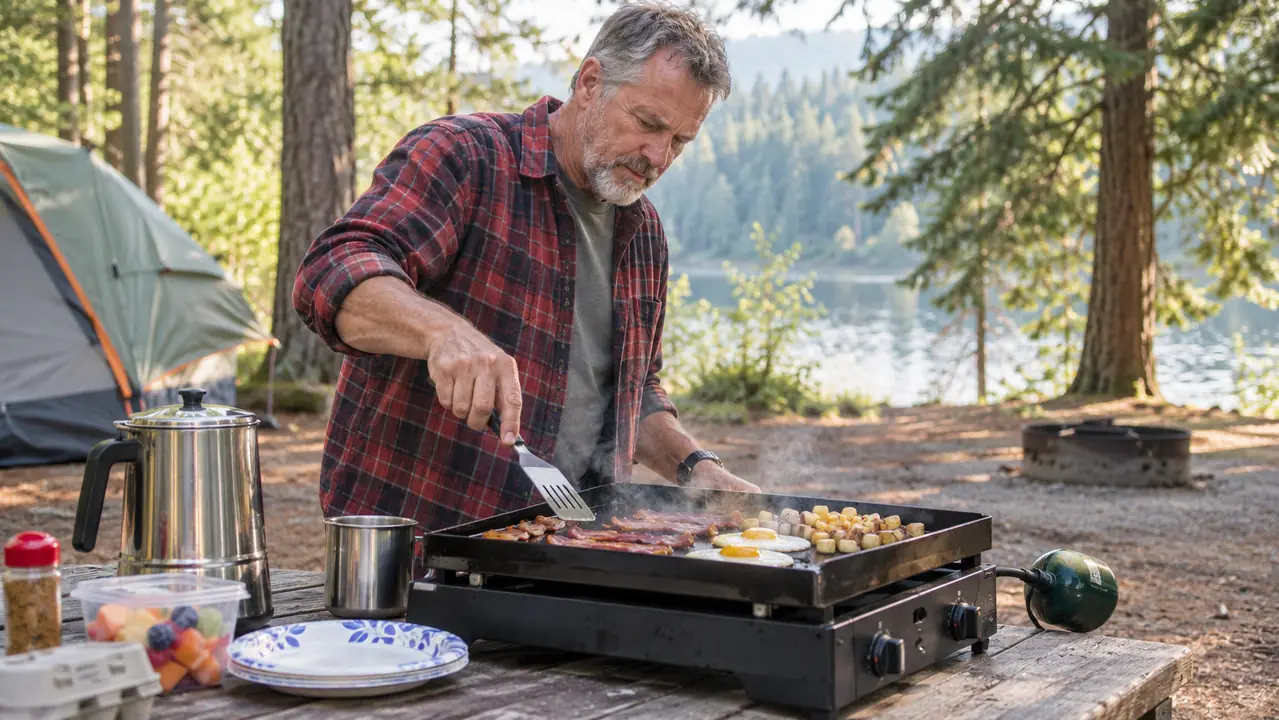
The first time I hauled a tabletop griddle to a tailgate, I brought the Blackstone 17 Inch. It rode behind the seat of my pickup, came out with one hand, and cooked breakfast for four before the coffee went cold. A buddy showed up with the Blackstone 22 Inch Tabletop Griddle, and by the time we scraped the last of the potatoes, I understood the choice. The 17 Inch is the one I would carry. The 22 Inch is the one I would leave on the patio. That is the short version.
If you cook for one to four people and you move the griddle, buy the Blackstone 17 Inch. If you cook for a crowd and the griddle lives on a sturdy table at home or at basecamp, the Blackstone 22 Inch Tabletop Griddle makes more sense. This is not a case where the bigger model is always better. The 17 Inch is smaller on purpose, and that purpose fits the way I cook most weekends. The 22 Inch is bigger on purpose too. Pick the purpose, not the spec sheet.
| Blackstone 17 Inch | Blackstone 22 Inch Tabletop | |
|---|---|---|
| Cooking surface | 268 sq. in., enough for about nine burgers at once | Larger 22-inch surface, better for a family cook |
| Portability | 9 kg and portable, fits in a truck or car trunk | Bigger footprint, so it is a stay-put choice for me |
| Footprint on the table | Listed at 21.7 by 20.5 by 14.7 inches | Needs more table depth and width for the larger surface |
| Heat control | Built-in igniter adjusts from light to high | Not scored here; I did not run a side-by-side heat test |
| Burner | H-style burner listed for even heat | No burner detail given here, so I will not guess |
| Grease management | Large-capacity tray, no mid-cook emptying for a normal breakfast | Not scored here; tray capacity is not given in my notes |
| Group cooking | Good for four, tight for more | The better choice for six or more |
| Camping and tailgating | Built for tailgating, camping, hiking, and trunk storage | Works at basecamp, but I would not want to load it alone |
| Best for | Couples, small families, campers who move it | Large families, patio breakfasts, group cooks |
Where the Blackstone 17 Inch Wins
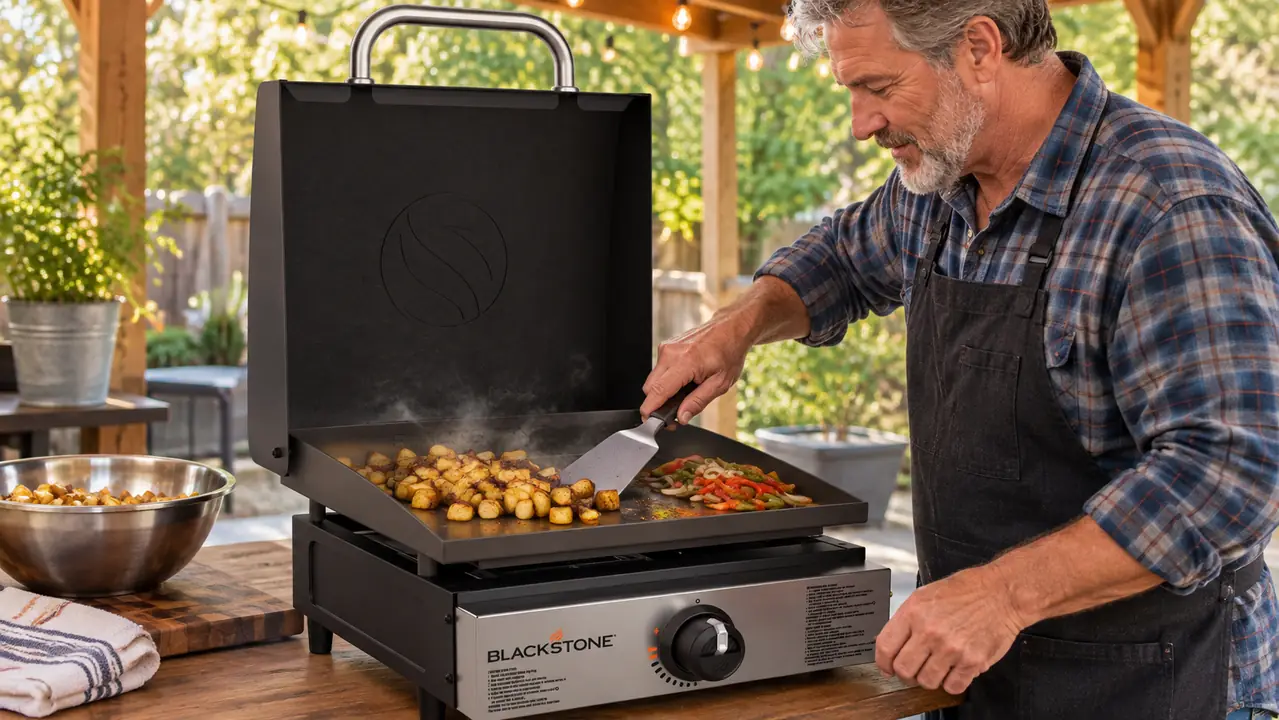
The 17 Inch wins on the thing that matters most to me: it goes where I go. The listing puts it at 9 kg, and I can carry it from the truck to a picnic table without asking Jo for help. The unit is listed at 21.7 by 20.5 by 14.7 inches, so it tucks behind a seat or onto a shelf in the garage. That is not a small thing when the alternative is leaving the griddle at home. A griddle that stays home does not cook breakfast.
The cooking surface is 268 square inches. Blackstone says that is enough for nine burgers, and I have done eight patties with a pile of onions without wishing for more room. For Jo and me, that is breakfast and dinner without a second batch. The H-style burner and built-in igniter give me control from light to high, so I can hold eggs at a low sizzle and then turn up the heat for potatoes. The large-capacity tray means I am not fighting grease halfway through.
The 17 Inch also wins on storage and setup. I keep it on a shelf with the propane tank beside it. I set it on the patio table, light it, and I am cooking in the time it takes to beat eggs. On a rainy Willamette Valley morning, that matters. I am under the patio cover, not running back and forth to the kitchen. The stainless steel front plate and hood have taken the bumps of a few seasons. The warranty is limited, so I keep the receipt, but I have not needed it.
Last October I tested that setup on a Tuesday when the rain came in sideways. I had the griddle on the patio table nearest the house, hood up, bacon going at a low setting. The wind pushed under the cover and the flame started hunting, so I turned the table ninety degrees and put my back to the gust. Fixed in about a minute. That is the whole advantage of a small griddle: you can move it by yourself, mid-cook, without a second set of hands. A 22-inch unit on the same table would have needed Jo, and she was inside making coffee.
The other thing I noticed is that the 17 Inch comes up to temperature quickly because there is less steel to bring along. I am not a competition cook and I do not own a thermal camera, so take that as an observation, not a measurement. What I can tell you is that I go from lighting the igniter to a ready surface in about the time it takes to set out plates and pour two mugs. On a morning when the band is loading gear into the truck bed, those few minutes are the difference between eating and skipping breakfast.
Where the Blackstone 22 Inch Wins
The 22 Inch wins when the griddle is not moving. The larger surface gives you more room for pancakes, eggs, hash browns, and the bacon that always seems to need its own corner. When the band and their families come over, the 17 Inch turns into a two-batch griddle. I can feed four from the 17 without much trouble. I cannot feed eight from it without making somebody wait. The 22-inch model is built for that kind of morning.
I learned that the hard way in July, when the band and their families came out to the house after a gig. Eleven people, two of them kids who wanted pancakes and nothing else. I had the 17 Inch going and a plate of finished food warming on the side table. The first four plates went out fast. Then I started parking pancakes on the cool half to keep them moving, and the cool half did not stay cool. I ran a second batch, then a third, and the last person ate about twenty minutes after the first. Nobody complained. That was on me for inviting eleven people to a four-person surface.
A 22-inch griddle would have taken that crowd in maybe two passes. That is the honest case for going bigger: not the spec sheet, the guest list. If your summers look like mine, with a band, their spouses, and a couple of kids who only eat pancakes, you will feel the smaller surface a few times a year. Whether that is worth more table space the other fifty weekends is the actual decision.
It also wins on the patio if you have a permanent table. A larger cooking surface means you can keep food warm on one side while you finish the next batch on the other. That is the real advantage, not the number on the box. If you are cooking for a family of five or more, the extra surface saves you from playing Tetris with pancakes. You still have to manage heat and grease. A bigger griddle does not fix bad habits.
The tradeoff is space and setup. A 22-inch tabletop griddle takes more table depth, more storage room, and more attention when you clean it. I would not want to load one into a truck bed alone for a weekend trip. If it lives under a patio cover and comes out for group breakfasts, that trade is easy. If it has to travel every time, the 17 Inch is the better tool. That is not a knock on the 22. It is the job it was built for.
The Griddle That Fits in the Truck and on the Shelf
The Blackstone 17 Inch is the model I reach for when the griddle has to travel, store small, and still cook a real breakfast for two to four. It has the 268 square inch surface, the H-style burner, and the built-in igniter I use every time.
Amazon See the Blackstone 17 Inch on Amazon →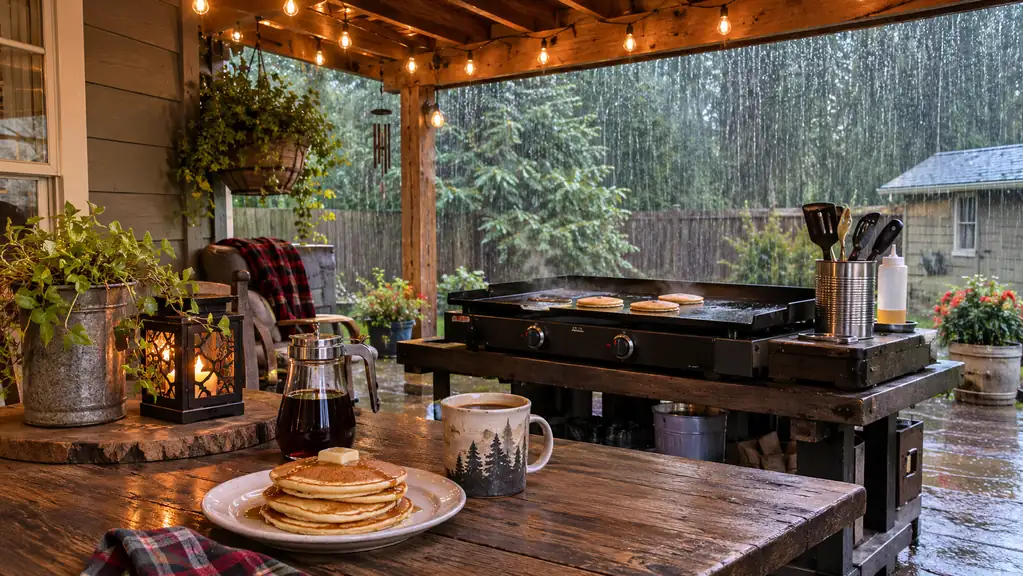
Who Should Buy Which
Buy the Blackstone 17 Inch if you cook for one to four people, if you camp or tailgate, or if your patio table is small. It is also the better choice if you have to carry the griddle up steps or store it on a shelf. I would buy it again for Jo and me. It does not feel like a compromise for a couple. It feels like the right size.
Buy the Blackstone 22 Inch Tabletop Griddle if you regularly cook for five or more, if the griddle stays on a sturdy patio table, or if you host group breakfasts. It gives you more surface for the food that needs to stay warm while you finish the next batch. If you have the room and the crowd, the larger surface earns its space.
If you are in between, be honest about the lifting and the storage. Most people overestimate how often they will move a big griddle and underestimate how much counter or table space it takes. The 17 Inch is not tiny, but it is small enough to live with. The 22 Inch is not huge, but it is big enough to become a permanent fixture. Choose the one that matches your real routine, not the one that looks better in a photo.
Measure the table before you buy either one. The 17 Inch is listed at 21.7 by 20.5 by 14.7 inches, and you need clearance for the hood and the front plate. The 22-inch model needs more room. I set mine on a concrete patio table with a lip, and I leave six inches behind it so the hood does not hit the wall. That is the kind of detail that decides whether you use a griddle or store it.
My patio table is 48 inches across, with a two-inch lip on the edge closest to the house. The 17 Inch sits with room to spare and still leaves a corner for the spatula and the bottle of oil. A 22 would cover most of it. That is worth knowing before you order, because a griddle that overhangs a table edge is a griddle waiting to tip. I measured the truck bed too: the 17 Inch slides in beside the cooler with the lid closed, and I do not have to unload anything to reach it.
Check the surface level. A tabletop griddle wants a flat, stable table. A wobbly picnic table makes uneven pancakes and pushes grease to one side. I carry a small level in the truck for campsite tables. It takes ten seconds and saves a breakfast. Also check the wind. A propane griddle on an exposed table in a coastal wind will fight you. I set up behind the truck or under the patio cover when I can.
Plan the cleanup before you cook. The 17 Inch has a large-capacity tray that does not need frequent emptying during a normal breakfast, but you still have to scrape the surface while it is warm. I keep a stiff scraper and a rag in a bucket. The stainless steel front plate and hood wipe down easily. The limited warranty is worth keeping in mind, so save the paperwork. None of this is hard. It is just easier when you set it up before the food comes out.
I keep the scraper, a wad of paper towels, and a squeeze bottle of oil in a plastic tote that lives next to the griddle. After breakfast I scrape into the tray while the surface is still hot, wipe it down with a paper towel held in tongs, and let it cool before the hood goes back on. That routine takes four minutes. When I skip it, I pay for it the next morning with a surface that has to be scrubbed. The tray holds a normal breakfast worth of bacon and sausage grease, so I empty it after it cools rather than in the middle of cooking.
Think about fuel and setup. The 17 Inch runs on propane, and the built-in igniter means I do not need a match. I keep a spare tank in the truck because a cold morning can burn through fuel faster than you expect. I also keep a small folding table in the truck for campsites where the picnic table is questionable. The griddle is portable, but the setup around it is what makes it easy. A five-minute prep saves a lot of cursing.
Think about the food you actually cook. If you are a pancake and eggs household, the 17 Inch has enough surface for a couple and a small family. If you are doing bacon for a crowd, the 22 Inch gives you more room to keep batches moving. I would rather have the smaller griddle and cook two batches than have a big griddle I leave at home. That is the whole decision in one sentence.
If the 17 Inch Matches Your Routine, Stop Comparing
For a couple, a small family, or a camper who moves the griddle, the Blackstone 17 Inch is the practical pick. It stores small, carries easy, and cooks a full breakfast on 268 square inches. Check it on Amazon and see if it fits your table.
Amazon Check the Blackstone 17 Inch on Amazon →