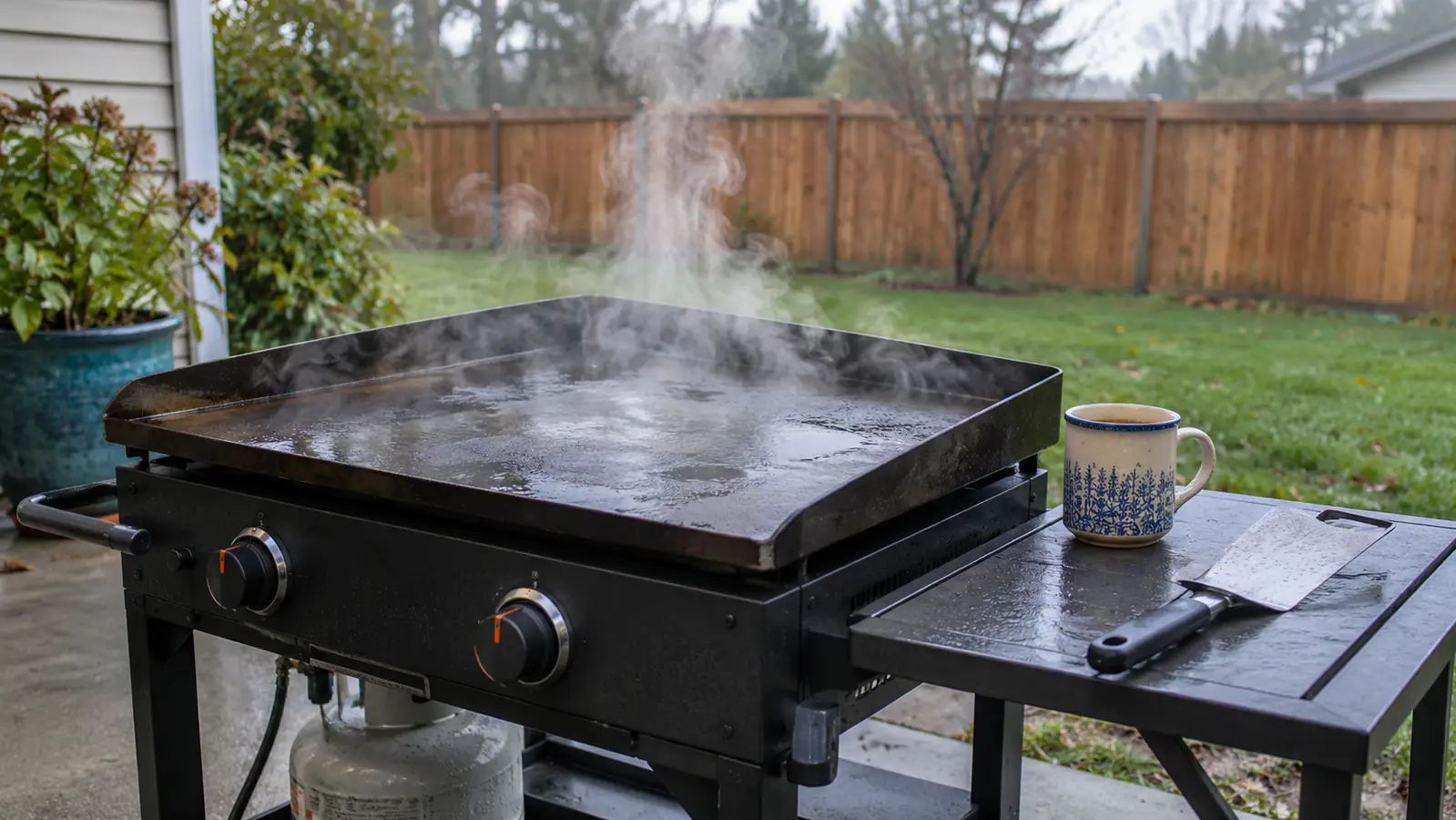
Breakfast is the one meal a grill is genuinely bad at. You learn that the first time you crack an egg over an open grate and watch half the white slide between the bars and hiss into the coals. I have cooked outdoors for about thirty years on a covered patio outside Salem, Oregon, and I have run the full routine more times than I care to count: charcoal chimney at six in the morning, cast iron over the coals, one hand on a spatula and the other on a squirt bottle. Then a friend rolled up for a band practice weekend with a Blackstone 1814 17 inch propane griddle in the back of his truck, and breakfast stopped being a job.
Here is the short version. A flat top gives you one continuous surface, heat you can actually control, and a tray that catches what a grill would drop into the fire. That combination changes the order of operations. You stop cooking breakfast in sequence, one thing at a time, while everyone else eats, and start cooking it all at once and sitting down with them. What follows are the ten reasons I reach for the griddle on a Saturday morning and leave the grill covered.
The One Piece of Gear That Lives on My Patio From March to October
The Blackstone 17 inch tabletop model is the unit I keep set up on the concrete pad, seasoned and ready, because setup takes about a minute. Check today's price and current stock on Amazon before your next camp trip.
Amazon Check Today's Price on Amazon →Eggs Stay Whole Because There Are No Grates to Fall Through
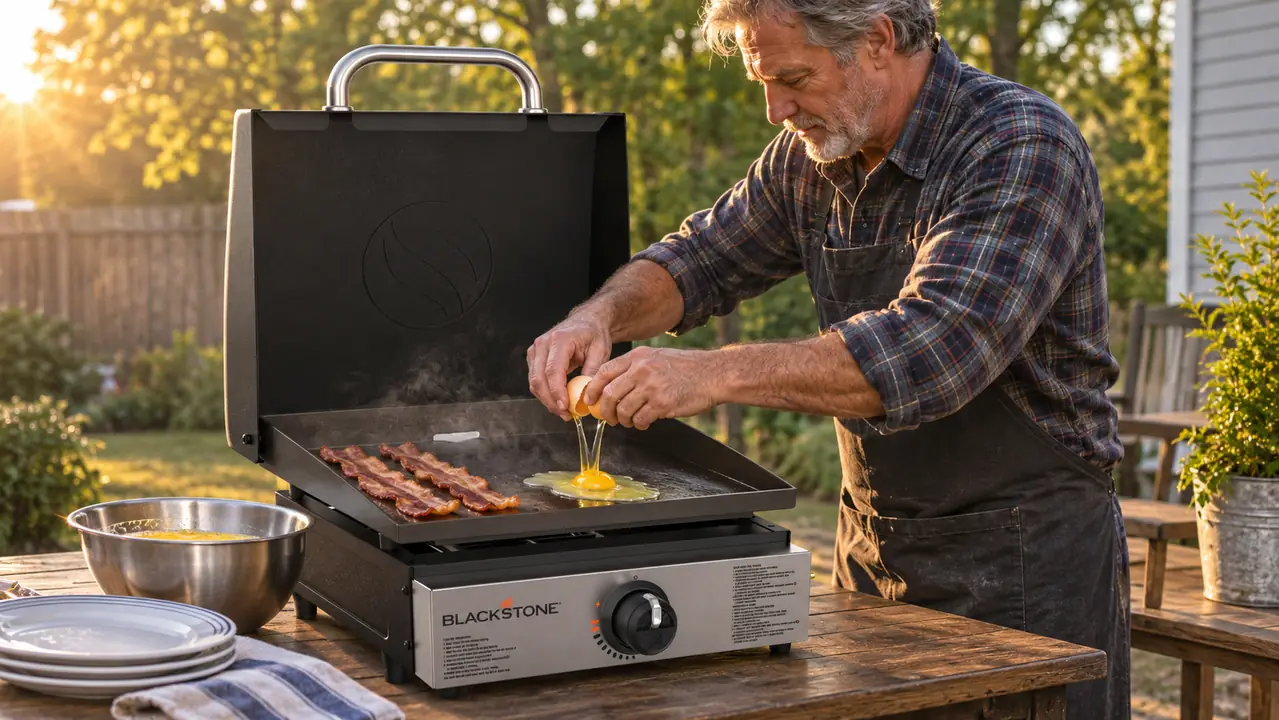
This is the reason that ends the argument. On a grill, an egg is a gamble. The white finds the gaps, the yolk slides off center, and you end up with something that looks like it lost a fight. On a flat surface you set the egg down and it stays where you put it. Six at a time, side by side, no rescue mission. Close the hood for a minute and the tops set without a flip. If you have ever handed a plate of broken yolks to guests, you already know what that is worth.
Bacon and Pancakes Cook Side by Side, Not in Sequence
On a grill, bacon goes first, then you wait, then you scrape, then maybe pancakes, and everybody eats at a different time. A griddle gives you zones. Bacon on the right where the fat renders and runs toward the tray, pancakes on the left where the heat is gentler. Both are working at once. I keep a stack of plates warming on the side and move food as it finishes. The whole meal hits the table together, which was the point of cooking for people in the first place.
268 Square Inches Holds a Full Breakfast for Six
The listing says 268 square inches and nine burgers at once. Translate that to the morning. That is roughly a dozen eggs, or eight pancakes plus a pound of bacon if you work in zones and keep the spatula moving. I cook for the band and their families a few times a summer, and this is the size that covers a crowd without turning my patio into a short order window. Bigger would cook more, but it would also eat the table, and I want that space back.
Hash Browns Get a Crust Instead of Sticking to a Grate
Potatoes are where grill cooking falls apart quietly. Shreds fall through, chunks stick, and what survives is steamed rather than browned. A flat steel surface with a thin film of oil gives you contact, and contact gives you crust. Press the potatoes down with the spatula, leave them alone for four or five minutes, flip once. Same story with the sliced leftover potatoes from the night before. It is a small thing that turns into a big thing when people at the table start asking who made the potatoes.
The Grease Tray Handles a Pound of Bacon Without a Fight
Grease on a grill means flare ups and a small fire you have to manage while you are also trying to cook. The front tray on this unit has enough capacity that I am not emptying it mid cook, which the listing calls out as a design goal. I keep an old metal cup nearby for the pour off once everything is done. Between that and a scraper, cleanup is a couple of minutes. Nothing about breakfast should involve a grease fire at seven in the morning.
No grates means no lost egg whites. And 268 square inches means nobody waits for a second batch.
The Built-In Igniter Means You Are Cooking in Ninety Seconds
The built-in igniter is not a luxury, it is the reason the thing gets used. No chimney to light, no coals to wait on, no fifteen minute warm up while guests stand around holding coffee. Turn the knob, hit the igniter, give the plate a few minutes to come up, and start. On a wet Willamette Valley morning that difference decides whether breakfast happens outside at all. A grill is for when you have time. This is for when you have people.
The H-Style Burner Stops the Hot Spot Shuffle
The burner under the plate runs in an H pattern, which the manufacturer says is there for even heat. What that means in practice is you are not rotating pancakes from the middle to the edges to keep them from scorching. There is still a cooler band near the front, and I use it on purpose to hold finished food. But the middle of the plate behaves like the middle of the plate. Fewer surprises, fewer burnt edges, and no hovering over the surface like you are defusing something.
It Fits in the Truck for Camp Mornings
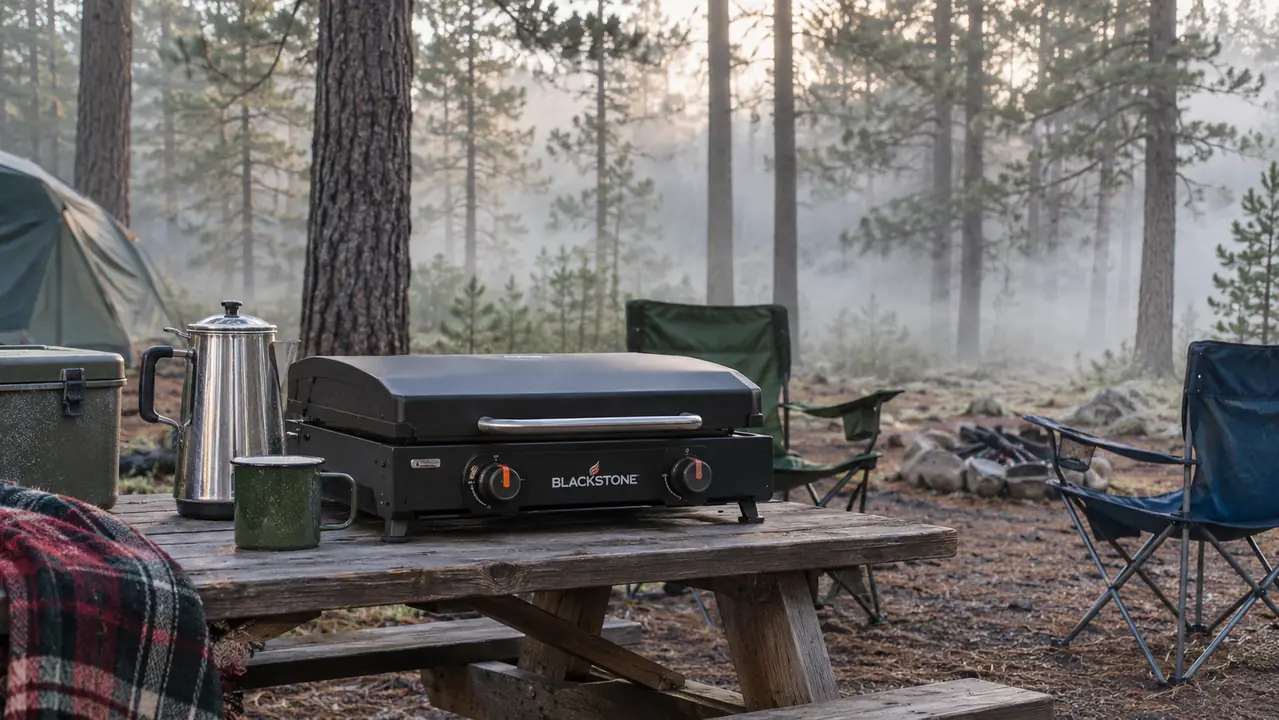
The whole unit weighs about nine kilos, roughly twenty pounds, and it drops into the truck bed next to the camp box without a second thought. That matters on the Oregon coast trips where the morning fog has everything damp and coaxing a fire to life has no appeal. Set it on a picnic table, hook up a small propane bottle, and breakfast is going while the coffee boils. It ships with a stainless steel front plate and hood, so it arrives as a finished unit and not a burner plus a plate.
The Hood Gives You a Windbreak and a Place to Finish
The hood earns its spot twice. Closed, it traps heat so egg tops set and cheese melts without a flip. Open, it blocks the crosswind that makes a grill behave unpredictably on a breezy patio. I also use the closed hood to hold a plate of finished pancakes warm while the last batch cooks. None of this is complicated. It is just the difference between equipment that fights the weather and equipment that ignores it.
Cleanup Is a Scrape and a Dump, Not a Chimney Wait
When breakfast ends on a grill you still have coals going and ash to deal with. Here the sequence is short. Scrape the plate toward the tray while it is still warm, dump the tray, wipe the surface with a rag and a little oil, shut the valve. Ten minutes and you are back inside. That low cost of cleanup is why the Blackstone gets used on a Tuesday and not just a Saturday. The best equipment is the equipment you will actually take out and set up.
What I'd Skip
Two things I would skip. First, I would not buy a larger tabletop griddle than this unless I routinely cook for ten or more. The 17 inch model covers six people comfortably, and anything bigger takes over the table and then lives in the garage. Second, I would skip the idea that a griddle replaces a grill. It does not. Steaks, chicken thighs, and anything that wants flame and char still belong over the grates, and I keep both. Where I would put the attention instead is the setup around the griddle: a folding table at the right height, a stack of plates within reach, and one dedicated spatula. Those three things do more for a breakfast than any upgrade to the unit itself.
Breakfast for Six, One Surface, Ten Minutes of Cleanup
The Blackstone 17 inch tabletop griddle is the piece of outdoor gear I use more than any other, and it is the one I would buy again first. Current price and stock are on Amazon.
Amazon Check Today's Price on Amazon →