
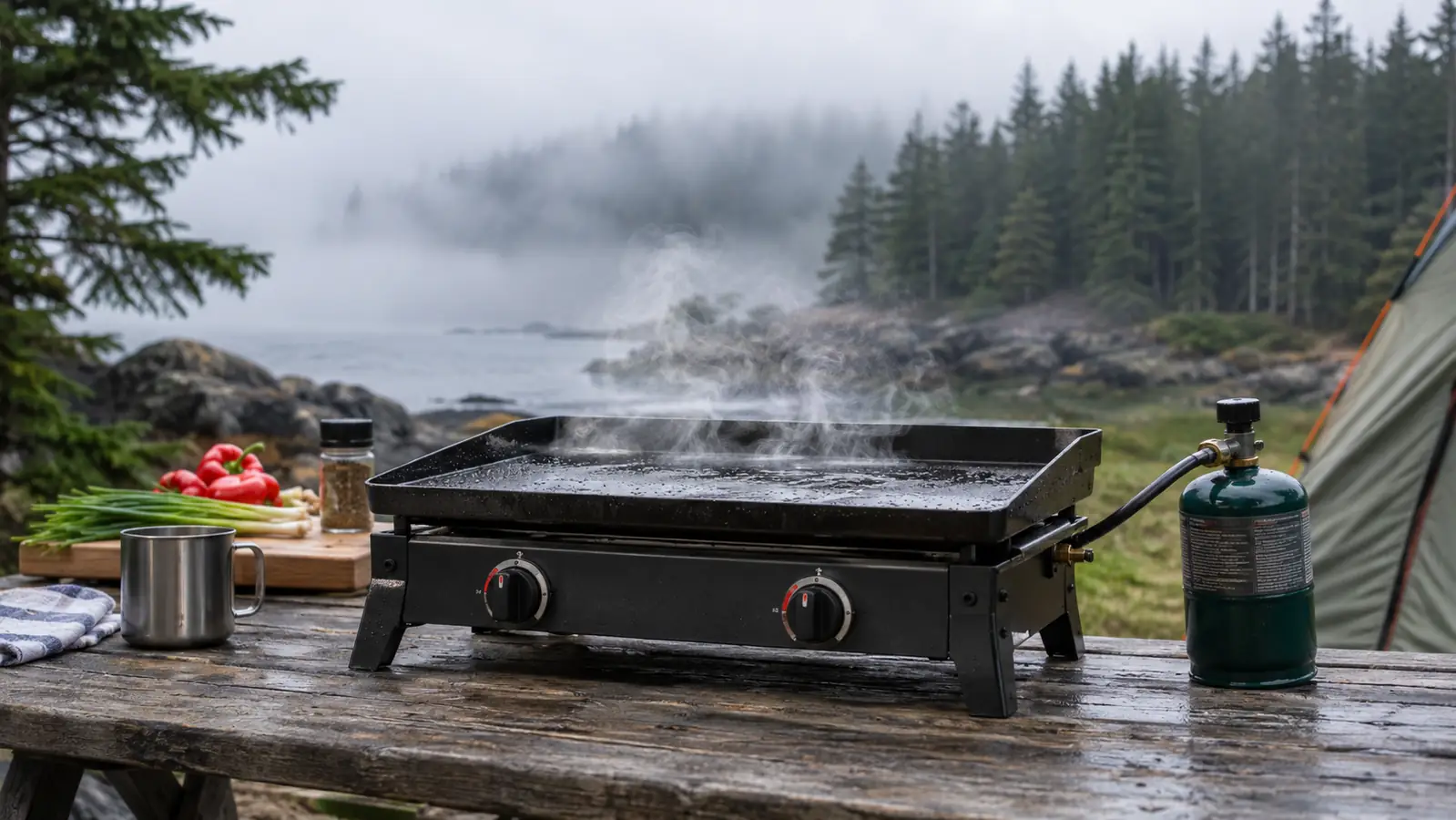
I bought the Blackstone 17 inch griddle for camping trips and assumed it would be a compromise. Two seasons later it sits under the cover on my back patio outside Salem, Oregon, and it comes out of the shed more often than the gas grill beside it. That is not the review I expected to write after I carried the box in with one hand and thought, this is going to be a toy.
Here is what nobody tells you before you buy one. This is not a small version of a full size flat top. It is a different tool with a different job, and most of the sour reviews I have read come from people who wanted the big one and bought this instead. Figure out which tool you actually need and the rest of the decision gets simple. I have cooked outdoors for roughly thirty years, I am not a competition cook, and I have nothing riding on whether you buy this. What follows is what I found after using it in sideways rain, in August heat, and at two campsites on the Oregon coast.
The Quick Verdict
A genuinely useful small flat top that feeds two to six people without drama, as long as you accept a 268 square inch surface and one flame you have to manage yourself.
Amazon Check Today's Price →Nine burgers of space and a nine kilo body. Check the numbers before you commit.
The cooking surface is the whole argument for this unit and the whole argument against it. If 268 square inches fits how you cook, everything else on the machine holds up. Current specs and today's price are on the listing.
Amazon Check Today's Price on Amazon →How I've Actually Used It
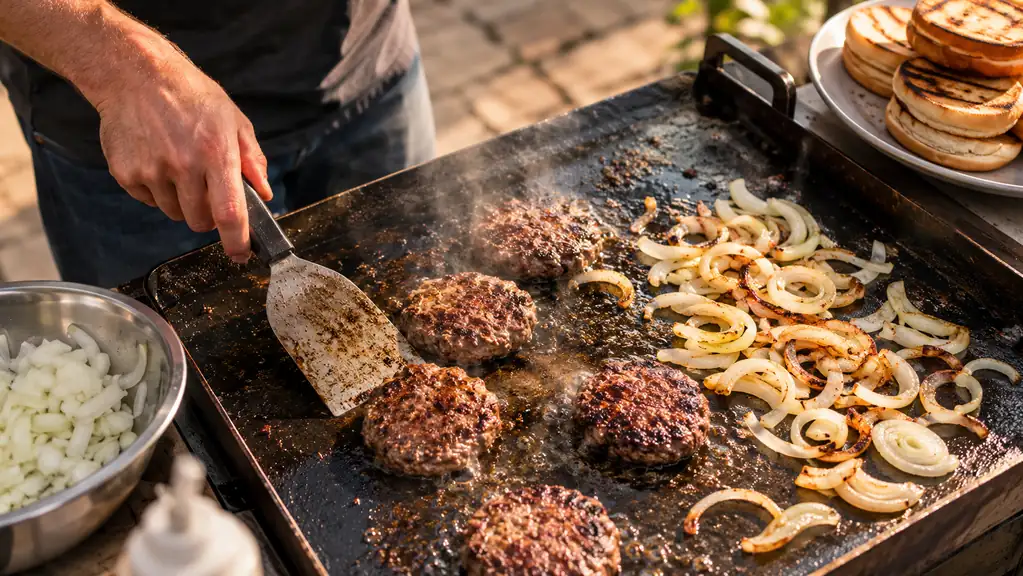
The first cook was a wet Tuesday in March. I set it on the concrete pad under the patio cover, lit it in the rain to see whether the built-in igniter would cooperate, and it caught on the first try. Eight burgers and a pile of sliced onions went on and came off in under twenty minutes. Jo stood at the door and asked why I had not been cooking on it all along. That is the honest answer to most griddle skepticism: the first cook is the argument, and everything after that is maintenance.
Since then it has done breakfast for the band and their families a few times each summer, which is the real test. Nine burgers is the listed capacity and I would call that accurate if you are not crowding them. Twelve people at a table means two rounds, and two rounds on a 268 square inch surface still beats standing around waiting for a single kettle grill to come up to heat. It also handles a pound of bacon and a dozen eggs in one pass, which is the kind of thing that makes a camping morning feel like a diner instead of a scramble. Nobody has complained about the food coming off this thing.
At the coast I set it on a picnic table with wind coming off the water and it held heat once it was up to temperature. That surprised me, because small propane units usually lose a fight with a coastal breeze. My read is that the burner sits close under the cook surface instead of throwing open flame at a thin grate, so there is less to blow around. I have no instrument to prove that. I know the eggs set instead of running to the low corner, and that is the measurement I care about.
The test I did not plan was a February night with the band over and the rain coming down hard enough that the patio cover was the only dry spot on the property. The griddle ran for two hours straight, refuelled once, and never faltered. Fifteen people ate in shifts. That night I stopped thinking of it as camping gear and started thinking of it as the second cooktop I never installed in the kitchen.
What Nobody Tells You About the Size
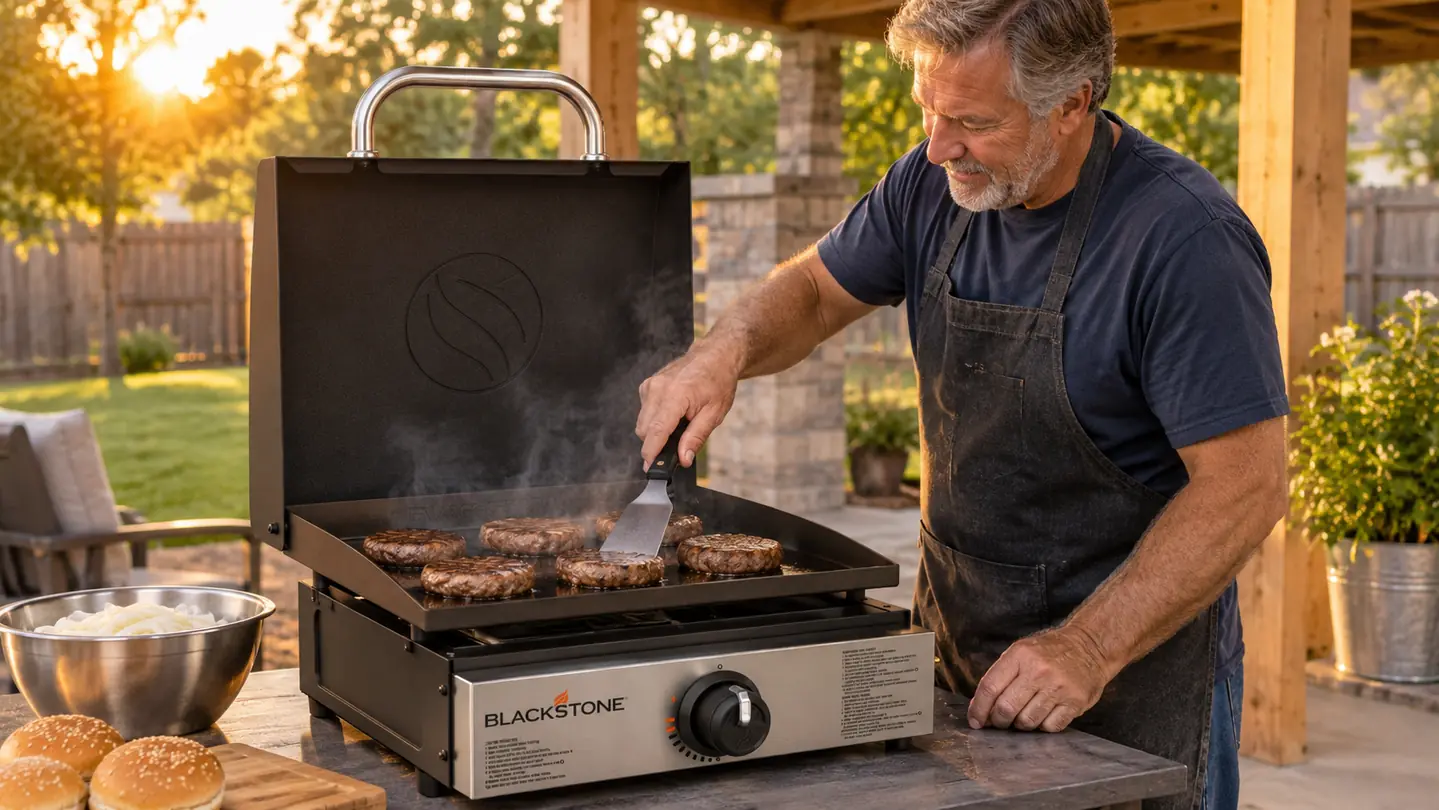
The listing says 268 square inches and I want to translate that into something you can feel. It is roughly the footprint of a large baking sheet. There is one flame to manage, so the whole surface moves together. I can push onions to the cooler edge and that is about the limit of the fine control. If you are the kind of cook who wants a hot side for searing and a low side for holding, this will frustrate you inside a week, and I would rather say so now than have you find out on a Sunday with eight people waiting.
Second thing nobody says out loud: 17 inches is small for a family of five who all want their burgers at the same time, and it is generous for two people eating a normal dinner. Jo and I use it for dinner more than we use the grill, because dinner for two on a 268 square inch surface feels roomy. The band cookouts are where it feels tight. Same machine, two different verdicts, and both of them are true.
Third: the footprint on a table matters as much as the cooking surface does. The unit measures 17.5 inches long, 18 inches wide and 8.5 inches tall, so it rides across the back seat of a pickup or sits in a trunk without a fight. It also eats most of a standard picnic table. If you are feeding people at a campsite, plan on that table being the griddle table and put the plates somewhere else entirely.
One more thing about the size that took me a while to appreciate. Because the surface is small, it heats through faster than a big unit does, which means the gap between deciding to cook and cooking is short. On a weeknight that matters more to me than capacity does. I would rather cook two quick rounds than wait on one slow one.
What I Liked
- 268 square inch surface holds nine burgers at once without crowding
- Built-in igniter caught on the first try, wet or dry
- H style burner held heat in a coastal breeze
- Large grease tray did not need emptying during a full cookout
- Nine kilos is light enough to carry from the truck with one hand
Where It Falls Short
- One flame for the whole surface, no hot side and hold side
- Tight for a family cookout, roomy for two to four
- Cook surface needs seasoning before the first meal
- No smoke and no char, so it does not replace a grill
Eight burgers, a pile of onions, and a machine I carried to the truck with one hand. That is the whole trade, and it is a good one if you cook for four instead of fourteen.
The Heat, and What It Will Not Do
The burner is laid out in an H under the plate, and the point of that shape is to push heat toward the corners instead of leaving a hot ring in the middle. In practice the center runs hottest and the outer two inches run cooler. That is normal for a flat top and it is useful once you know it. The cooler edges are where the buns go to toast, and where I park finished burgers while the cheese catches up.
The igniter is built in and the heat runs from light to high, so you are adjusting one flame instead of juggling burners. There is nothing to program and nothing to read. You learn the machine by cooking on it. My first batch of pancakes came out pale because I had the flame lower than I thought it was. The third batch was right, and I have not thought about it since.
What it will not do is behave like an oven. It is not going to hold a low temperature for three hours while you go do something else. I tried a pork shoulder on it once out of curiosity. It was edible and it was not good, and I have not repeated it. If low and slow is the goal, this is the wrong machine and no amount of technique fixes that. It is a hot surface, not a cooker with a door on it.
The Grease Tray and the Cleaning Nobody Mentions
The grease tray is genuinely large, and the claim that it does not need frequent emptying held through a full band cookout. That is the most annoying part of most small griddles and Blackstone got this one right. I emptied it once, at the end, with a spatula and a paper towel. On a wet night that is the difference between cleaning up and putting it off until morning, and putting it off is how these things die.
Cleaning is the part the videos skip. A flat top is not a grill grate you brush and walk away from. You scrape it hot, wipe it while it is still warm, and put a thin coat of oil back on before you cover it. Call it five minutes. Do that and the surface stays slick. Skip it for a couple of weeks in a wet Oregon spring and you will be re seasoning a surface that should not have needed it, which is a forty minute job you gave yourself for no reason.
The stainless front plate wipes down with the same rag. Small thing, and it makes the machine look cared for even when the rest of my patio does not.
Weight, Setup, and Living With It
The Blackstone 17 weighs nine kilos, a hair under twenty pounds. That is portable in the sense that one person carries it from the truck to a picnic table without help, and it is not portable in the sense that you want to carry it any distance. I have hauled it maybe forty feet from the truck bed to a table at a coastal campground and that was plenty. For a tailgate or a patio it is a non issue. For anything involving walking, bring a cart or bring a friend.
Setup takes about two minutes. Propane, a light, a few minutes to come up to heat. I have done it in the dark with a headlamp and did not need the manual. The limited warranty is standard for the category and I have not had to use it. Two seasons in, no failed igniter, no warped surface, no trouble at the connection. That is a boring reliability report, which is exactly what you want from a propane appliance.
Where It Falls Short
The honest complaints are about capacity and control, and they are the same complaints every time. Nine burgers sounds like a lot until nine people are standing there with plates. There is one flame, so when the bacon is finished and the eggs are not, you are moving food to a plate and covering it. A larger unit with more than one burner solves both problems and costs you the trunk space and the one handed carry. That is the trade, and I would make it again for my patio.
The other thing is char. There is no char on a flat top. You get an even crust on a burger and you do not get grill marks or smoke, and if the smell of a fire is half of why you cook outside, this will leave you cold. I keep both. The griddle does breakfast, burgers, onions and tortillas. The grill does anything that wants flame. Anyone who tells you one replaces the other is selling something.
If your cooks are bigger than this machine, look at the larger tabletop units before you buy. A friend has a 22 inch and it is the same idea with more surface. The honest trade is two hands to carry and a bigger table to set it on. It is a real fork in the road and I would not want to talk anyone into the smaller unit who needed the larger one.
Two Seasons In: What Held Up
Two seasons is not a decade, but it is enough to see what a propane appliance is going to do. The plate has stayed flat. The igniter has not needed a second try since that first wet March. The tray has not leaked. The front plate has a couple of scratches from a scraper and that is cosmetic. I have not touched the warranty and I would be surprised if I do.
What wore off first was the novelty, and that is a compliment. For the first month I cooked on it four nights a week because it was new. Now I cook on it because it is the fastest route to dinner on a weeknight, and speed is the thing I did not expect from a camping purchase. The grill takes twelve minutes to be ready. This takes four or five. On a Tuesday in February under a covered patio, that difference decides what we eat.
Who This Is For
This is for the person who cooks for two to four most nights and wants to be outside while it happens. It is for the camper with a pickup and a picnic table, and for the tailgater who wants breakfast at nine in the morning without tending a fire. It is for anyone who has watched a flat top video and wanted that crust on a burger without buying a big multi burner unit that ends up in the garage because it is too heavy to move. If you are in that group, the Blackstone 17 does the job without much fuss, and the 268 square inch surface is the number that decides whether you are in that group.
It also suits a small patio. I have a concrete pad under a cover and about eight feet of clearance. That is all this needs, and a 2024 model with a stainless front plate and a limited warranty is a simple enough machine that there is not much on it to break.
Who Should Skip It
Skip it if you regularly cook for more than six people. Skip it if you want two independent heat zones, because there is one flame here and no way around that. Skip it if you want smoke and char, which I have already covered at length. Skip it if you want to set a temperature and walk away, because you will be standing there with a spatula and that is the entire point of the machine. And skip it if you are not going to scrape and oil it after a cook, because an unmaintained flat top turns into a chore faster than any grill I have owned.
If you cook for four and want to stay outside, this is the one to look at.
Two seasons, no failures, and one honest limitation: it is small. Current specs and today's price are on the listing, and the 17 inch surface is the number that decides whether it fits your table.
Amazon Check Today's Price on Amazon →