Here is the short answer before the long one. The Weber Rapidfire is the chimney starter I reach for, and the Kingsford is the one I keep as a spare. Both light a load of charcoal without lighter fluid. Both are a metal tube with a handle. Neither one will ruin your cook. The Rapidfire is built better, lights faster with nothing but newspaper, and has a handle you can grab bare-handed while the body is still hot. The Kingsford costs less, weighs less, and is on the shelf at the grocery store when you forgot to plan. Light charcoal most weekends and the Weber earns its keep. Light it four times a year at a campsite and the Kingsford is fine.
I have cooked outdoors for about thirty years, the last stretch of it on a covered patio with a concrete pad outside Salem, Oregon. I am not a competition cook and I do not pretend to be one. I cook for the band and their families a few times a summer, and I keep a kettle going through the wet months because the patio cover makes that possible. What I want from a chimney starter has not changed in three decades: coals ready in about fifteen minutes, no kneeling in the rain, and a handle that does not teach me a lesson. That is the whole test. The cook that made me picky about this was a July evening two summers back. Twelve people coming, two kettles going, and I had promised ribs that needed a steady low fire for four hours. I walked out at twenty to four to start the first chimney, got distracted moving a folding table, and came back six minutes later to a cold tube with a dead curl of newspaper in the bottom. No flame, no smoke, nothing. That cost me twenty minutes and put the whole meal behind. Fourteen dollars of tool, and it had just spent my evening for me. I have not owned a starter since that did not light on the first match.
| Weber Rapidfire | Kingsford Chimney Starter | |
|---|---|---|
| Bottom grate | Cone-shaped grate that leaves a pocket for paper and pulls air up through the middle of the load | Flat wire grid, coals sit level on top of it |
| Body material | Alloy steel, feels solid when you pick it up | Lighter steel, feels thinner in the hand |
| Handle | Plastic handle shaped to fit a hand, still usable while the body is hot | Simple loop handle that warms up fast on a full load |
| Cost | More | Less |
| Carrying it around | Heavier, you notice the walk out to the pad | Light enough to toss in a truck bed with the rest of the camp gear |
| Finding one | Hardware stores and grill shops | Almost anywhere, including the grocery store |
| Size | 7.5 inches across and 12.5 inches tall | Comparable footprint, holds a similar load |
| Cleaning out ash | Coals burn down through the cone, some caking if it sits out damp | Flat grid scrapes clean with a putty knife in seconds |
| Best for | Cooks lighting a kettle or barrel grill most weekends, year round | Campers and anyone who wants a second starter that works |
Where the Weber Rapidfire Wins
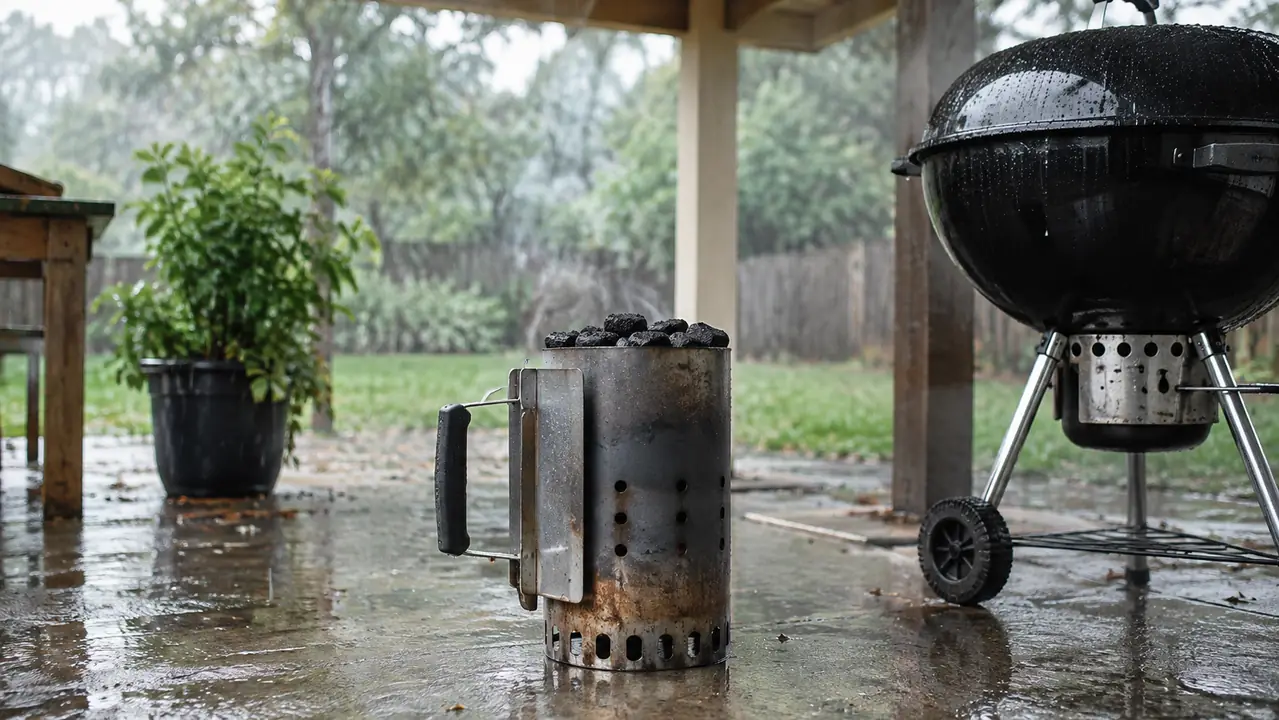
The cone is the whole thing. Most chimney starters put a flat grid at the bottom and the coals sit level on top of it, which works, but the fire has to spread sideways from wherever the paper happens to catch. The Rapidfire has a cone-shaped grate, so you stuff newspaper or a starter cube into the pocket underneath and the flame comes straight up through the middle of the load. Air moves up the center, the bottom coals light first, then the ones above them, evenly. The second November I owned it I lit it in a sideways drizzle with two sheets of newsprint and a paper towel, and it came up clean while water was beading on the outside of the tube. I have never had to relight this one. Not once in five years, and I am the man who killed a chimney with a folding table.
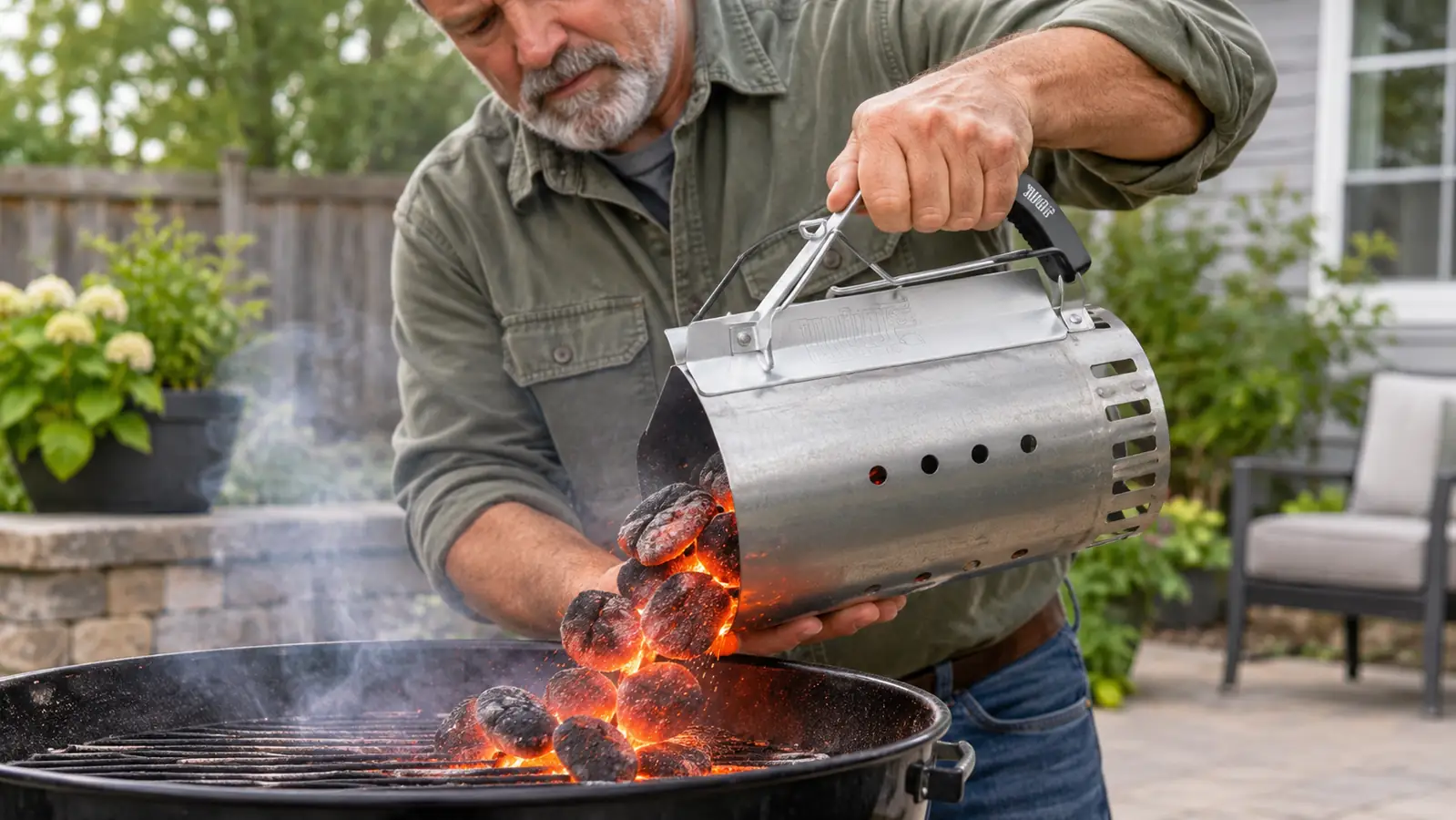
The second thing is the handle. It is plastic, it is shaped to fit a hand, and it stays usable long enough to carry a full load of burning coals from the pad to the grill without a glove. That sounds like a small detail until you have owned a starter with a bare metal loop and done the hot-potato walk across a wet patio. The body is alloy steel and it has held up. Mine has been rained on, left out overnight more than once, and scraped out with a putty knife, and the only thing that has changed is the soot.
I have lit this one in a sideways drizzle with two sheets of newsprint and a paper towel, and I have never had to relight it once in five years.
Where the Kingsford Wins
The Kingsford wins on the thing that decides a lot of purchases: it costs less. If you are outfitting a campsite, or buying a starter for a rental cabin where it might walk off, that matters and I am not going to pretend it does not. It is also the one you can find almost anywhere. I have bought one at a grocery store on the way to a cookout because I left mine sitting on the patio, and that kind of availability is worth something real.
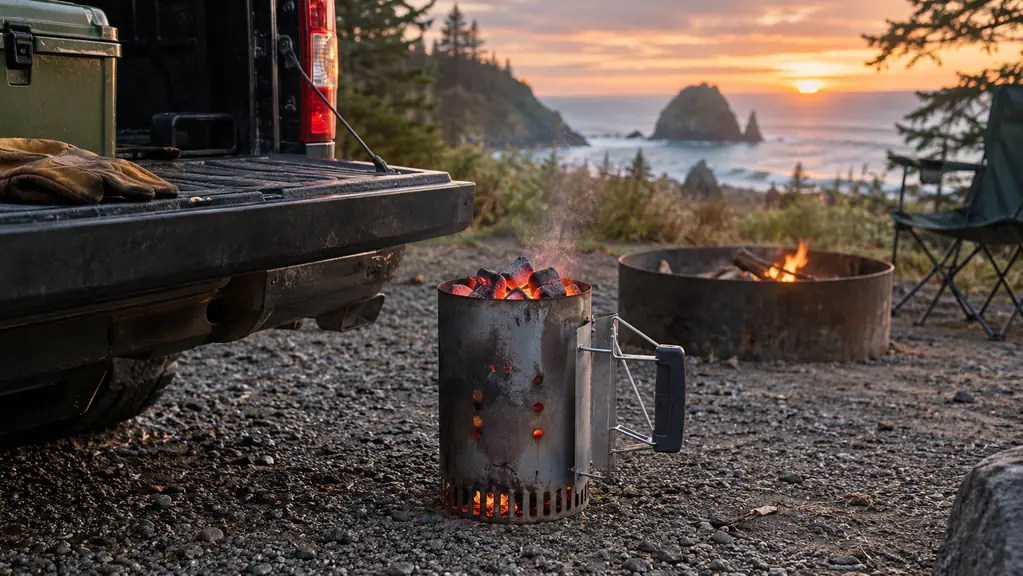
It is lighter, too. My camping trips are a couple a year, one to the coast and one up into the Cascades, and everything goes in the truck bed. A lighter chimney is easier to throw in with the rest of the gear and easier to carry out to a fire ring. The flat grid at the bottom scrapes clean in about ten seconds with the back of a putty knife, which is more than I can say for the cone once ash has baked onto it. And if you light with a starter cube instead of newspaper, the lighting gap between these two narrows quite a bit. A cube burns steady for several minutes and does not care much where it sits. Most of the cone advantage is really an advantage with loose paper, and paper is what I use, so that is worth saying plainly.
The one I would buy again for the patio
The Weber Rapidfire lights a full chimney with newspaper and a match, and the handle is still grabbable when the coals are ready to dump.
Amazon Check Today's Price on Amazon →How the Two Actually Light
Both starters light the same way in principle: load charcoal into the tube, put your fire starter underneath, light it, wait. The difference is how much babysitting the wait takes. With the Rapidfire I tear two pages out of the local paper, wad them loose, tuck them into the cone pocket, and light the bottom edge. The draft does the rest. I set a timer, go inside, and come back to coals that are gray at the edges and orange in the middle. With the flat-grid starter I have to be more careful about where the paper goes, because if it burns down before the coals above it catch, the whole thing stalls and you start over. That is the folding table story again, and it is the reason I stopped buying the cheap ones for the patio.
Timing matters more than people think. Coals that sit in the chimney too long burn hot and fast and are half spent by the time they hit the grill. Coals dumped too early smoke and smolder and you end up with a fire that never comes up to temperature. I aim for the point where the top layer has just started to go gray and the bottom is fully lit. That is roughly fifteen minutes with either starter on a dry day and closer to twenty in damp weather. The Rapidfire gets there more consistently because the fire is not fighting the geometry of a flat grid. On a wet afternoon in February I have had the Kingsford take closer to twenty five, and I stood there the whole time with a flashlight because it was dark by five. That is not a reason to hate the tool. It is a reason to know what you are buying.
Wind is the other variable. On the patio the cover helps, but at a campsite the starter sits out in the open and a flat-grid chimney will gutter if the wind crosses the bottom and blows the paper out from under the load. The cone pocket gives the burning paper a recess to sit in, which helps more than you would guess. It is a small design difference that shows up on the days you least want to fuss with a fire, and it is part of why I take the heavier one to the coast. The other part is that coastal wind in Oregon does not negotiate. You either have a starter that can hold a flame in it or you eat cold sandwiches and act like that was the plan.
What I Liked
- Cone grate lights fast and even on nothing but newspaper
- Plastic handle stays usable while the body is still hot
- Alloy steel body shrugs off rain, heat and repeated scraping
- 7.5 inches across sits stable on a kettle grate
Where It Falls Short
- Heavier than the Kingsford, and you feel it carrying it out
- Costs more than the budget option
- Ash cakes into the cone if you leave it out in damp weather
Build, Handle, and Ash
The Rapidfire is 7.5 inches across and about 12.5 inches tall, so it holds a full load and still sits stable when you set it down. Alloy steel body, plastic handle, cone-shaped grate at the bottom. There is nothing adjustable on it and nothing to break. The one maintenance note I have is that ash cakes into the cone if the thing sits out in damp weather, so I knock it out with a putty knife while it is still warm instead of waiting until spring. I learned that the hard way. One year I left it out from October to March under the eaves, and by the time I picked it up the cone had a crust on it like a calzone and I had to soak it in a bucket of warm water overnight before it would come clean. Twenty minutes of annoyance for thirty seconds of work I skipped. A chimney starter only really fails one way, and that is a handle that comes loose, which has not happened here.
The Kingsford weakness is the same as its strength. Thin, light steel is easy to carry and easy to dent. Mine has a small bend in the body from a tumble out of the truck bed on the way home from the coast. The bend has not hurt anything, but it is the sort of thing that eventually cracks a seam. Treat it like a tool and store it under cover and it will last years. Leave it outside in the rain and it will not last as long as the Weber. That is the honest trade for the lighter weight. I keep mine in the camping tote now, upside down, with a rag stuffed in the bottom so it does not rattle against the stove. That one habit has done more for its lifespan than anything else I have tried.
Who Should Buy Which
Buy the Weber Rapidfire if you light charcoal most weekends, if you cook through the wet months, or if you have ever done the hot-potato walk with a bare metal handle and would rather not repeat it. It makes a fifteen-minute job feel like nothing, and after thirty years of lighting fires I have stopped being interested in tools that make a simple job fussy. It is also the one I would hand to somebody who has never used a chimney before, because the cone forgives a sloppy newspaper wad, and a beginner's first chimney should not be the thing that discourages them.
Buy the Kingsford if you light charcoal a handful of times a season, if the starter lives in a tote with the camping gear, or if you want a second chimney so you can run two loads back to back for a big cook. It lights coals. It just asks a little more of you in the process, and for a few cooks a year that is a fair ask. Either way, skip the lighter fluid. That argument is settled in my book, and there is a longer case for it on the site.
Coals in fifteen minutes, handle still grabbable
The Weber Rapidfire is the chimney that lives on my patio. Load it, light the paper, and go sit down with your guests.
Amazon Check Today's Price on Amazon →