For most of my thirties I lit charcoal with a squeeze bottle of lighter fluid and a match, and I assumed that was simply how a fire got started. Then a friend carried a chimney starter to a band cookout, poured coals into my grill in one motion, and I felt a little foolish standing there holding my jug. I have had a Weber Rapidfire on the patio ever since, through wet Willamette Valley winters and a few camping trips out to the coast.
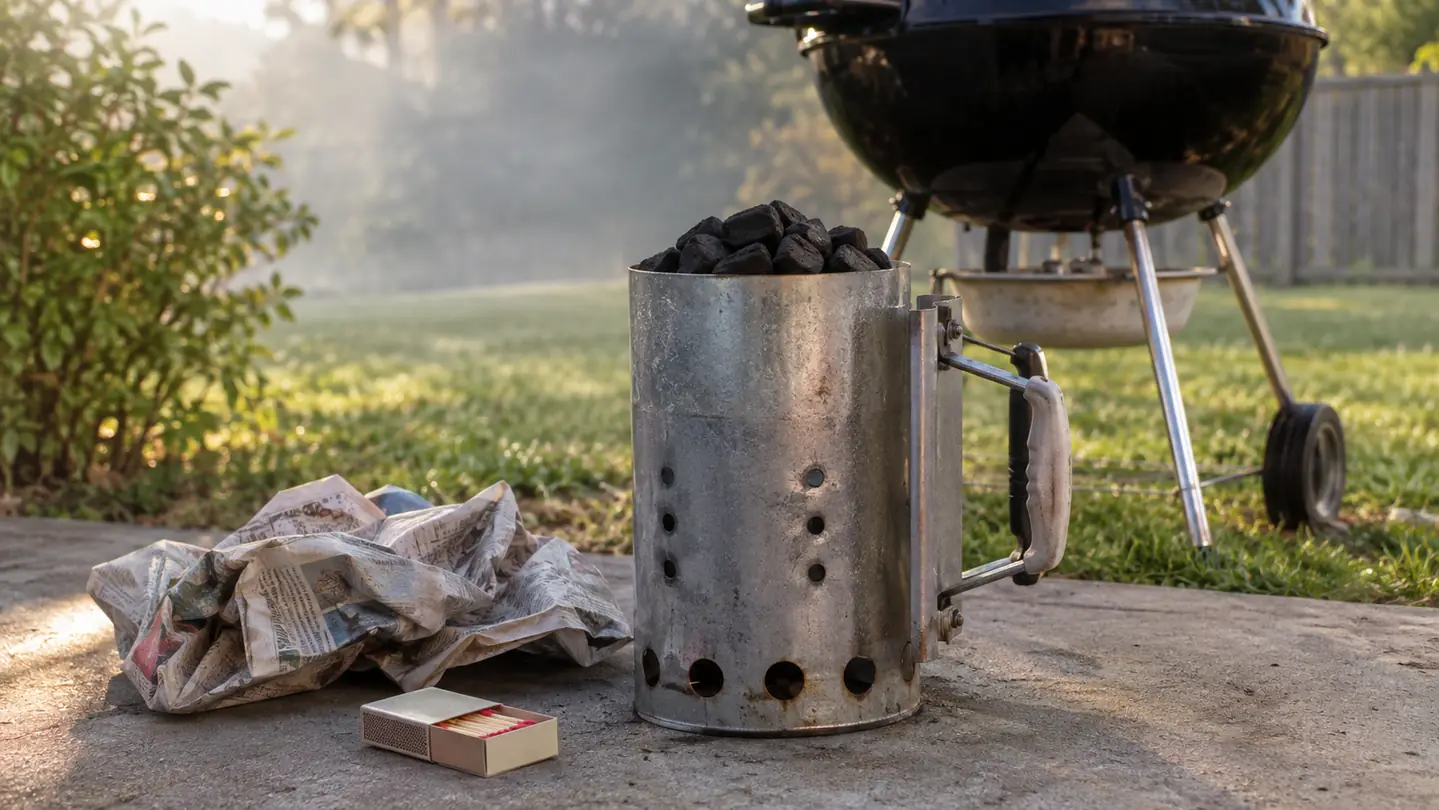
Here is the case for it, and it is not complicated. A chimney starter is a steel tube with a grate near the bottom. You load charcoal on top of the grate, light a couple of sheets of newspaper underneath, and the draft carries the flame up through the pile. No fluid, no soaking, no standing around deciding whether the briquettes took. Ten reasons that matters, in the order I would explain it to somebody in my driveway.
One load of charcoal, one match, and you stop buying the can
The Weber Rapidfire holds a full load of charcoal on a specialized cone-shaped grate and gives you ashed-over coals in about the time it takes to set the table. Steel body, plastic handle, 7.5 inches across.
Amazon Check Today's Price on Amazon →Your food stops tasting like the fuel
Lighter fluid does not burn clean. It soaks into the briquettes, and whatever has not cooked off by the time you spread the coals ends up sitting under your dinner. Most people never notice until they cook the same meal on a chimney-lit bed and wonder why it tastes better. The difference is not subtle on chicken. With a chimney there is no solvent anywhere in the chain, so there is nothing to burn off and nothing to wait out.
You can see when the coals are ready instead of guessing
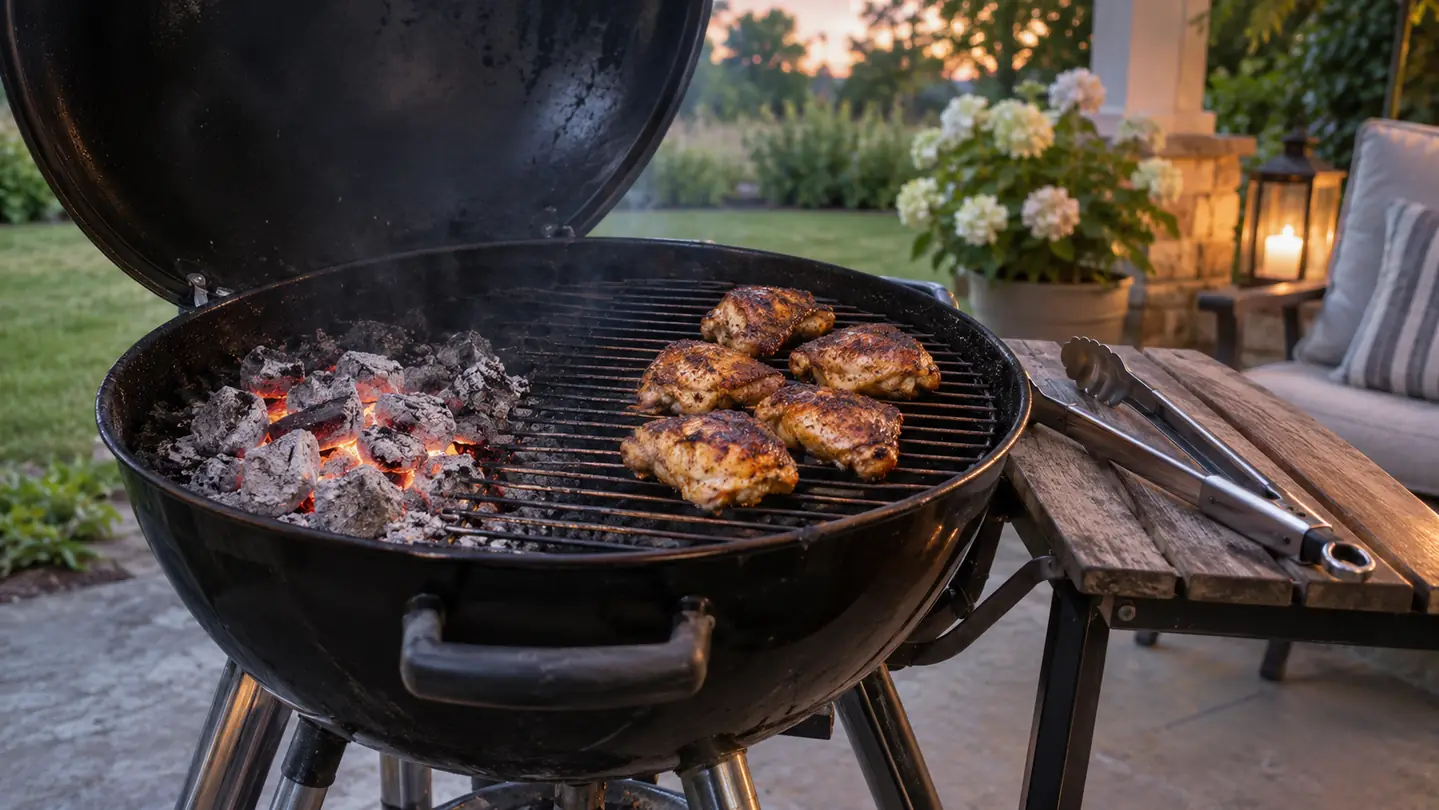
Every fluid cook I know works on a squirt and a hunch. You soak, you wait, you touch one with your glove, you spread too early or too late. A chimney gives you a readable signal. The coals at the top go gray and ashed over while the ones below are still black, and when the top layer is gray, you pour. Twenty minutes or so on a mild day, depending on the charcoal. It is a look rather than a guess, and a look is more reliable.
No flare-up the second the coals hit the grate
Freshly soaked briquettes carry solvent into the firebox. When they heat, that solvent flashes and the flames come up over the grate, right about where your hands are. I have singed a knuckle or two to this. A chimney load has nothing in it but charcoal and heat by the time you pour, so it lands flat. Fat hitting coals will still give you a small flare, and that is normal. This is a different animal: the fuel itself is not spitting at you.
It lights lump charcoal, not just briquettes
Lump charcoal is irregular, burns hotter, and goes out faster. Lighter fluid wants uniform briquettes because the fluid has to soak in evenly, and lump simply does not cooperate with that. A chimney does not care about the shape of what you put in it. Fill the tube, light paper underneath, and the specialized cone-shaped grate at the bottom feeds air to whatever is in there. If you have wanted to try lump and never bothered because the fluid method is fussy with it, the chimney is what makes it easy.
Nothing flammable has to live on the patio
My patio is covered, with a concrete pad and a shed full of things I will get to eventually. A jug of lighter fluid sitting out there between cooks is one more item to store properly and one more thing to think about when company comes over or when the weather turns. The chimney is steel and a handle. It sits on a shelf. There is nothing to spill, nothing to keep away from a flame, and nothing to remember you left out in the rain.
You stop buying the same consumable all season
Lighter fluid is a supply. You buy it, you use it, you buy it again, and the cycle runs all summer. The chimney is one purchase that keeps working, and the only things it burns are a couple of sheets of newspaper and a match. I have been running the same one for a long while now. If you want the long version of how it has held up, I put the multi-season notes in my Weber chimney starter review, but the short version is that nothing has bent or seized.
The cone-shaped grate feeds air from underneath
A chimney is a straight tube with a specialized cone-shaped grate near the bottom. Charcoal sits on the grate, paper burns below it, and the draft pulls heat upward through the whole column. That is why the pile catches from the bottom instead of smoldering all at once. It is a small piece of geometry doing real work, and it is the reason the load lights in one go rather than needing a second match and a pep talk.
The handle keeps your hand out of the heat
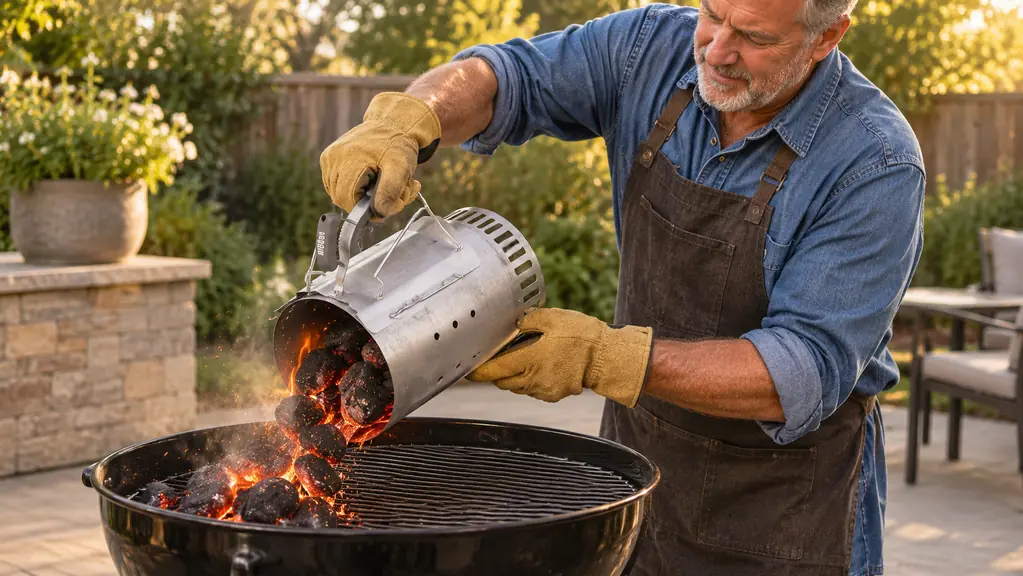
Pouring a lit chimney is the moment that matters. The handle is plastic and set off the body of the tube, so you can pick it up with one hand, tip it over the grate, and keep your arm clear of the coals. I still wear a canvas glove on that hand, because a full load radiates and the handle is not a heat shield. What it does give you is a grip comfortable enough to control the pour, which is most of the battle when you are trying not to scatter coals off the edge.
You can pour exactly what you need to one side
For anything I cook for the band and their families, I want two zones: coals banked on one side for searing, nothing on the other for finishing. A chimney lets me decide how much fuel to light, then pour it where I want it. With fluid I was soaking the whole pile and spreading it, which means a grill full of fire and no cooler side to move anything to. That one change did more for my chicken than any rub I have ever bought.
You get your evening back
The reason I care about any of this is not charcoal. It is that I cook outside so I can be outside with people. A fluid fire wants attention in the early going, the smell hangs around, and the whole business feels like a chore before dinner. I fill the chimney, light the paper, set it on the pad, and go back to the conversation. Fifteen or twenty minutes later I pour and cook. That is the entire job of a starter, and it is why the one on my patio says Weber on it.
What I'd Skip
If I were buying again, what I would skip is a starter with extra hardware bolted to it. There are models with crank mechanisms, hinged bottoms, side doors, and gauges on the tube. Every one of those is a part that can bend, rust, or seize after a few seasons on a damp patio. The plain design is a tube, a grate, and a handle, and there is not much on it that can fail. I would also skip the idea that you need a second gadget to get it going. Newspaper and a match is the method, and it works in the rain as long as you keep the paper dry until you light it. If you are weighing this one against the Kingsford version, that comparison is worth a few minutes before you commit.
The coals on top go gray and ashed over while the ones below are still black, and when the top layer is gray, you pour. It is a look, not a guess.
One purchase, then a season of easier cooks
No jug on the patio, no solvent under the chicken, no squinting at the coals trying to decide. Same starter, every cook, all year.
Amazon Check Today's Price on Amazon →