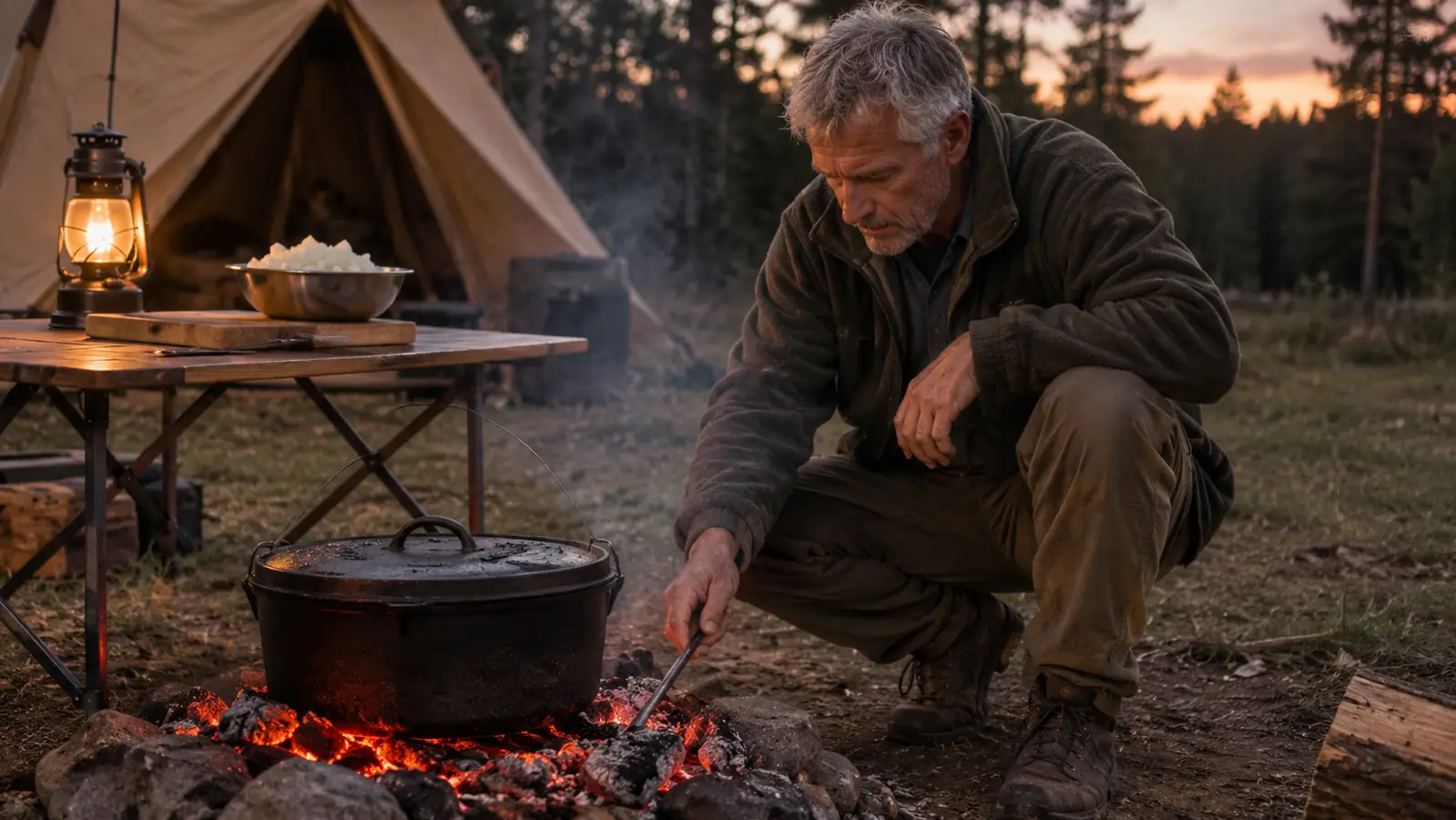
The first meal I cooked in the Lodge camp Dutch oven had a bottom layer I could have used for a coaster. I had coals under it, I had the lid on it, and I walked away to argue about a set list with the bass player. I came back to chicken thighs that needed a chisel. Nobody warns you about that part, so I will. This pot rewards attention and punishes assumptions, and the gap between those two things is roughly one summer of cooking.
I have cooked outdoors for about thirty years, mostly on a covered patio outside Salem and a few times a year in the Cascades or out at the coast. I am not a competition cook and I have no interest in becoming one. I own exactly one camp oven. It is this one. I have run it hard enough to know where it is good, where it is a nuisance, and who should not buy it. Lodge builds a serious piece of cookware. That does not make it the right pot for everybody, and the honest version of this review spends most of its time on the second half of that sentence.
The Quick Verdict
A well made six quart camp oven that will outlast the truck, with a heat control learning curve the listing never mentions.
Amazon Check Today's Price →Worth the trouble once you stop treating it like a stove burner
Six quarts of pre-seasoned cast iron with a flanged lid that holds coals and flips into a griddle. If you cook for a crowd over fire, this is the pot I keep reaching for.
Amazon Check Today's Price on Amazon →What Nobody Tells You Before the First Cook
Pre-seasoned does not mean non-stick. It means the foundry already did the first pass so you do not have to. The first four or five cooks in mine were a shakedown cruise. It got better around the sixth time out and genuinely good somewhere around the tenth. That is normal for iron, not a defect. But it does mean you should not plan a showpiece meal for your first outing. Start with a stew or a pot of beans, something with enough liquid in it to forgive a hot spot. Save the biscuits for a month in, when you and the pot have come to an understanding.
The listing says the pot is designed for campfire coals, and that sentence is doing more work than it looks like. This is not a pot you slide onto a gas grate and forget about. It wants heat from below and heat from above, and the above part is the entire reason the lid has that flanged rim. Cooking it like a normal pot on a burner will work, sort of, but you will finish the meal wondering why anybody bothers with camp ovens at all. Cook it over coals with heat on the lid and the thing starts to make sense.
Six quarts sounds enormous until eight people show up hungry. It will hold a whole chicken with root vegetables packed around it and still let the lid seat properly. It will not hold two of those. I found that out at a band cookout when the second chicken had to go into a foil pan on the grill, which is a sentence I am not proud of and will not be repeating in front of Jo. One pot, one bird, one round of sides. That is the honest capacity.
The Lid Is the Whole Point, and the Lid Is Also the Headache
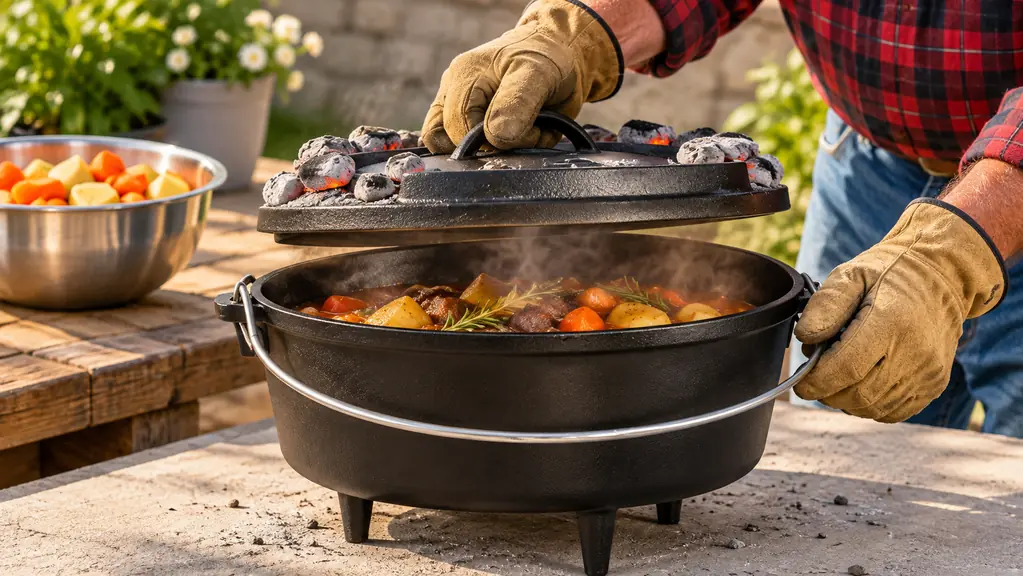
The feature that makes this a camp oven instead of a heavy pot is the lid. The rim is flanged, which means it will hold a shovel's worth of coals directly on top of your food. That is how you get browning on a pot sitting on the ground instead of in an oven. The lid also inverts and works as a griddle, and that is not a marketing line. I have done sausage and peppers on the flipped lid while a stew simmered underneath, and it saved me hauling a second pan out to the patio.
Here is the headache. A lid that holds heat also hides heat. You cannot look at the top of a camp oven and know what is happening inside it. Every time you lift that lid you dump the coals that were sitting on it, which means you are either committing to leaving it alone for the next half hour or rebuilding your coal pile from scratch. My first summer I lifted the lid about every four minutes and could not figure out why nothing browned. I was cooking with the heat I kept throwing on the grass.
Now I open it twice on a long cook. Once at the halfway point to check the liquid, and once near the end to look at color. That is the whole method, and it took a full season to learn because I am stubborn. If you are the kind of cook who likes to stir and poke and taste as you go, this design will fight you every step of the way. The pot is not wrong. My habits were.
A lid that holds coals also hides them. The less you open this pot, the better your food gets, and that is a discipline rather than a technique.
Eighteen Pounds Is a Decision, Not a Statistic
The pot weighs eighteen pounds empty. Add the lid, add a chicken, add a couple quarts of liquid, and you are moving something closer to twenty five pounds with your wrists while your hands are covered in soot. On the patio that is nothing. At a campsite where you have to carry it from the truck bed to the fire ring, it is a thing you plan around. The bail handle helps. It swings clear when you do not need it and gives you a real grip when you do.
The listing also notes you can hang this pot from a tripod by that handle. I do not own a tripod and have never tried it, so I will not pretend otherwise. If rigging a tripod over a fire is part of how you camp, that handle is the reason this particular pot earns its space in the truck. If it is not, the handle is still the easiest way to move eighteen pounds of hot iron without burning your forearms.
One thing I would tell a friend: do not buy this thinking it will double as your everyday kitchen pot. It is eighteen pounds. You will not haul it in and out of a cabinet on a Tuesday. Mine lives on a garage shelf and comes out when there is fire involved. That is the right job for it, and treating it as a single purpose tool is the fastest route to being happy with the purchase.
The lid does not lock down for travel, which is worth knowing before your first trip. It seats well enough in camp but it will slide in a truck bed, and I have learned to wedge a folded towel over the top rather than listen to iron clang against a cooler for two hours. That is not a flaw in the pot. It is a flaw in my packing, and it took me two trips to fix it.
Heat Control Without a Dial
There is no dial on this pot and no thermometer, and that is the source of most of the frustration in the reviews that are not four stars. Your controls are a bag of charcoal, a count, and your own patience. The method most people settle on is a ring of coals under the pot with a few in the middle and a matching ring on the flanged lid. You adjust by adding or removing briquettes rather than turning anything. It sounds imprecise. It is imprecise. It also works, once you have done it a few times and stopped guessing.
My first attempts were all too hot. Everybody's are. A six quart pot full of stew does not need the coal pile you think it does, and cast iron holds heat so well that once you overshoot you are waiting instead of cooking. On a long braise I start with fewer coals than feels right, get the pot to a gentle bubble, and then nurse it through the rest of the afternoon. That is a slower rhythm than a stove and it is the rhythm this pot wants.
Wind is the variable nobody mentions. Under my patio cover it is a non-issue. Out in the Cascades with a breeze moving through camp, coals on the windward side burn down faster and the pot cooks uneven. I set up behind the truck when I can. That is not something the pot can fix for you, and it is worth knowing before your first windy trip rather than after.
For a sense of pace, a pot of chili takes me about two hours from lighting coals to lifting the lid for bowls, with maybe one top up of briquettes in the middle. A whole chicken with vegetables runs closer to ninety minutes. Neither of those numbers came on the box. They came from a season of writing things down on a notepad and getting better at reading the pot instead of the clock.
Seasoning, Cleaning, and the Rust Argument
The care instructions say hand wash only and oven safe, and the warranty is lifetime, which tells you Lodge expects this thing to survive a generation of normal use. The ways to void that expectation are all small. Leaving it wet. Soaking it overnight because you are tired and it is late. Putting it away with the lid clamped down on a damp interior. Any one of those will grow rust on you, and none of them are hard to avoid until you are cleaning up in the dark with a flashlight in your teeth.
My routine is hot water and a stiff brush while the pot is still warm, no soap, dry it on a low burner, then wipe a thin film of oil across the cooking surface. Five minutes, maybe. When I have skipped the oil I have gotten small rust blooms, which scrub off and leave no lasting damage. It has never gotten bad enough to worry about. But if you are the sort of person who leaves a pan in the sink until morning, this is not your pan and I would not talk you into it.
The pre-seasoning from Lodge is a starting point rather than a finish line. Mine has darkened and slicked up over a couple of seasons of steady use, and it keeps getting better. If you cook in yours four times a year, it will stay close to how it arrived, which is close to sticky. The pot improves with use in a way that is genuinely satisfying, but only if the use actually happens.
One small chore nobody mentions: grease collects in the channel of the flanged rim, and it is easy to overlook because you cannot see it from above. Wipe that rim every time, not just the cooking surface, or you will find a sticky brown ring the next time you pull the pot off the shelf. It takes an extra ten seconds and saves a scrubbing session.
What I Liked
- Six quarts handles a whole chicken plus vegetables for a group
- Flanged lid holds coals on top and inverts into a usable griddle
- Bail handle makes it easy to carry and to hang from a tripod
- Lifetime warranty and cast iron that will outlast the truck
- Holds a low simmer for an hour with almost no fiddling
Where It Falls Short
- Eighteen pounds empty, and heavier once it is full of food
- No way to check on the food without dumping the coals on the lid
- The first several cooks are a real learning curve
- Hand wash only, and it will rust if you get lazy about drying
- Wants coals, not a burner, so it is not an everyday pot
Where It Genuinely Falls Short
If you want a pot you can check on whenever you feel like it, this is the wrong design. The whole system assumes you will leave it closed for long stretches, which is fine for chili, beans, a braise, or a whole chicken. It is bad for anything that needs stirring every few minutes, and it is bad for a beginner who learns by watching. My first season with it was more frustrating than fun, and I say that as somebody who wanted to like it before I ever owned it.
Storage and transport are the other shortfall. Eighteen pounds of round iron with a lid that does not lock down takes up real space in a truck bed and takes real effort to carry any distance. If your camping is a walk-in site, think hard about that before you buy. If your camping is a tailgate with the truck ten feet away, it is a non-issue and you can ignore this entire section.
And I would be lying if I said I never reach for something lighter on a weeknight. I do, regularly. This pot has one job and the job is a fire, a group of people, and an afternoon with nothing else on the schedule. It is very good at that job. It is not trying to be anything else, and the sooner you accept that, the less often you will be annoyed by it.
If I were starting over, I would still buy this one, but I would buy it in spring rather than August. The learning curve costs you a few meals, and it is a lot more pleasant to lose those meals on a cool evening in May than on the one weekend a year when the whole band is standing around waiting to eat.
Who This Is For
This is for the person who already knows they like cooking outside and wants one piece of iron that can do several jobs. If you feed a crowd a few times a summer, if you have a fire ring or a patio where a bed of coals is not a problem, and if you are willing to lose two or three meals to the learning curve, the Lodge camp Dutch oven will pay you back for years. It is also a good fit if the idea of a lid that doubles as a griddle appeals to you, because that trick has saved me from bringing a second pan more times than I can count.
Who Should Skip It
Skip it if you want to peek. Skip it if you cook for two, mostly on weeknights, mostly indoors. Skip it if you are not going to dry and oil it, because cast iron does not forgive neglect the way a coated pan does, and the rust conversation gets old fast. Skip it if the weight is going to be a genuine problem on the trip you actually take rather than the trip you imagine taking. There is no shame in a lighter pot. There is only shame in buying eighteen pounds of iron and leaving it in the garage, and I have watched two friends do exactly that.
If you are cooking over coals for a crowd, this is the pot
Six quarts, pre-seasoned cast iron, a flanged lid that holds coals and inverts into a griddle, and a bail handle that will take a tripod. Give it a season and it will do the rest.
Amazon Check Today's Price on Amazon →