Nine years ago I bought a camp Dutch oven because a friend would not shut up about his. It sat in the garage for two seasons before I ever lit coals under it. Now the Lodge 6 quart lives on the covered patio from April through October and rides in the truck bed on every trip to the coast and up into the Cascades. I am not a competition cook. I am a man with a concrete pad, a chimney starter, and a wife who would rather I was outside with the band than inside fussing with a stove. That is the standard this review is written against.
What follows is from nine years of actual use: what I cook in it, how it behaves four hours into a braise, what annoys me, and who should not buy one. Nine years is long enough to stop being polite about a piece of cookware.
The Quick Verdict
Heavy, slow to heat, and worth it. Six quarts of pre-seasoned cast iron with a lid built to hold coals, and it will outlast the truck you haul it in.
Amazon Check Today's Price →The pot that got me out of the kitchen and back to the party
Six quarts of cast iron, pre-seasoned, with a flanged lid that holds coals on top. It is the difference between cooking at an event and attending one.
Amazon Check Today's Price on Amazon →How I've Used It
The first thing I cooked was a pot of chili for eight, and I scorched the bottom because I loaded too many coals underneath and then walked off to talk to somebody. That was my error, not the pot's, but it taught me the first real lesson: there is no dial on this thing. Heat comes from coals, and you manage it by counting them and by rotating the pot and the lid a quarter turn every so often so nothing scorches in one spot.
Since then it has been cornbread, biscuits, a pot roast that fed the band and their families on a Saturday in July, a pot of pinto beans that took most of an afternoon, and two cobblers. There was also one attempt at a whole chicken in front of guests that I will not be repeating in mixed company. The successes outnumber the failures by a wide margin, and every failure was heat management, which is a skill and not a switch.
Where it earns its keep is the standing-around problem. A Dutch oven sitting on coals is a slow cooker that happens outdoors. I set it up, look at it every twenty minutes, and spend the rest of the afternoon with the people I invited. If a piece of cookware makes me miss my own party, I do not keep it on the patio.
The bail handle matters more than I expected. It is the difference between carrying a hot pot of chili twenty feet and doing an awkward two-glove shuffle with your arms out. The handle is stout, and it is set up so you can hang the oven from a tripod if you would rather cook over open flame than in a bed of coals.
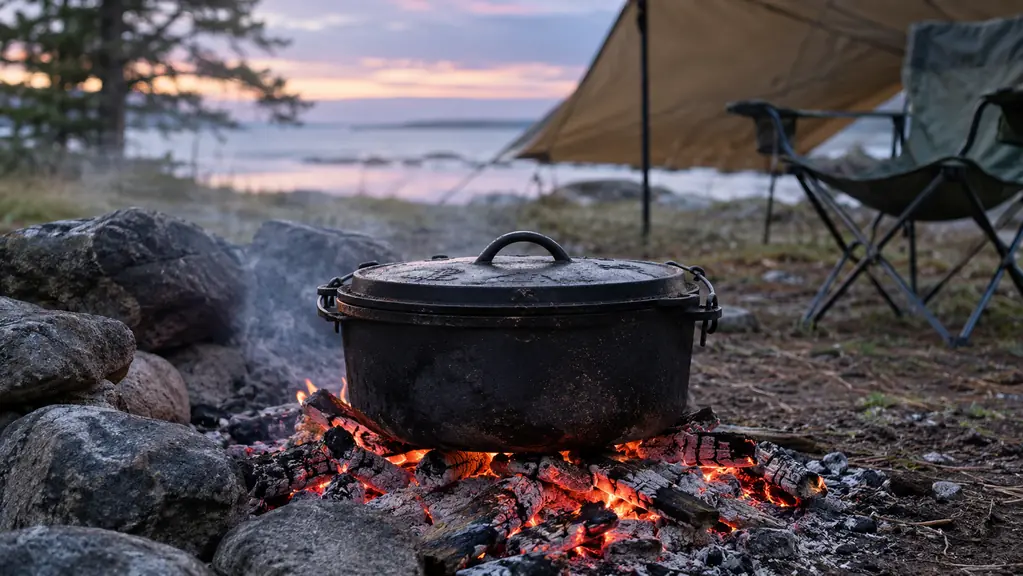
Camping is the other half of the year. On the coast the wind does not quit and a camp stove is a joke in it, but a bed of coals in a ring holds heat fine. I have made biscuits in this pot in a drizzle under a tarp, and they came out better than the ones I make at home, mostly because I was paying attention instead of also doing three other things.
One July the band came over and I did a pot roast for fourteen people, because everybody brought their families and nobody told me in advance. I started it at eleven in the morning and pulled it at four, and the only thing I did in between was add coals twice and turn the pot a couple of times. That is the entire appeal. The meat came apart with a spoon and I never once had to think hard about it.
What Six Quarts Actually Holds
Six quarts sounds generous until you are standing in front of it, so here is what it means in practice. It is a round pot, 13.4 inches across and 7.35 inches tall, and it weighs 18 pounds empty. For a crowd of eight to ten with side dishes, it is close to ideal. Four pounds of chuck with a pile of onions and carrots fills it to a sensible level and still leaves room to stir without slopping.
The 18 pounds is the number to sit with. Empty, it is a two-hand lift. Full, it is a two-hand lift and a plan. It is not a pot you carry with one hand while holding a lantern in the other, and it is not a pot that goes backpacking. It lives in a truck bed or on a patio, and it should.
The pot is deep, which matters more than the width for anything with liquid in it. A deep pot lets you braise without the liquid climbing the walls and boiling over, and it gives a pot of beans room to move. The tradeoff is that reaching the bottom with a spatula takes a long-handled spoon and some commitment.
If you cook for two, six quarts is more pot than you need, and you will be heating a large mass of iron to cook a small amount of food. That is not a flaw, it is a size mismatch, and it is worth being honest with yourself about which one you have.
Packing it for a trip is its own small routine. I nest a towel and a pair of gloves inside it, set the lid on top, and wedge the whole thing behind the cab so it does not slide. It takes up real space in a truck bed, and if you are already tight on room you will feel it.
The Lid Is the Whole Trick
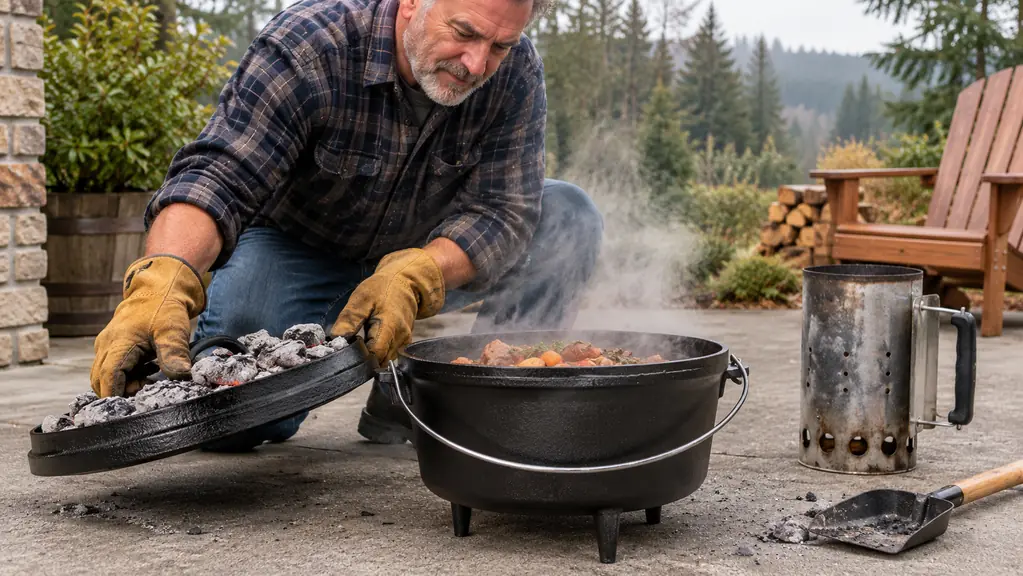
The part people miss when they buy a camp oven and then wonder why their biscuits come out with a pale, doughy top is the lid. This one is flanged, meaning it has a raised rim, and that rim is made to hold hot coals. Heat from below cooks the bottom. Heat from the lid cooks the top. You need both, and a pot with a plain lid only gives you one.
Once I started putting coals on the lid, the whole thing opened up. Biscuits went from flat and pale to browned on top. Cobbler got a crust instead of warm fruit soup. Cornbread came out with a crust on both sides. That single feature is the reason to pick a camp oven over a regular cast iron Dutch oven with a flat lid, and it shows up on the plate every time.
Invert the lid and it works as a griddle. I have cooked bacon and eggs on it on a Sunday morning and it did the job without any ceremony. It is not a large griddle, so you cook in batches, but it is one less pan to pack and one less thing to wash.
I keep a small garden shovel in the truck for moving coals, and that is not a joke. Getting coals onto a lid with tongs is slow and you will drop most of them. Shovel them on, spread them out even, and let the lid do the work. When the cook is done, brush them back into the ring and let them burn down.
Heat Control Takes a Season to Learn
There is no thermostat, no sensor, no dial. You are the control system. The rule of thumb I use is roughly twice as many coals on the lid as underneath for baking, and closer to even for a long braise. Wind will eat your heat, cold will eat your heat, and rain will end the conversation entirely unless you have a tarp over you.
The first few cooks will not go the way you want. You will burn something on the bottom, or you will pull the lid off every ten minutes to look and lose all your top heat. Both are fixable. The fix is patience, a pair of long gloves, and the discipline to leave the lid alone.
What it does not do is quick. This is a bad pot for a fast weeknight dinner. Cast iron that weighs 18 pounds takes a while to come up to temperature, and if you are in a hurry you will stand there watching it. It is a pot for a long afternoon when you have nowhere else to be, which is the only kind of afternoon I want to spend outdoors anyway.
By the end of one season you stop counting and start reading the coals. You learn what a dull orange bed looks like versus a bright one, and you learn that the pot tells you when it is running hot by how fast the liquid moves. That is not a feature you can buy. It comes from burning a few dinners.
Seasoning, Cleaning, and the Weight
The Lodge arrives pre-seasoned with iron and oil, so it was usable the day it showed up. I still gave it a first cook with something fatty to settle it in, but that was habit more than necessity.
Care is hand wash only, and there is no dishwasher in its future. My routine is a plastic scraper, hot water, a stiff brush, then dry it on a low burner and wipe a thin coat of oil on while it is still warm. That is four minutes of work. The lifetime warranty covers defects and not rust, and rust only happens if you put it away wet.
The weight is the honest annoyance. 18 pounds empty, and with a pot roast and a quart of liquid in it, considerably more. Lifting it off a bed of coals with gloves on while it is full of simmering chili is a two-handed, feet-apart, think-about-it-first operation. I have done it dozens of times without incident, but I do not do it casually, and I would not hand it to a guest to move.
Store it with the lid off or propped open so air can move through it. I learned that the ordinary way, by leaving it closed after a damp weekend and finding a bloom of rust on the inside the following Thursday. It scrubbed off with steel wool, took a fresh coat of oil, and went right back to work. One afternoon of neglect is recoverable. A winter of it might not be.
What I Liked
- Holds heat through a four-hour braise with almost no attention from me
- The flanged lid takes coals on top, which is how you get real biscuits and a set cobbler
- Arrives pre-seasoned, so it cooked the day it landed on the porch
- Bail handle is stout enough to carry a full pot or hang from a tripod
- Lifetime warranty, and cast iron is close to unkillable if you dry it
Where It Falls Short
- 18 pounds empty, and a good deal more when it is full of chili
- No heat adjustment beyond counting coals and rotating the pot
- Hand wash only, and it will rust if you put it away wet
- Six quarts is more pot than a household of two will ever need
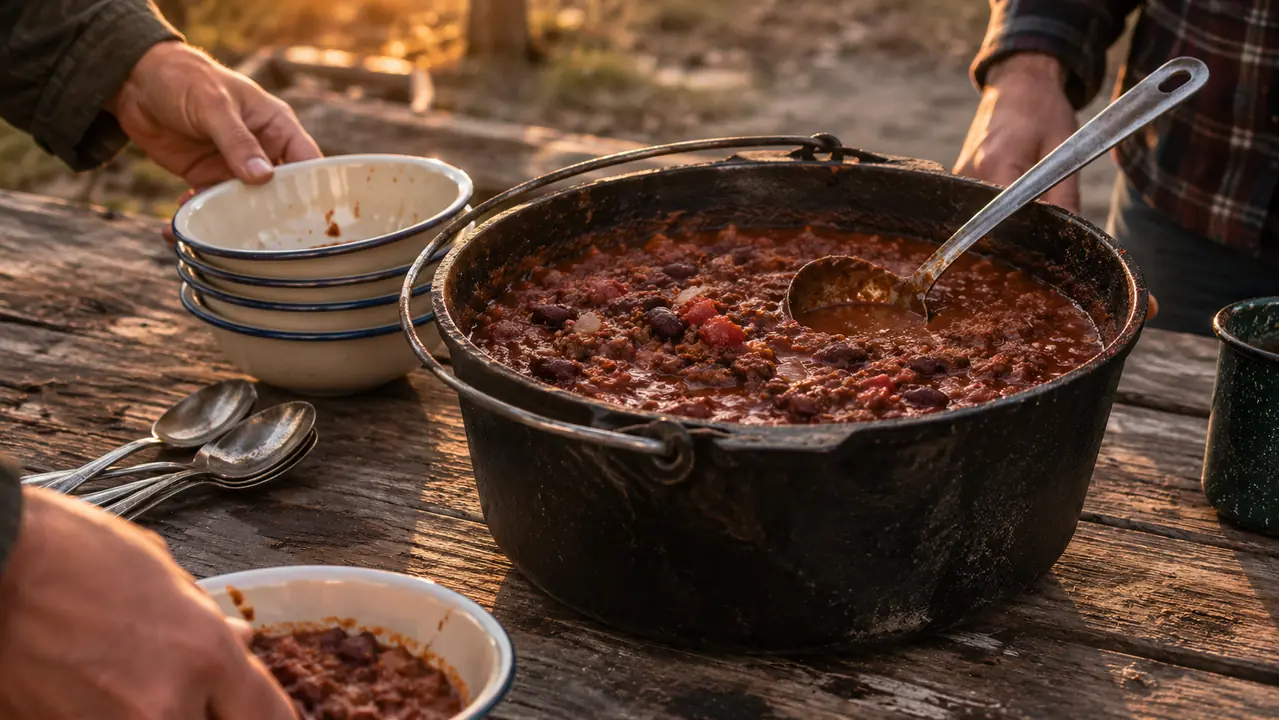
Eight people, one pot of chili, and I did not touch the coals once after the first twenty minutes.
Who This Is For
You cook outdoors a few times a month, you feed more than four people at a time, and you want to be present while the food cooks instead of chained to a fire. You have a spot where a bed of coals is safe and allowed, whether that is a fire ring at a campsite or a concrete pad behind the house. You do not mind four minutes of cleaning for a pot that will outlast you.
It also suits the person who already owns a flat-lidded cast iron Dutch oven and has been quietly disappointed by pale biscuits. The flanged lid is the upgrade, and unlike most upgrades it is obvious on the plate the first time you use it.
And it suits the camp cook who has been fighting a two-burner stove in the wind for years. Coals do not care about wind the way a stove flame does. That is worth something on the Oregon coast in June.
Who Should Skip It
If you cook for two, six quarts is a size mismatch and a smaller oven will serve you better. If you want dinner in thirty minutes, cast iron is the wrong tool and you will come to resent it. If you are backpacking, 18 pounds is absurd. And if you will not hand wash and dry a pot, it will rust, and you will blame the pot.
One more: if you are weighing it against a lighter enamel-coated oven for patio use, that is a fair comparison and a different one. The Lodge wins on coals and on durability. It loses on weight and on cleanup. Be clear with yourself about which of those you actually care about before you order.
Nine years in, it is still the pot I reach for first
Six quarts, pre-seasoned, flanged lid that holds coals, lifetime warranty. If you have a fire ring and a crowd, this is the one that earns its spot in the truck.
Amazon Check Today's Price on Amazon →