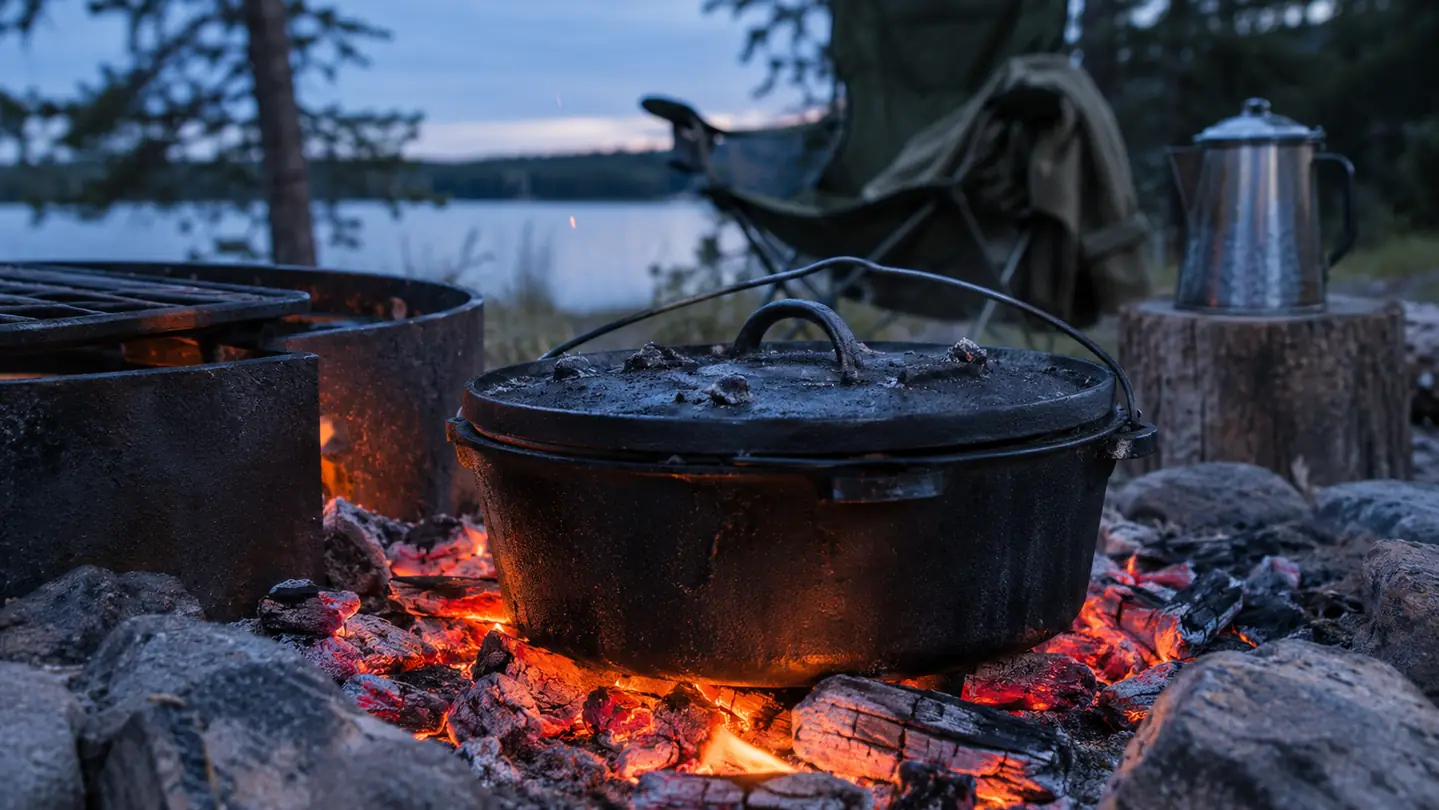
Two pre-seasoned cast iron camp ovens, both six quarts, both with a lid you can pile coals on. On the shelf at an outfitter they look like the same pot with a different name stamped in the iron. I have cooked in the Lodge and I have cooked in the Camp Chef, not side by side on a test bench but the way anyone actually uses one: over coals, in the rain, with people standing around asking when the biscuits will be done. The differences that matter do not show up in the first hour. They show up on the fourth trip, when you already know what you reach for.
The short answer: for most people the Lodge is the better buy, and I would hand it to a friend without much hedging. The lid is the reason. It is flanged to hold coals, and it inverts and works as a griddle, which turns one pot into two cooking surfaces at breakfast. The lifetime warranty and the plain iron-and-oil finish do the rest. But the Camp Chef is not a bad pot and I will not pretend it is. It is typically the less expensive of the two, you can put your hands on one at a sporting goods store, and it often comes in a kit with a lid lifter. If you are buying your first camp oven and you are not sure you will stick with it, that is a real argument.
| Lodge Camp Dutch Oven | Camp Chef Cast Iron Dutch Oven | |
|---|---|---|
| Capacity | 6 quarts, 13.4 inches wide, 7.35 inches tall, 18 pounds | Also sold in a 6 quart size |
| Lid | Flanged to hold coals, and it inverts to work as a griddle | A lid, and a heavy one. Inverting it for a griddle is not something Camp Chef advertises |
| Bail handle | Sturdy enough to carry a loaded pot or hang it from a tripod | Has one too |
| Finish | Iron and oil only, pre-seasoned, no coating to chip | Pre-seasoned, same idea |
| Warranty | Lifetime, per Lodge | Shorter, and worth confirming with the seller before you buy |
| What it costs | More than the Camp Chef at most retailers | Typically the cheaper of the two |
| Where you can buy it | Online, and at Lodge's own stores | Sporting goods stores, so you can lift the lid before you spend anything |
| What comes in the box | The oven and its lid | Often bundled as a kit with a lid lifter |
Where Lodge Wins
Start with the lid, because the lid is the whole argument. The Lodge lid is flanged, meaning there is a raised rim around the edge that holds coals in place so they do not roll off into the dirt. Those coals are what bakes bread in a camp oven, and the flange is what keeps them from sliding away before they do their job. The rule I was taught is coals on the lid at roughly double the count underneath. On a cool Saturday in July I ran nine briquettes under the pot and eighteen on the lid and held a steady heat long enough to bake a pan of biscuits without touching it. On top of that, the lid comes off, inverts, and gives you a second cooking surface. That same morning I had beans going down in the pot and bacon and eggs working on the inverted lid beside it. Two burners out of one piece of iron, on a fire, without a stove.
Then there is the iron itself. Cast iron and oil, no enamel, no coating to chip off and leave you wondering what got into the chili. It arrives pre-seasoned and it only gets better as the seasoning builds. The dimensions matter more than they sound. At 13.4 inches across and 7.35 inches tall it is a wide, fairly shallow pot, wide enough to lay a small chicken out flat and shallow enough that a spoon reaches the bottom corners without a fight. Lodge backs it with a lifetime warranty and lists the care as hand wash only and oven safe, which is the entire instruction list: wash it, dry it on the heat, wipe a little oil on it. Eighteen pounds for six quarts is heavy, and the weight is the point. A heavy pot holds heat and does not shift around when you take the lid off to look. The listing sits at 7,023 reviews and 4.8 stars, and after a season with one that number stops looking surprising.
Where Camp Chef Wins
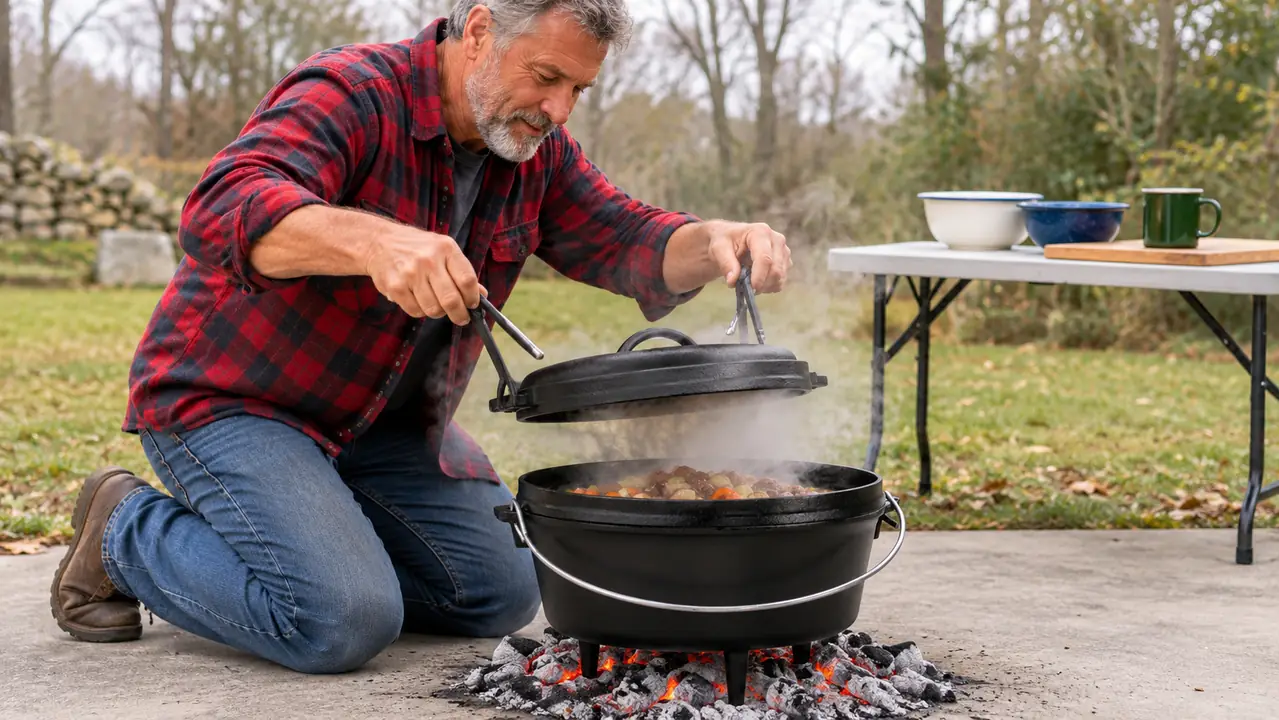
Camp Chef wins on the two things that quietly decide how much a person actually uses a camp oven: what it costs and whether they can walk out and buy one. It is typically the less expensive of the two, and it is sold in sporting goods stores where a person can lift the lid and feel the weight before spending anything. I have stood in that aisle in Salem with one in my hands, hefting it and setting it back down, and that is worth something when you are not yet sure the whole idea is for you. When you are new to coal cooking and half convinced you will scorch everything, buying the cheaper pot is the choice that gets you cooking. So does the fact that Camp Chef is often sold as a kit with a lid lifter, which is the one accessory you will absolutely want and the one most people forget to buy. I forgot mine. I used a pair of channel locks for half a season and I do not recommend it.
I will also give Camp Chef this. A pot that costs less is a pot people take out of the truck. I have watched a friend leave a nicer oven at home for two straight seasons because it felt too precious to risk on a wet weekend. The cheaper pot got used, got seasoned, and got good. There is a version of this comparison where the right answer is whichever one you will actually cook in, and Camp Chef makes that easier for a lot of people. A camp oven that sits in a garage is not a camp oven. It is eighteen pounds of iron with a nice lid.
The lid that turns one pot into two burners is why I would buy the Lodge again
Six quarts, pre-seasoned, flanged lid that inverts to a griddle, and a lifetime warranty behind it. If you want the pot I keep reaching for, this is it.
Amazon Check Today's Price on Amazon →Where They Are Even, and Why That Matters
Set them next to each other and the honest answer is that these are the same idea executed to the same standard. Six quarts is the right size for four to six people and it is the size both makers build around. Both are round. Both have a bail handle, that half hoop of iron over the top that lets you carry a hot pot or hang it from a tripod over a fire. Both come pre-seasoned. Both want the same care, which is to say almost none beyond drying them properly before they go back in the truck.
Neither one is a slow cooker and neither one will be kind to you the first time out. Coal cooking is a skill and the pot does not supply it. Both want coals on the lid and coals underneath, and a rotation of the whole pot and lid a quarter turn every fifteen minutes or so if you are baking, because the fire is never even. Both will taste like the last thing you cooked in them for a while if you do not wash and re-oil them. Both will go rusty in the back of a truck overnight if you put them away wet, and neither maker has a fix for that beyond the obvious one. A better pot does not fix a fire that is too hot, and a cheaper pot does not ruin a fire that is right. That part is on you.
Two burners out of one piece of iron, on a fire, without a stove. That is the thing the spec sheet cannot tell you.
What a Season of Cooking With the Lodge Taught Me
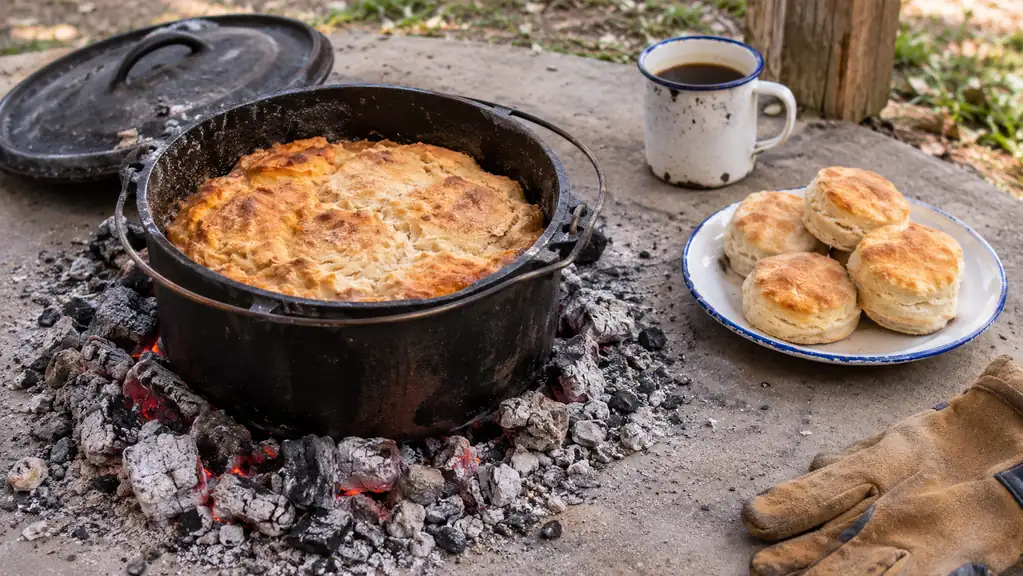
I cook for the band and their families a few times a summer, and the covered patio out back is where it happens. Concrete pad, coals in a ring, a folding table for the bowls. The first cook of the year was a chili in late May that I rushed, and I had the coals too hot and too many of them, and the bottom of the pot caught while the middle was still cool. That was my mistake, not the pot's, but it taught me to build the fire first and let it settle to a grey ash before the oven ever goes on. After that the Lodge did chili for fourteen, a pork shoulder, and more biscuits than I can count. What I noticed over the season is that the pot stopped being a project. In June I was checking the coals every ten minutes like a man watching paint dry. By August I could set it up, walk away, and go argue about a bass line.
The inverted lid earned its keep on those mornings. Sausage on the lid, potatoes in the pot, coffee going on a little stove beside it. One fire, three things happening, and I stayed outside with people instead of babysitting a flame. That is worth more to me than any number on a spec sheet, and it is the reason I stopped rotating pots in and out of the truck.
The gripes are real but small. Eighteen pounds empty is a load when you are already carrying a stove and a cooler, and it does not get lighter as the morning goes on. I have hauled it from the truck to the pad and back enough times to know I feel it in my shoulder the next day. Hand wash only means hand wash only, and if you leave it wet in the bed of the truck overnight you will meet rust by Thursday. The lid does not seal like an oven door and it is not supposed to. And buy a lid lifter, because a pair of channel locks on a hot lid is a fine way to end an otherwise good Saturday.
Two Things I Would Warn You About
First, size. Six quarts sounds modest until you are carrying it. It feeds four to six without strain and it is more pot than a couple needs for a weekend. If you mostly cook for two and you are hiking to your site, a six-quart camp oven is a lot of iron to justify, and the weight is exactly what you would be carrying in. Second, do not judge either pot on the first cook. New seasoning is uneven and the first batch of biscuits will come out darker on one side. That is the fire and the pot learning each other, not a defect. Give it four or five cooks before you form an opinion.
The other mistake I see is people treating the flanged lid as a serving platter and then wondering why the rim is sticky. Set the lid down on a flat rock or a board, not in the dirt, and not upside down on the picnic table where the flange collects pine needles. Small thing. It saves you a scrubbing.
Who Should Buy Which
Buy the Lodge if you already know you will cook outside more than a few times a year, if you want the lid that inverts into a griddle, and if a lifetime warranty on a piece of iron is the kind of thing you like having. It is the pot I would hand to someone who asked me at a campground, and it is the one that will still be in the family when the kids are dividing up the tools. Buy the Camp Chef if you are new to coal cooking, if you want to feel the weight in your hands before you spend anything, or if the lower cost is what gets you to actually take it out of the truck instead of leaving it in the garage. Neither choice is a mistake. One of them just has a better lid.
If you are going to buy once, buy the one with the lid that cooks
Pre-seasoned cast iron, six quarts, flanged lid that holds coals and inverts to a griddle, plus a lifetime warranty. That is the whole case for the Lodge, and it holds up over a season.
Amazon Check Today's Price on Amazon →