

I bought the MEATER Plus wanting to dislike it. That is the honest place to start. I have cooked outdoors for about thirty years, most of it on a covered concrete pad behind the house outside Salem, Oregon, and my patience for a cooking gadget runs about as long as my patience for a folding chair that wobbles. I want a tool to do one job, do it quietly, and then get out of my way while I talk to the people I invited over.
So when a box shows up holding one probe, one charger that also repeats the signal, and a single AAA battery, my first instinct is that it is solving a problem I already solved with a dial thermometer and a pair of tongs. Six months of real cooking later, I was partly right. The MEATER Plus is worth owning in two narrow situations and mildly irritating in about four others, and the product listing does not walk you through the four. That is what this review is for.
The Quick Verdict
Accurate readings and genuine freedom to step away from the grill, undercut by Bluetooth range, a small battery and an app that wants your attention before it will give you a number.
Amazon Check Today's Price →The probe is the good part. Here is the current price and the full spec sheet.
In six months the readings never failed me. The range and the battery are the honest trade. If your chair sits close to your grill, this is the one worth looking at.
Amazon Check Today's Price on Amazon →What the Listing Does Not Say Out Loud
The first thing to understand is what kind of wireless this actually is. The MEATER Plus is a Bluetooth tool. The probe talks to the charger, and the charger repeats that signal out to your phone, which is why the charger is not just a parking spot for the probe. It is half the product. Set it closer to where you are sitting and the entire experience improves. Jam it against the hot side of the grill and you will spend the evening watching a spinning icon instead of your dinner.
The second thing is range, and I am not going to quote a distance because the distance that matters is the one in your own yard. In mine, the signal walked from the patio through an open slider and into the kitchen without complaint. It did not survive a closed door and a wall. That is not really a knock on MEATER, it is a fact of Bluetooth that the photographs of people strolling a lawn do not convey. If your chair sits on the far side of a wall from your grill, put the charger on your side of the wall and you will be fine.
The third thing is the battery, and this is the one that changed how I cook. The listing says five minutes in the charger buys you two hours of cook time. That held up for me, and it is also the catch. Two hours is a chicken. Two hours is not a pork shoulder, and it is nowhere near the overnight brisket people picture when they order one of these. On a long cook you treat the probe like a phone with a tired battery. Pull it, park it in the charger for a few minutes, put it back in the meat, and check the app to be sure it reconnected. It works. It is simply a chore the box does not show you.
How I Actually Use It
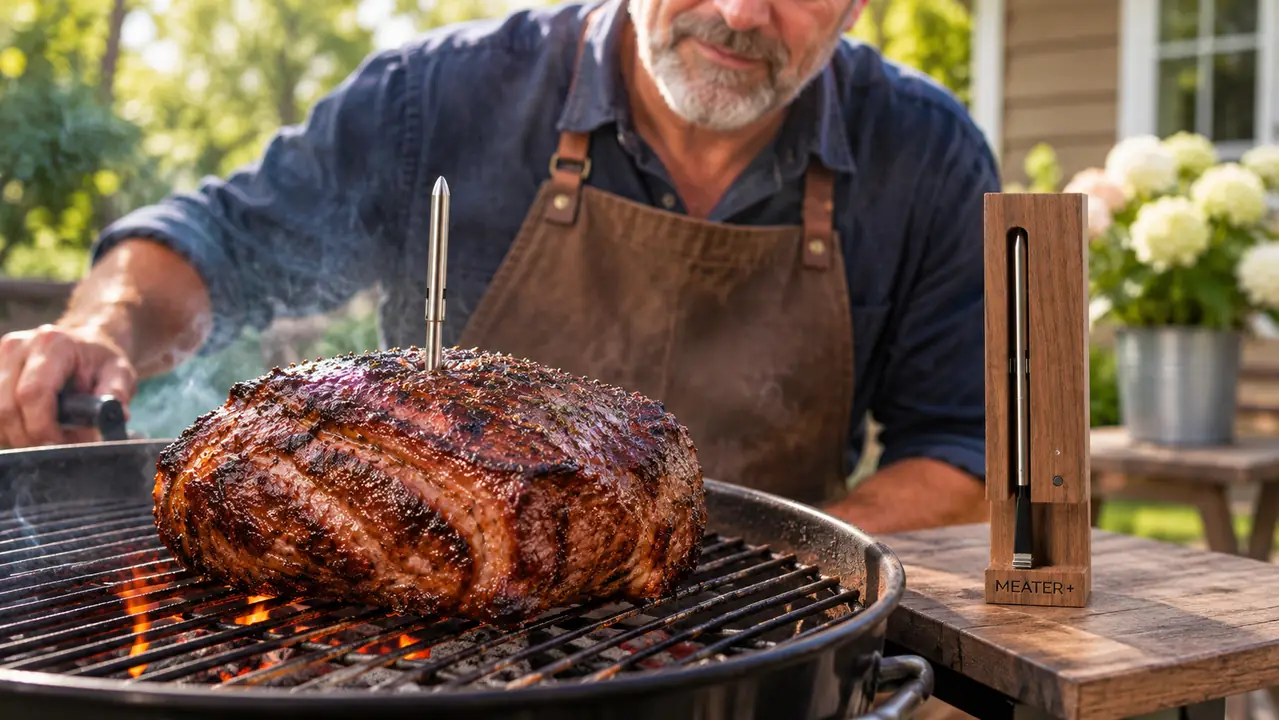
My cooking is not competition cooking and I will not pretend otherwise. I play bass in a weekend cover band, and a few times a summer the band and their families land in my backyard. That means six to ten people, a pile of chicken thighs, a tri-tip or two, and me standing at the grill while everyone else is on the patio with a drink. That is the exact scenario this probe was built for, and it is where it earned a permanent spot in the drawer by the patio door.
The rest of my cooking is smaller. Burgers for me and Jo on a Tuesday. A whole chicken on a Sunday afternoon. A few camping trips a year, one out to the Oregon coast and one up into the Cascades, with a small kettle grill riding in the back of the pickup. The probe travels better than I expected. The charger is small enough to live in the camp box, and the AAA battery means nobody is hunting for a charging cable in a tent at dusk.
Camping is also where the range limits got almost funny. I set the charger on the picnic table, walked down toward the water, and lost the signal before I got far. Nothing broke. The probe kept cooking, and the reading was waiting when I walked back up the bank. But if you are picturing yourself monitoring a roast from a neighboring campsite, this is not that tool, and no amount of hopeful reading of the listing will make it one.
Where It Earns Its Place
Chicken is the short answer. Chicken is the one thing I cook where guessing has real consequences and where the old routine of poke, cut, squint and poke again ruins the very thing you are trying to check. With the probe in the thickest part of a thigh, I get a number, the number shows up on my phone, and I stay in my chair with a drink and a conversation. Every time I spot-checked against my instant-read, the two agreed. That is the only accuracy test I care about.
The dual sensors are the reason those readings hold up. One sensor at the tip is a guess with a screen on it. Two sensors in the same probe give the tool something to compare against, and in six months I never once looked at a reading and doubted it. That sounds like a low bar to clear. Most budget wireless probes do not clear it.
The oven-safe rating turned out to matter more than I expected. The listing puts the range at 32 to 527 degrees Fahrenheit and calls the probe oven safe, which means I can start a pork loin indoors and finish it on the grill without swapping tools or pulling the probe and losing my reading. Wipe it clean, back in the charger, done. That is the entire maintenance routine, and I appreciate that in a way I did not anticipate.
The timer gets used more than I thought it would, too. I set it, I walk away, I get a nudge, and I do not have to hold a cooking time in my head while somebody is telling me a long story about their transmission.
The cook that sold me was a tri-tip for the band in July. I had the probe in the thick end, the charger on the patio table next to my chair, and I never stood up to check anything I could not see from where I was sitting. I pulled it at the number, rested it, sliced it, and it was the first tri-tip I have cooked where both ends came out the way I wanted. Nothing about my technique changed that day. I just stopped guessing.
The number on the screen was never the thing that failed me. The handoff between the probe, the charger and my phone was.
Where It Falls Short
One probe means one piece of meat. On a band night I am cooking eight thighs and a tri-tip, and the probe is in exactly one of them. I still keep a dial thermometer in my other hand. That is less a flaw than a boundary, but the picture of a whole bird on a grill makes it easy to forget that you are buying a single probe and not a system that watches the entire grate.
Thin cuts are awkward. Burgers, thin chops, a butterflied breast: there is not enough meat for a probe to sit in properly, and you end up either skipping it or leaving a hole bigger than the cut deserved. The listing puts the item length at 6.18 inches, and in the hand it feels like a real piece of hardware rather than a toy, which is good news for a shoulder and less good news for a chicken breast.
The app wants a phone and an account. I am fifty-seven. I do not love a tool that needs me to sign in before it will tell me the temperature of my dinner. It works, it is not sinister, but it is one more thing standing between me and the food. When my phone was charging in the house, I got nothing at all, and the grill did not care one bit.
The listing also mentions Wi-Fi support among its features, and I want to be straight with you about that. Everything I did in six months ran on Bluetooth through the repeater in the charger. If there is a Wi-Fi path in the app, I never needed it badly enough to go find it, and I would not buy this expecting to watch a cook from the office. Buy it for the patio and you will be happy. Buy it for the office and you will be disappointed.
What I Liked
- Readings matched my instant-read every time I spot-checked
- Two sensors in one probe, so the number is not a single-point guess
- The repeater built into the charger gives real freedom to step away
- Oven safe from 32 to 527 degrees Fahrenheit, so you can start indoors and finish outside
- Wipe clean and back in the charger, no maintenance routine to learn
- Travels well on camping trips on a single AAA battery
Where It Falls Short
- One probe, one piece of meat
- Two hours of cook time per short charge is a real limit on long cooks
- Bluetooth does not like walls or closed doors
- The app needs a phone and an account before it will show you a reading
- Awkward on burgers and other thin cuts

What It Does Not Fix
A thermometer does not make you a better cook, and I want to be clear about that because the marketing around these tools edges toward the idea that it does. The probe tells you the temperature of the meat. It does not tell you that your fire is uneven, that you put the lid on too late, or that the cut you bought is too lean for the method you chose. I have cooked bad food with a perfect reading and good food with none at all.
What it does fix is narrower and more useful: it removes the standing-and-worrying part. If you are the person who cuts into a chicken three times because you cannot stand the uncertainty, this tool replaces that with one number. That is a real improvement in a backyard where people are waiting on you. It is not a transformation, whatever the reviews on the listing page say.
What Six Months of Ownership Looks Like
The honeymoon ended around month two, and what replaced it was a habit. The probe lives in the charger on the counter by the patio door. I grab it when I am cooking something thick. I do not grab it when I am doing burgers. That is the honest rhythm. It is not a tool that changed how I cook. It is a tool that removed one specific irritation, which is standing at a grill, hungry, with people waiting, guessing whether the chicken is done.
The thing that surprised me is how much I trusted it by the end. Trust is the whole product here. A thermometer you doubt is worse than no thermometer at all, because you poke and cut anyway, and now you have also lost the juice. By month six I was pulling chicken at the number without cutting into it first. Small change, real payoff on a Saturday when there are eight people on the patio and one of them is asking when dinner is.
Who This Is For
This is for the backyard cook who wants to be a host instead of a nurse. If your grill sits on a patio, if your chair is within sight of it, and if the people around the table are the reason you are cooking at all, the MEATER Plus earns its keep. It is also good for anyone who has ruined one too many chickens and would rather have a number than a hunch.
It suits a camper with a kettle grill and modest expectations about range. It suits anyone cooking thick cuts: shoulders, whole birds, tri-tip, a leg of lamb. And it suits anyone who has already figured out that a dial on the lid tells you about the air inside the grill and not about the meat.
Who Should Skip It
Skip it if you mostly cook thin things. Burgers, sausage links, thin chops, skirt steak. A probe this size is in the way more than it helps, and you will not reach for it after the first week.
Skip it if your grill and your chair are separated by walls, or if you genuinely want to watch a cook from somewhere else in the house. The Bluetooth handoff through the charger is good, not magic, and the Wi-Fi line on the listing is not a promise you should build a plan around.
And skip it if a phone and an account before dinner sounds like a nuisance, because that is exactly what it is. A good instant-read thermometer has no app, no sign-in and no battery to manage. This tool is better than one in two specific situations and worse in the rest, and only you know which situations you actually cook in.
If your chair is close to your grill, this is the one to get.
Six months in, the readings never let me down. The range and the battery are the honest trade you are making. Check the current price and the full spec sheet before you decide.
Amazon Check Today's Price on Amazon →