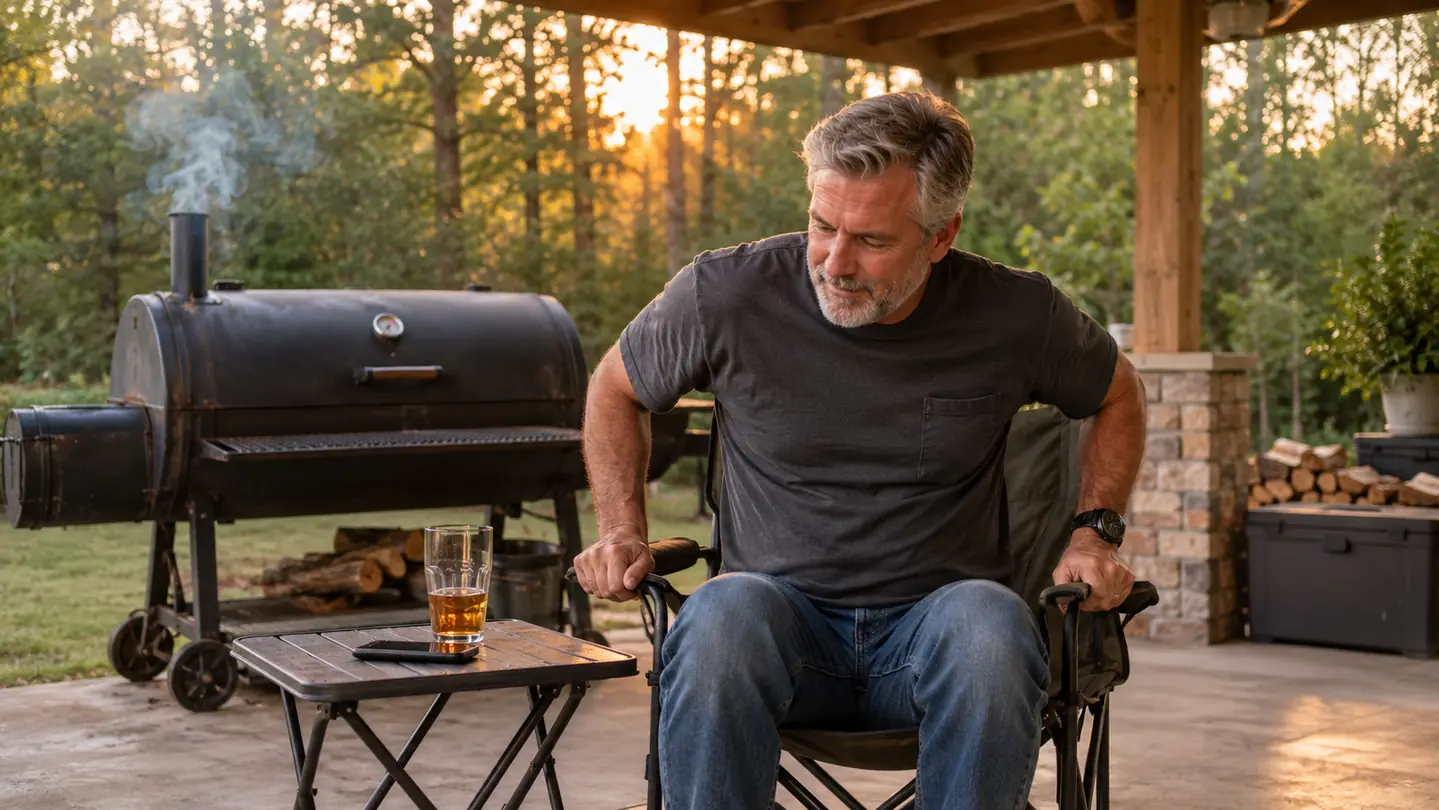
The first brisket I ever smoked, I spent the entire afternoon in a folding chair about six feet from the firebox, standing up every twenty minutes to poke at the meat with a cheap thermometer. The brisket came out fine. The day did not. I had a dozen people on the patio and I spent most of it talking to them over my shoulder while I fiddled with a vent.
That is the real cost of a long cook. Not the meat, the chair you never sit in. I tried the obvious fixes. I moved my chair farther back, lost track of the pit temperature, and ruined a rack of ribs. I bought a better instant-read and probed the meat every half hour, which meant opening the lid every half hour, which stretched the cook and softened the bark I had worked for. Neither fix gave me what I actually wanted, which was a number I could read without standing up. The MEATER Plus does that. It took me most of a season to work the routine down to something I would tell a friend to do, and this article is that routine, in the order I actually do it.
Here is the order I do it in now, start to finish.
The number you can read from the chair
One wireless probe, a charger that repeats the signal out to your phone, and a live reading of both the meat and the air around it while you stay seated with your guests.
Amazon Check Today's Price on Amazon →What the MEATER Plus Is Doing While You Sit
Strip the packaging away and it is one probe with two temperature sensors inside it. One sensor reads the middle of the meat. The other reads the air around the probe, which is your best local read on pit temperature. The probe is 6.18 inches long and rated from 32 to 527 degrees Fahrenheit, which covers a cold smoke on one end and a hot sear on the other.
The probe is completely wireless. No cable runs out from under the lid, and that changed my routine more than any other single thing. A wire hanging out of a smoker is a small detail until you snag it on a hot grate and watch an afternoon go sideways. The charger doubles as a repeater, so the probe talks to the charger and the charger talks to your phone. That relay is why the phone can sit on the arm of the lawn chair instead of being held up against the lid.
Charging is fast. Five minutes in the charger gives you roughly two hours of cook time, and the charger itself runs on one AAA battery that comes in the box. The spec sheet also lists Wi-Fi support, which matters if you want to step inside for a drink and still see where the cook stands.
Step 1: Charge the Probe When You Walk Outside
I do this before I touch the chimney. The probe goes into the charger, the charger sits on the shelf by the patio door, and I go light the fire. By the time the coals are ashed over and spread, the probe has more charge than I need for the first stretch of the cook. Last November I timed it once out of curiosity. Chimney lit at 7:40 in the morning, coals dumped and spread by 8:05, first live reading on the app at 8:12. That is a little over half an hour of charging for a cook that did not come off until the middle of the afternoon, and the probe never dropped below a usable charge the whole way.
If the plan is a pork shoulder or a packer brisket that will run most of the day, I top the probe up again at the stall. Five minutes in the charger is nothing when the alternative is losing the reading in the middle of the longest part of the cook.
Cleanup is a damp cloth. The probe is oven safe and wipes clean, so it goes back in the charger and that is the entire maintenance routine.
Step 2: Put the Charger Next to the Cooker, Not Next to Your Chair
This is the step people get wrong, and it is usually the reason someone reports a dropped signal. The probe does not talk to your phone. The probe talks to the charger, and the charger repeats that signal out to your phone. The charger has to be near the meat. I learned that the hard way on a windy Saturday in September, when I left the charger on the kitchen counter because I was charging my phone at the same time. Every time I walked to the far end of the patio the app went quiet for a minute and then came back with a reading I did not trust. I moved the charger to the smoker shelf, walked the same path, and the dropouts stopped.
I set it on the side shelf of the smoker, or on a board on the concrete pad when the shelf is crowded with a water pan. Then I walk back to the chair with the phone. That gives the short hop from probe to charger a clean path and lets the long hop from charger to phone use the repeater the way it was meant to.
What kills the signal is a charger tucked behind a metal toolbox on the far side of the patio, or left inside on the kitchen counter. Keep it close to the heat and out in the open and the relay does its job all afternoon.
Step 3: Load the Probe and Pair the App
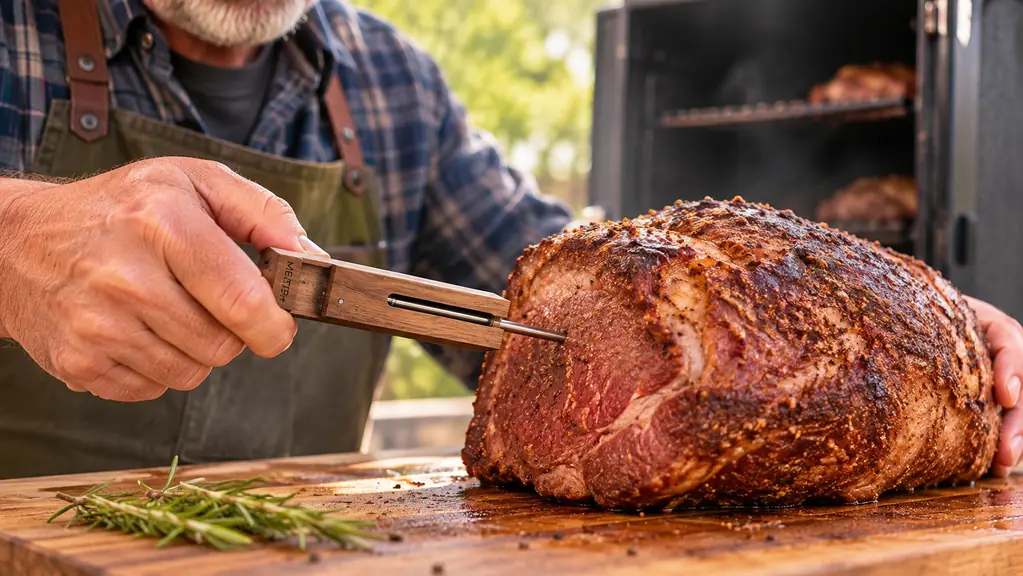
Push the probe into the thickest part of the meat, working in from the side, and stop before you reach bone or a big pocket of fat. The back end of the probe has to sit outside the meat. That is not a suggestion. Bury the whole probe and the second sensor reads the roast instead of the pit, and your ambient number is worthless.
On a brisket I go in at the point end and aim toward the flat. On a chicken I go in at the thigh, which is always the last part to finish. The last bird I did was a five pound bird on a Sunday in July, and the breast read 158 while the thigh was still sitting at 171. If I had pulled it on the breast number the legs would have been pink at the joint. The thigh is the honest read. On a rack of ribs I do not bother, because there is not enough meat to hold a probe steady, and the bend test tells me more anyway.
Then open the app, let it find the probe, and name the cook. That is a thirty second job. After that the phone can lie face up on the arm of the chair and I can go back to being a guest at my own party.
Step 4: Set Your Target and Watch the Ambient Number
Set the target temperature for the meat and let the app handle the arithmetic. The number I watch most, though, is the ambient reading. It tells me what the air around the meat is doing right now. If I am aiming for 250 and the ambient sensor says 310, I know to close a vent before the outside of the roast races ahead of the middle and I end up with a gray band under the bark.
The probe reads up to 527 degrees Fahrenheit, so there is headroom for a hot and fast cook without worrying about the sensor. I still would not park the probe directly over a live flame, because what you measure there is the fire and not the cooker.
There is a timer in the app too, and I use it for the wrap rather than the cook. The cook is a temperature. The timer is for the fifteen minutes I want the meat to sit in foil before I open it back up and check my work.
The probe does not talk to my phone. It talks to the charger, and the charger talks to my phone. Once I moved the charger next to the smoker, the dropped readings stopped.
Step 5: Pull Early and Let Carryover Finish the Job
A large piece of meat keeps climbing after it comes off the heat. I pull brisket and pork shoulder a few degrees under target and let the rest do the last of the work under foil and a folded towel in a cooler.
This is where the MEATER Plus earns its keep, because I can leave it in while the meat rests and watch the number hold or creep up. A shoulder I pulled at 198 two summers ago climbed to 205 in the cooler over forty minutes, which is exactly the margin I was counting on. Had I pulled it at 203 and let it sit, it would have gone past tender and started to come apart in the wrong way when I tried to slice it. With a wired unit I would be feeding a cable out from under the foil. With an instant-read I would be guessing at a moving target.
Slice against the grain, and if you want a second opinion on doneness across the whole flat, that is the one place I still reach for a handheld. One probe reads one spot, and a brisket is never the same temperature everywhere.
What Else Helps
A patio cover is worth more than any gadget. I cook under one from October through May, and in a Willamette Valley winter it is the difference between smoking and not smoking. If you do not have cover, a wind break on the upwind side will settle a fire that keeps jumping around.
Keep the lid down. Every time you open it you lose heat and add time, and the whole point of a remote read is that you do not have to look. I check the water pan once an hour and otherwise leave the cooker alone.
A small folding table at chair height is the unglamorous hero of this setup. Phone, drink, notebook, and a pair of gloves all within reach means I am not getting up every time I need something.
I keep a notebook. Pit temperature, outside temperature, target, actual pull temperature, and how it turned out. After a couple of seasons you start to see your own cooker's habits on paper instead of guessing at them. The entry for a rainy Saturday last March reads 38 degrees outside, 240 on the pit, a nine pound shoulder, pulled at 199 after eleven hours. The entry three weeks later, same weight, same target, warmer day, finished in nine and a half. That is the kind of thing paper tells you and memory does not.
Charge your phone before the guests arrive. It sounds like trivial advice until the afternoon you sit down, open the app, and watch the battery indicator drop. I plug mine in while I am trimming meat, and it lasts the rest of the day.
Where It Falls Short
One probe means one piece of meat. The MEATER Plus is a one probe tool, so if I am cooking two pork shoulders for the band, one of them is flying blind and I am back to the handheld on the second one. For a bigger cook, budget for a second probe or accept that you are guessing on part of the load.
The ambient reading is local. It tells you the air around that one spot near the probe, not the average across the whole grate. On a big offset with a hot end, the far side can run thirty degrees different and the app will never mention it.
Bluetooth is still Bluetooth. Walls eat it, distance eats it, and a charger left on the kitchen counter will cost you readings. The charger battery is a AAA that you will forget about until it dies mid cook, so keep a spare in the drawer with the foil.
Set it, sit down, and let the afternoon be yours
The MEATER Plus probe, the charger, and the app do the watching. You keep the chair and the company.
Amazon Check Today's Price on Amazon →